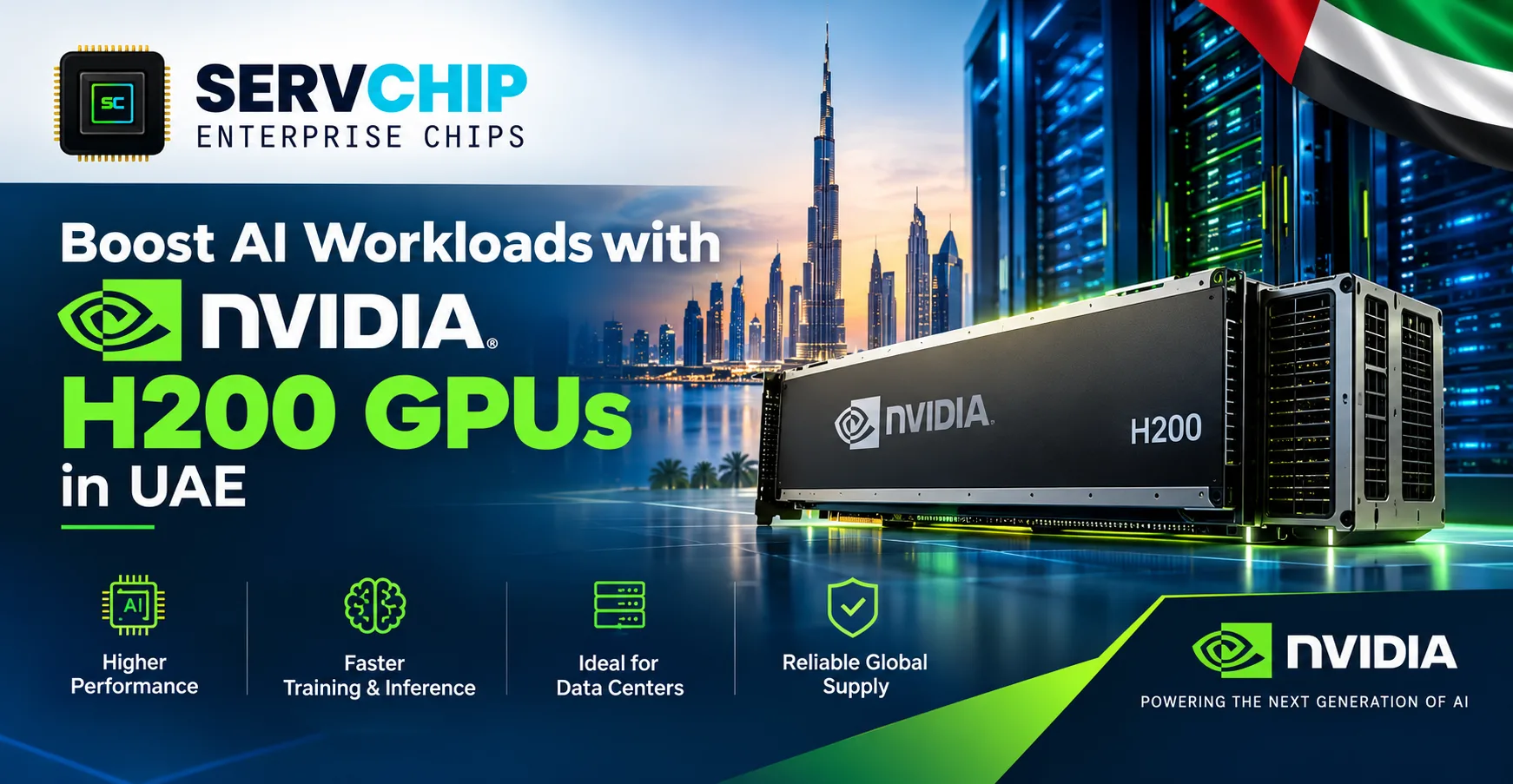
The UAE has made artificial intelligence a national priority, and enterprises, government entities, and startups are building the compute foundations to match. Whether the goal is training a domain-specific language model, running real-time inference, or processing massive datasets, the hardware underneath decides how fast and how cost-effectively you can move. For organizations weighing an NVIDIA H200 Tensor Core GPU UAE deployment, the key question is how this accelerator changes what is possible compared with earlier generations. This article covers the performance benefits, the memory advantage, and what the H200 means for large language models (LLMs) and AI training.
Why the H200 Matters for Modern AI
The NVIDIA H200 is built on the Hopper architecture and was the first GPU to ship with HBM3e memory. Its compute engine is closely related to the H100, so the headline upgrade is not raw arithmetic. It is how quickly data reaches the compute units and how much of it can stay on the GPU.
That matters because modern AI workloads are often memory-bound rather than compute-bound. LLM inference, long-context processing, and retrieval-augmented generation spend a large share of their time moving weights and activations in and out of memory. A GPU with more capacity and bandwidth keeps its cores busy instead of waiting on data.
Memory Capacity and Bandwidth: The Core Advantage
The H200 offers 141 GB of HBM3e memory with 4.8 TB/s of memory bandwidth, according to NVIDIA’s published specifications. Compared with the H100’s 80 GB and 3.35 TB/s, that is roughly 1.76 times the capacity and about 1.4 times the bandwidth.
In practice, this delivers several benefits:
- Larger models on fewer GPUs. Models that previously had to be split across several accelerators can fit on fewer devices, which simplifies deployment and cuts inter-GPU communication overhead.
- Bigger batch sizes. More memory allows larger batches, improving throughput and lowering the cost per token or per inference.
- Longer context windows. Extended context requires large key-value caches. The extra headroom helps serve long documents and multi-turn conversations without constant memory juggling.
- Faster data feeding. Higher bandwidth shortens the time spent shuttling parameters, which is where many LLM workloads lose efficiency.
For any team planning an NVIDIA H200 Tensor Core GPU UAE rollout, these gains directly shape cluster sizing, power budgets, and total cost of ownership.
Accelerating Large Language Models
LLM inference is where the H200 stands out most. NVIDIA reports up to 1.9x faster inference on Llama 2 70B and up to 1.6x faster on GPT-3 175B compared with the H100. Those figures come from NVIDIA’s own benchmarks, so real results will vary with your model, precision, batch size, and software stack, but the direction is clear: more bandwidth and capacity translate into higher tokens per second.
The Hopper Transformer Engine adds to this by using FP8 precision where it is safe to do so, increasing throughput while preserving accuracy. Combined with optimized inference libraries such as TensorRT-LLM, this lets enterprises serve chatbots, copilots, summarization tools, and Arabic-English multilingual assistants with lower latency and fewer GPUs.
For Arabic-language and bilingual models, which are increasingly important across the region, the larger memory pool is especially useful. Larger vocabularies and bigger parameter counts place real pressure on memory, and the H200 absorbs that pressure well.
Strengthening AI Training and Fine-Tuning
Pretraining frontier-scale models remains the domain of very large clusters, but most enterprises focus on fine-tuning, continued pretraining, and training mid-sized models on proprietary data. Here the H200 helps in several ways:
- Faster fine-tuning cycles. More memory per GPU reduces the need for aggressive memory-saving tricks that slow training.
- Efficient scaling. Fourth-generation NVLink provides up to 900 GB/s of GPU-to-GPU bandwidth, supporting multi-GPU training with less communication bottlenecking.
- Flexible utilization. Multi-Instance GPU (MIG) support allows a single GPU to be partitioned into isolated instances, so smaller jobs can share hardware without interfering with each other.
Together, these capabilities make the H200 a strong foundation for any AI workload GPU UAE strategy, from experimentation through production.
Building an AI Workload GPU UAE Strategy
Choosing a GPU is only one part of the picture. Power and cooling, networking, software compatibility, procurement lead times, and local support all influence whether a deployment succeeds. Teams should consider:
- Workload profile. Is your priority training, inference, or both? Inference-heavy teams benefit most from the memory bandwidth gains.
- Cluster design. Interconnects, storage throughput, and data pipelines must keep pace with the GPUs.
- Infrastructure readiness. H200 systems draw significant power, so rack density and cooling need early planning.
- Support and lifecycle. Warranty, spares, and expert guidance reduce downtime and protect your investment.
Sourcing H200 Infrastructure with a Trusted Partner
Working with an experienced supplier simplifies many of these decisions. Servchip supplies enterprise-grade AI and data center hardware to organizations across the UAE, helping teams match the right GPU platform to their workloads. You can explore available accelerators in the NVIDIA Data Center GPU collection, which brings together options for training, inference, and high-performance computing.
Supplier credibility matters when you are investing in high-value infrastructure. Servchip maintains a verified business presence, and you can review its profile on its DealerBaba supplier listing to confirm company details before you engage. For the most accurate pricing, configurations, and availability of any NVIDIA H200 Tensor Core GPU UAE solution, speak with the Servchip team directly.
Beyond Hardware: Deployment and Ongoing Support
Buying GPUs is the first step. Keeping them running efficiently is the long game. Our managed services can help with deployment planning, configuration, monitoring, and ongoing support, so your engineers can focus on models and applications rather than infrastructure upkeep. For teams without deep in-house GPU operations experience, this can shorten time to production considerably.
To validate performance expectations for your own use case, review NVIDIA’s official H200 Tensor Core GPU specifications and benchmarks, then compare them against your target models and latency requirements.
Conclusion
The H200’s combination of 141 GB of HBM3e memory and 4.8 TB/s of bandwidth removes one of the biggest bottlenecks in modern AI. It speeds up LLM inference, makes fine-tuning more practical, and lets teams do more with fewer GPUs. For UAE enterprises building serious AI capability, the NVIDIA H200 Tensor Core GPU UAE opportunity is real, and the right planning and partner make the difference between a stalled pilot and a scalable platform. Ready to plan your deployment? Contact Servchip today to discuss your workloads, configurations, and timelines.
Frequently Asked Questions
1. What makes the NVIDIA H200 different from the H100?
The H200 uses the same Hopper architecture but adds 141 GB of HBM3e memory and 4.8 TB/s of bandwidth, versus 80 GB and 3.35 TB/s on the H100. This benefits memory-bound workloads such as LLM inference and long-context processing.
2. Is the H200 suitable for large language model inference?
Yes. NVIDIA reports up to 1.9x faster Llama 2 70B inference than the H100. The larger memory lets bigger models and batches fit on fewer GPUs, which improves throughput and reduces cost per token.
3. Can the H200 handle AI training as well as inference?
Yes. It is well suited to fine-tuning, continued pretraining, and mid-sized model training, with NVLink for multi-GPU scaling and MIG for sharing a GPU among smaller jobs.
4. What should UAE enterprises plan for before deploying H200 GPUs?
Plan for power and cooling capacity, high-speed networking, storage throughput, and software stack compatibility. Aligning these with your workload profile ensures the GPUs are fully utilized.
5. How can I find the right H200 solution for my AI workload GPU UAE needs?
Start by defining your models, data volumes, and performance targets, then consult a specialist supplier. Servchip can recommend configurations and support deployment through its managed services.