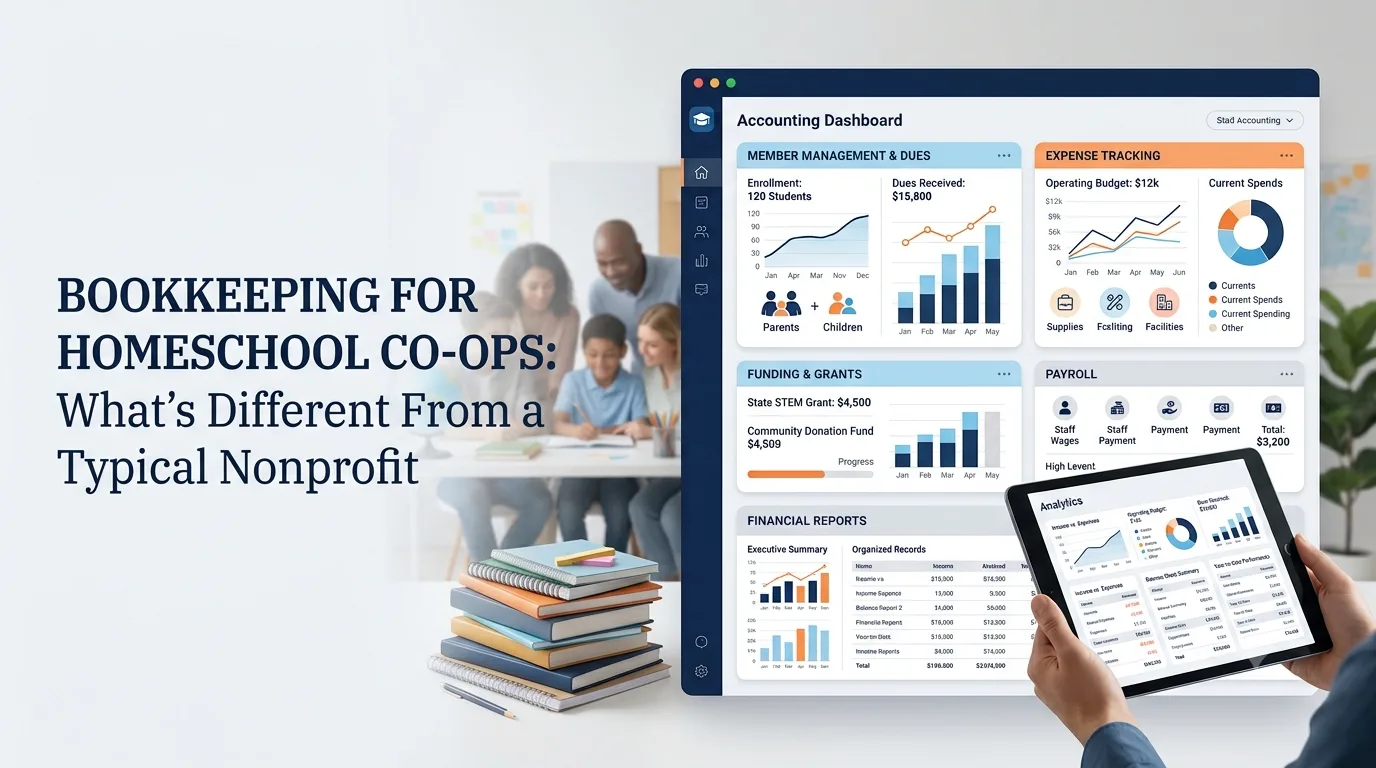
Homeschool co-ops may be nonprofit organizations, but their financial operations can look very different from those of a typical nonprofit.
A co-op may collect membership dues, class fees, activity payments, field trip costs, and contributions while also paying instructors, purchasing supplies, renting facilities, and managing shared resources. These transactions can create unique bookkeeping challenges.
Understanding those differences is important for maintaining accurate records and giving families and board members a clear view of how funds are being used.
Why Homeschool Co-op Bookkeeping Is Different
Outsourced bookkeeping for homeschool co-ops can help organizations manage financial records while their volunteers and administrators focus on educational activities.
Unlike many traditional nonprofits that may depend heavily on grants and donations, homeschool co-ops often have several recurring sources of revenue tied directly to their members and programs.
For example, a co-op might collect:
- Annual membership dues
- Registration fees
- Class or curriculum fees
- Field trip payments
- Activity fees
- Fundraising proceeds
- Donations
- Facility or equipment contributions
Each revenue stream may need to be tracked separately.
The bookkeeping system should make it easy to see where money comes from and how it is being spent.
Membership Dues Require Careful Tracking
Membership dues are often a major source of funding for a homeschool co-op.
However, dues are not always as simple as recording one payment per family.
A co-op may have different membership categories, family rates, early-registration discounts, installment plans, or additional fees for specific activities.
If payments are recorded inconsistently, it can become difficult to determine which families have paid and which balances remain outstanding.
A good bookkeeping process should connect payments to the appropriate family or member account while keeping the organization's financial records organized.
Class Fees and Program Revenue Need Separate Tracking
Many homeschool co-ops operate several classes or programs at the same time.
One family may pay for science classes, another may enroll in art and music, and another may participate in a field trip or extracurricular activity.
Combining all these payments into one revenue category can make financial reporting less useful.
Instead, co-ops may benefit from tracking revenue by:
- Class
- Program
- Semester
- Activity
- Age group
- Location
This allows the board to understand which programs are financially sustainable.
It can also help identify programs that consistently cost more than they generate.
Expenses Can Be More Program-Specific
Homeschool co-ops often have expenses that are directly connected to particular programs.
For example, a science class may require laboratory materials. An art program may require specialized supplies. A field trip may involve transportation and admission costs.
If these expenses are recorded without identifying the related program, it becomes harder to calculate the actual cost of running each activity.
Program-level expense tracking can give administrators a clearer picture of financial performance.
Volunteer-Driven Operations Create Unique Challenges
Many homeschool co-ops rely heavily on volunteers.
A parent may serve as treasurer one year and another parent may take over the role the following year.
This can create continuity problems.
The organization should not depend on one person's memory or personal spreadsheets.
Instead, bookkeeping procedures should be documented.
Someone taking over financial responsibilities should be able to understand:
- Where financial records are stored
- How payments are recorded
- How expenses are approved
- How reimbursements are processed
- How bank reconciliations are completed
- How reports are prepared
- How tax documents are maintained
Consistent procedures make leadership transitions much easier.
Reimbursements Need Clear Controls
Parents, teachers, and volunteers may purchase supplies or pay expenses on behalf of the co-op.
Without a clear reimbursement process, these transactions can become difficult to track.
The organization should establish guidelines for:
- What expenses are reimbursable
- Which receipts are required
- Who approves reimbursements
- When reimbursement requests are submitted
- How payments are recorded
Every reimbursement should have adequate documentation.
This protects both the organization and the individuals handling its finances.
Restricted and Unrestricted Funds Matter
Not all money received by a nonprofit necessarily has the same restrictions.
A donor may provide funds for a specific educational purpose. A fundraising campaign may also be intended for a particular project.
This makes restricted vs. unrestricted fund accounting an important concept for organizations that receive restricted contributions.
Co-op leadership should understand whether funds can be used generally or only for a specific purpose.
Mixing restricted and unrestricted funds can make financial reporting more complicated and may create compliance concerns.
Budgeting by School Year Can Be More Useful
Traditional businesses often build budgets around calendar or fiscal years.
Homeschool co-ops may find it more useful to think in terms of the academic year.
Revenue and expenses may follow enrollment cycles rather than traditional business seasons.
For example, the co-op may collect significant registration payments before the school year begins. Expenses may then increase as classes and activities start.
A school-year budget can help the board anticipate these patterns.
It can also make it easier to compare actual results with expectations.
Tracking Grants and Contributions
Some homeschool co-ops may receive grants or charitable contributions.
These funds should be properly documented and tracked.
If a grant has specific requirements, the co-op should maintain records showing how the money was used.
Grant tracking and compliance accounting can become especially important when an organization receives funding from multiple sources with different restrictions.
Good documentation also makes future reporting easier.
Payroll and Contractor Payments
Some co-ops pay instructors directly.
The payment arrangement matters.
An instructor may be an employee or may provide services as an independent contractor, depending on the circumstances and applicable rules.
The organization should not assume that every instructor can simply be treated as a contractor.
Proper classification and recordkeeping are important for payroll and tax reporting.
When applicable, the co-op may also need to prepare information returns such as Form W-2 or Form 1099.
Tax Filing Is Part of the Bigger Picture
Nonprofit status does not automatically mean that an organization has no tax filing responsibilities.
The specific requirements depend on the organization's legal structure, tax-exempt status, activities, and financial circumstances.
Some organizations may need to file an annual information return or other applicable forms.
This is where professional accounting and tax guidance can be useful.
A co-op should understand its filing responsibilities rather than assuming that nonprofit status eliminates them.
Financial Reporting for the Board
Board members need financial information they can understand.
A basic bank balance is not enough.
Useful reports may include:
- Statement of financial position
- Statement of activities
- Budget-to-actual comparisons
- Program revenue and expenses
- Cash flow information
- Outstanding member balances
- Fund balances
Reports should be prepared consistently so the board can identify trends.
For example, if class expenses are increasing faster than enrollment revenue, the board should be able to see that before the issue becomes significant.
Internal Controls Still Matter
Small organizations sometimes assume that internal controls are only necessary for large nonprofits.
That is not the case.
Even a volunteer-run co-op should have basic financial controls.
Ideally:
- One person should not control every financial function.
- Bank accounts should be reconciled regularly.
- Expenses should require appropriate approval.
- Receipts should be retained.
- Financial reports should be reviewed by leadership.
- Access to financial accounts should be limited appropriately.
These controls reduce the risk of errors and misuse of funds.
Why Accurate Records Build Trust
Families contribute money because they expect the organization to use it responsibly.
Clear financial records help demonstrate that responsibility.
When parents can see that funds are being managed carefully, it can strengthen confidence in the organization.
Accurate bookkeeping also helps board members make decisions based on facts rather than assumptions.
This becomes particularly important when deciding whether to add a program, increase fees, hire an instructor, or purchase new equipment.
When Should a Co-op Consider Outsourcing Bookkeeping?
Volunteer involvement is valuable, but bookkeeping can become time-consuming.
As membership grows, the number of transactions can increase quickly.
The organization may also have multiple programs, bank accounts, payment platforms, instructors, and funding sources.
At that point, professional bookkeeping support can provide greater consistency.
Outsourcing can be particularly useful when:
- Financial records are behind
- Reconciliations are inconsistent
- Board reports take too long to prepare
- Volunteers frequently change
- Member payments are difficult to track
- Multiple programs need separate reporting
- Tax filing preparation becomes complicated
The goal is not to remove volunteers from financial oversight.
It is to give them more reliable information and better processes.
Final Thoughts
Bookkeeping for a homeschool co-op requires more than recording deposits and expenses.
The organization may need to track membership dues, class fees, program costs, contributions, reimbursements, instructor payments, and restricted funds.
Because co-ops are often volunteer-driven, consistent procedures are especially important.
Accurate bookkeeping gives board members better financial visibility. It also helps families understand how funds are being managed.
With clear controls, organized records, and appropriate professional support, homeschool co-ops can spend less time dealing with financial administration and more time supporting their educational communities.