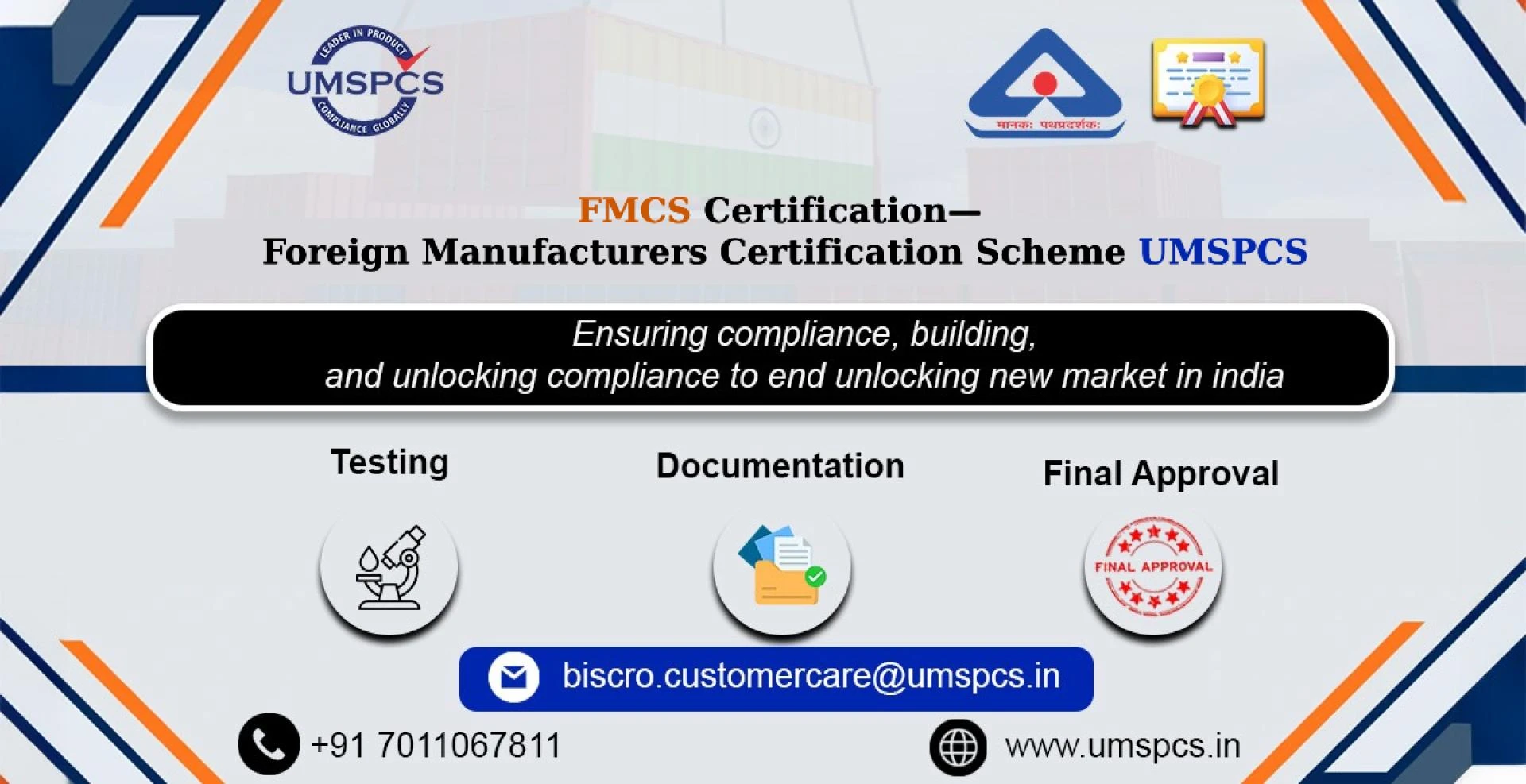
In today’s globalized market, foreign manufacturers seeking access to the Indian market must comply with India’s quality and safety regulations. One of the most important regulatory frameworks governing product quality in India is the Bureau of Indian Standards (BIS) certification system. For foreign manufacturers, this certification is issued under the Foreign Manufacturers Certification Scheme (FMCS), which allows overseas companies to use the ISI Mark on their products.
UMSPCS plays a crucial role in guiding foreign manufacturers through the complexities of BIS-FMCS certification, ensuring compliance with Indian standards while minimizing delays, errors, and regulatory risks.
What Does UMSPCS Do?
UMSPCS is a professional compliance and certification consultancy that assists manufacturers—especially foreign manufacturers—in obtaining BIS-ISI certification under the FMCS scheme. The BIS certification process involves multiple technical, legal, and procedural requirements that can be challenging for overseas entities unfamiliar with Indian regulations. UMSPCS acts as a bridge between foreign manufacturers and Indian regulatory authorities.
Key Roles of UMSPCS:
- End-to-end BIS-FMCS consultancy for foreign manufacturers
- Product standard identification as per applicable Indian Standards (IS)
- Documentation preparation and verification
- Coordination with BIS officials and recognized testing laboratories
- Application filing and follow-up with BIS
- Support during factory inspection and sample testing
- Post-certification compliance and renewal assistance
By leveraging its regulatory expertise and experience, UMSPCS ensures that manufacturers achieve certification efficiently, compliantly, and cost-effectively.
Scope of BIS-FMCS
The Foreign Manufacturers Certification Scheme (FMCS) was introduced by BIS to allow overseas manufacturers to obtain BIS certification for products intended for export to India. Under this scheme, foreign manufacturers can legally apply the ISI Standard Mark on their products, signifying compliance with Indian quality and safety standards.
Key Features of BIS-FMCS:
- Applicable only to manufacturers located outside India
- Certification is granted to the manufacturing unit, not traders or exporters
- Covers a wide range of mandatory and voluntary BIS products
- Requires factory inspection by BIS officials
- Product testing must be conducted in BIS-recognized laboratories
Products Covered Under FMCS:
- Electrical and electronic products
- Automotive components
- Cement, steel, and construction materials
- Household appliances
- Industrial machinery and equipment
- Chemicals and consumer goods (as notified)
The scope of BIS-FMCS continues to expand as the Indian government adds more products under mandatory BIS certification to ensure consumer safety and quality assurance.
Is BIS-FMCS Certification Necessary?
Yes, BIS-FMCS certification is mandatory for foreign manufacturers whose products fall under the list of products notified by the Government of India for compulsory BIS certification.
Why BIS-FMCS Certification Is Necessary:
- Legal Market Access
- Without BIS-FMCS certification, notified products cannot be imported, sold, or distributed in India.
- Customs Clearance
- Indian Customs authorities require valid BIS certification for clearance of regulated products.
- Consumer Safety and Quality Assurance
- BIS certification ensures products meet Indian safety, performance, and quality benchmarks.
- Brand Credibility and Trust
- The ISI Mark enhances brand reputation and consumer confidence in the Indian market.
- Avoidance of Penalties and Seizures
- Non-compliance can lead to confiscation of goods, monetary penalties, or import bans.
For foreign manufacturers aiming for long-term business growth in India, BIS-FMCS certification is not only a legal requirement but also a strategic necessity.
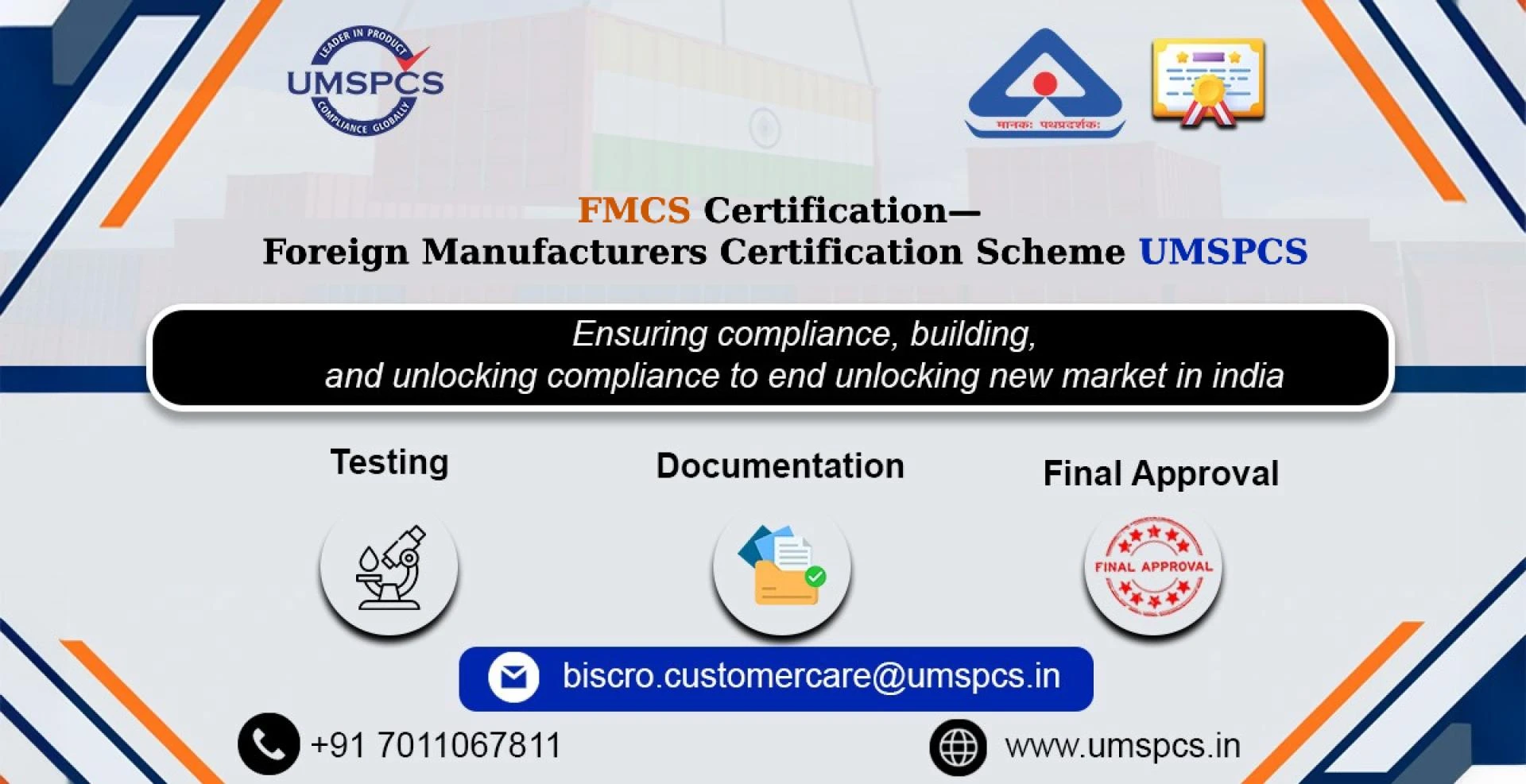
Required Documents for ISI (BIS) Certification – Foreign Manufacturers
Foreign manufacturers must submit a comprehensive set of documents to BIS under the FMCS scheme. Accuracy and completeness of documentation are critical to avoid delays or rejection.
Key Documents Required:
- FMCS application form duly filled and signed
- Business registration certificate of the manufacturing company
- Manufacturing process flowchart
- Factory layout plan
- List of manufacturing machinery and testing equipment
- Quality control and assurance details
- Test reports from BIS-recognized laboratories (or samples for testing)
- Authorization letter for Indian Authorized Representative (AIR)
- Trademark registration certificate (if applicable)
- Undertaking and declaration forms as prescribed by BIS
All documents must be in English or accompanied by certified English translations.
General Documents (Indian Manufacturers)
Although FMCS certification for foreign manufacturers, it is useful to understand the general documentation required for Indian manufacturers, as many requirements are similar.
Common Documents for Indian Manufacturers:
- Certificate of incorporation / MSME / factory license
- PAN card and GST registration
- Manufacturing process details
- In-house testing facility details
- Calibration certificates for testing equipment
- Quality manual and control procedures
- Product test reports as per relevant Indian Standard
- Trademark authorization (if brand owner differs)
Understanding these requirements helps foreign manufacturers align their documentation and quality systems with BIS expectations.
Validity and Renewal of the Licence to Use the Standard Mark (FMCS-ISI)
Once BIS grants certification under FMCS, the manufacturer is allowed to use the ISI Standard Mark on certified products.
Validity:
- The BIS-FMCS license is initially granted for 1 to 2 years
- Validity depends on product category and BIS discretion
Renewal Process:
- Renewal application must be submitted before expiry of the license
- Updated documents and test reports may be required
- BIS may conduct surveillance inspection or sample testing
- Payment of renewal fees and marking fees is mandatory
Post-Certification Obligations:
- Continuous compliance with the applicable Indian Standard
- Maintenance of quality control systems
- Prompt reporting of any changes in manufacturing process, location, or product design
Failure to comply with renewal or surveillance requirements may result in suspension or cancellation of the BIS license.
UMSPCS Conclusion
UMSPCS serves as a reliable and knowledgeable partner for foreign manufacturers seeking BIS-ISI certification under the FMCS scheme. With its deep understanding of Indian regulatory requirements, technical standards, and procedural nuances, UMSPCS simplifies what is otherwise a complex and time-consuming process.
From identifying applicable Indian Standards to coordinating factory inspections and managing post-certification compliance, UMSPCS provides end-to-end support that enables manufacturers to enter and sustain their presence in the Indian market confidently.
In an environment where regulatory compliance is non-negotiable, UMSPCS ensures accuracy, transparency, and efficiency—helping foreign manufacturers achieve BIS certification consultants in India smoothly while focusing on their core business goals.
📞 Get in Touch for BIS Certification Support-
UMS Product Compliance Services Pvt. Ltd.
Logix Technova, A-810, Sector 132,
Noida, Uttar Pradesh, India – 201304.
📱 Phone: +91-7011067811
✉️ Email: [email protected]