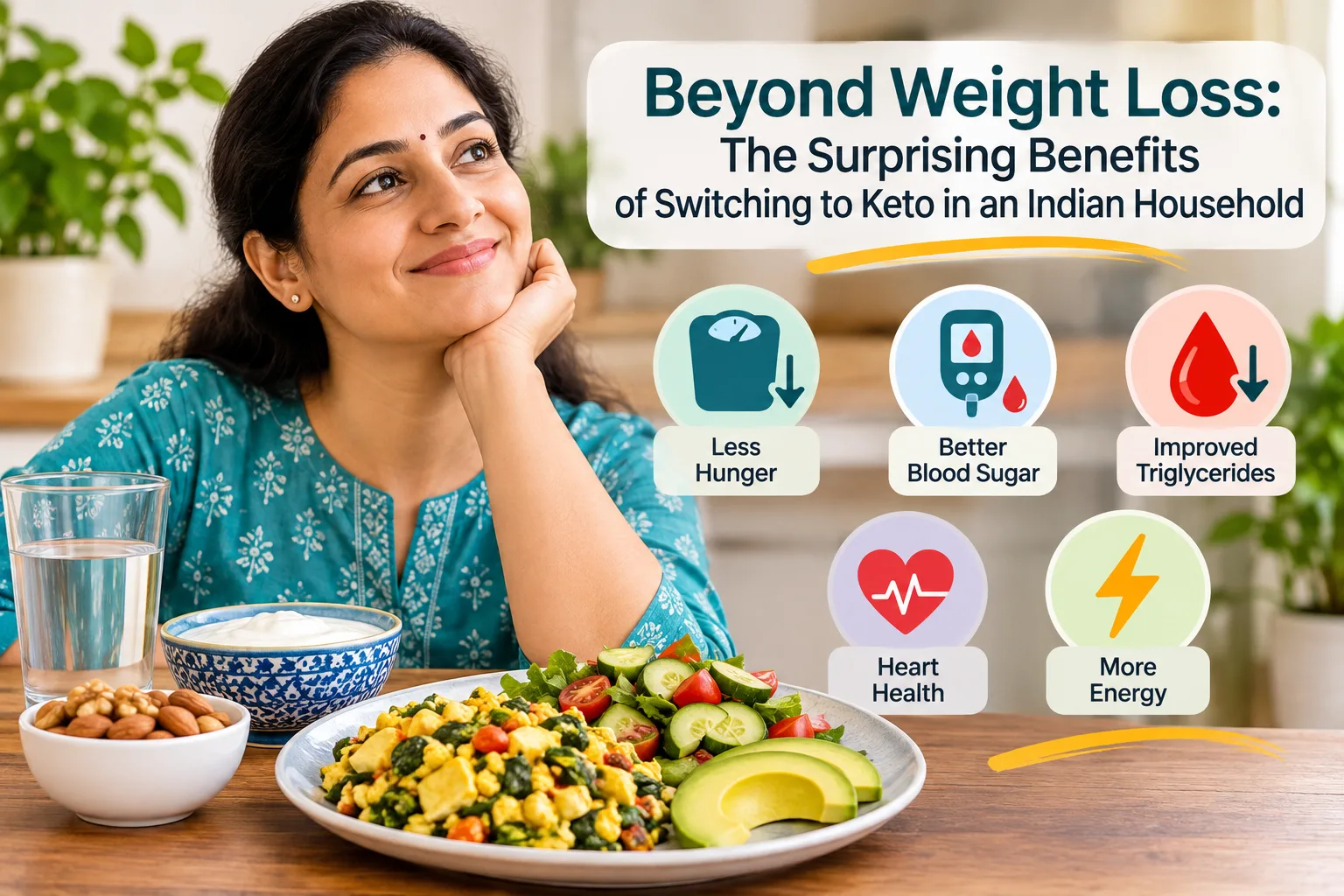
In an Indian home, changing the way you eat rarely affects just one plate.
It changes the morning chai routine. It raises questions about what goes into the lunchbox. And sooner or later, someone at the dining table asks, “But what will you eat without roti or rice?”
For many people, keto begins with a weight-loss goal. But the conversation can become more interesting than a number on the weighing scale. Some notice that they feel less hungry between meals. Others start paying closer attention to their blood sugar, reading food labels, or cooking more often.
These changes deserve a closer look—but not every benefit comes from ketosis itself, and not everyone will experience the same results.
A ketogenic diet may offer certain metabolic benefits, including improvements in triglycerides and blood glucose measures in some settings. However, studies are often relatively small and short, and keto is not consistently better than other dietary approaches over the longer term.
The most useful question is not simply, “Will keto help me lose weight?” It is, “Can this way of eating improve my health while still fitting my family, my kitchen, and my everyday life?”
First, What Does Switching to Keto Actually Mean?
Keto is a very-low-carbohydrate, high-fat dietary pattern designed to encourage nutritional ketosis. It commonly restricts carbohydrate intake to around 20–50 grams a day, although individual responses and dietary definitions vary.
In an Indian household, that usually means substantially reducing:
- Rice, wheat roti, naan, and regular paratha.
- Poha, traditional upma, idli, and dosa.
- Potatoes and other starchy foods.
- Sugar, sweets, biscuits, and sweetened drinks.
- Large servings of pulses and many fruits.
Meals might instead centre on paneer, tofu, eggs, fish, chicken, plain yogurt in suitable portions, non-starchy vegetables, nuts, seeds, and measured cooking fats.
That does not make rice, dal, or fruit “bad.” They simply may not fit a strict ketogenic carbohydrate target. A moderate low-carb approach leaves more room for these foods and may be a more comfortable choice for some families.
1. You May Feel Less Hungry Between Meals
Think about the familiar late-afternoon routine: tea, a few biscuits, and then another search through the kitchen before dinner.
One potential advantage of keto is a modest reduction in hunger for some people. A systematic review found that people following ketogenic diets reported less hunger or a reduced desire to eat during weight loss. The effect was generally small, and the evidence does not mean everyone will suddenly stop wanting snacks.
Still, a manageable appetite can make a real difference to an ordinary working day.
In the kitchen, this might mean replacing a breakfast built mainly around toast and sweetened tea with eggs and vegetables, or paneer bhurji with an appropriate accompaniment.
The important point is to eat satisfying meals—not to use reduced hunger as a reason to under-eat.
What this could look like at home?
- A proper breakfast rather than tea alone.
- A lunch that includes a suitable protein source.
- An optional, portioned snack instead of continuous grazing.
- Less pressure to eat simply because someone has opened a packet of namkeen.
These are practical ways to organize meals. They are not a promise that keto will eliminate cravings.
2. Blood Sugar Management May Improve—but Supervision Matters
For someone managing type 2 diabetes, progress may show up in a glucose reading before it becomes visible in the mirror.
An umbrella review of randomized-trial evidence found support for improvements in HbA1c, a measure of average blood glucose, with ketogenic diets in some comparisons. However, a separate review of trials in people with type 2 diabetes found no additional improvement in glycaemic control compared with control diets over periods extending to two years.
The balanced conclusion is that keto can be one option for blood sugar management, but it is not guaranteed to outperform other well-planned diets.
And better readings do not mean you should stop medication yourself.
Insulin and some diabetes medicines may need adjustment when carbohydrate intake falls.
A better way to judge progress
Rather than asking only whether you have lost weight, discuss:
- Your blood glucose pattern.
- Your HbA1c.
- Any episodes of low blood sugar.
- Whether your medication needs review.
- Whether the diet is realistic to maintain.
The goal is safer, better-managed health—not simply producing ketones.
3. Triglycerides May Improve, Even When Weight Is Not the Whole Story
A blood test can tell a different story from a weighing scale.
Research reviews have found reductions in triglycerides—a type of fat in the blood—with ketogenic diets. One review of trials in type 2 diabetes also found greater triglyceride reductions and modest HDL cholesterol increases compared with control diets.
But there is an important catch: LDL cholesterol can rise in some people. A lower triglyceride reading does not cancel out an unfavourable change elsewhere in the lipid profile, and these changes do not by themselves prove fewer heart attacks or strokes.
That is why “my triglycerides improved” should lead to a conversation about the whole report, not a declaration that unlimited butter is now healthy.
In an Indian kitchen
Avoid building every meal around cream, cheese, butter, and ghee. Use cooking fats deliberately, include suitable vegetables and protein, and review your lipid results with a clinician.
Keto is a dietary pattern, not permission to ignore fat quality or portion size.
4. Your Family May Become More Aware of Hidden Sugar
Not every useful change requires ketosis.
Once someone starts checking the sugar in flavoured yogurt, packaged sauces, breakfast cereals, and drinks, the rest of the household may begin noticing those ingredients too.
A practical shopping habit is to compare:
- Serving sizes.
- Total carbohydrates.
- Added sugars.
- Protein content.
- Ingredients used in “sugar-free” or “keto” products.
This awareness can be useful even for family members who continue eating rice, roti, pulses, and fruit.
It also helps challenge a common assumption: that honey, jaggery, or a “natural” sweetener automatically makes a product compatible with strict keto.
The benefit here is not a special metabolic effect. It is making more deliberate choices.
5. Meal Planning Can Become Simpler Than Expected
At first, keto can seem like a list of foods you cannot eat. Over time, a flexible meal structure may be easier than searching for a new “diet recipe” every evening.
Try thinking in components:
- A protein: paneer, tofu, eggs, chicken, or fish.
- A vegetable dish: spinach, cabbage, cauliflower, mushrooms, or brinjal.
- A flavour base: cumin, ginger, mint, coriander, lemon, or an unsweetened yogurt dressing.
For example, one family dinner could include:
- Palak paneer.
- A vegetable side.
- Rice or roti for family members who want them.
- Cauliflower rice for the person following keto.
You do not necessarily need two separate dinners. Often, you need one shared meal with different accompaniments.
This is a household strategy, not a reason everyone at the table should adopt keto.
6. Familiar Indian Food Can Stay at the Centre
One of the most reassuring discoveries is that eating differently does not have to mean eating unfamiliar food.
A keto-style menu can still carry the flavours of home:
Familiar preparationA keto-style adaptationPaneer bhurjiServe with vegetables rather than regular breadPalak paneerPair with cauliflower riceEgg curryOmit potatoes and choose a suitable vegetable sideTandoori chickenServe with salad and an unsweetened dipCabbage thoranAdd a suitable protein to complete the mealMushroom masalaUse a portioned gravy without flour or added sugarCucumber raitaCheck the yogurt portion and keep it unsweetenedThese are meal ideas, not guaranteed keto servings. The final carbohydrate content depends on quantities, ingredients, and accompaniments.
There is comfort in knowing that cumin, curry leaves, ginger, chilli, coriander, and lemon still belong in the kitchen. The plate may change, but it does not have to lose its identity.
What About Better Energy and Mental Clarity?
These are among the most appealing claims made about keto. They are also easy to overstate.
Some people describe feeling more alert or less distracted by hunger. Others find the diet tiring, restrictive, or difficult to maintain. Strong claims that keto universally improves concentration, productivity, or mood go beyond what can reasonably be promised.
Harvard’s review highlights the need for more evidence on long-term benefits and notes potential concerns such as nutrient inadequacy and difficulty maintaining the diet.
If you feel better, that matters. But it is worth considering the whole picture: perhaps you are eating more regularly, drinking less alcohol, preparing meals at home, or sleeping better too.
Not every positive change needs to be attributed to ketones.
Switching One Person Does Not Mean Switching the Whole Family
An Indian household can include a child, an older parent, a pregnant family member, and an adult managing diabetes—all with different needs.
Do not assume that a plan chosen by one adult should become the default for everyone.
A more considerate approach is to:
- Keep shared dishes flexible.
- Serve carbohydrate accompaniments separately.
- Avoid describing someone else’s food as “bad.”
- Explain your needs without policing other plates.
- Get individualized advice where health conditions are involved.
A food plan should make family life manageable, not turn dinner into a debate.
How to Start Without Turning the Kitchen Upside Down?
Begin with the reason
Be specific about what you want to improve. Is it blood glucose management, appetite, meal planning, or something else?
A clear goal helps you evaluate whether the approach is actually useful.
Choose the level of restriction carefully
You may prefer a moderate low-carb plan rather than strict keto. Stricter is not automatically better, especially if it makes meals stressful or difficult to sustain.
Build a small recipe rotation
Start with a few meals you already enjoy:
- Paneer or tofu bhurji.
- Egg curry.
- Grilled fish or chicken.
- Spinach and mushroom dishes.
- Cabbage stir-fry.
- Unsweetened yogurt-based sides.
Monitor more than weight
Depending on your medical situation, track appetite, how you feel, blood glucose, HbA1c, and your lipid profile with professional guidance.
Reassess honestly
If the plan causes persistent symptoms, creates anxiety around food, or is difficult to afford, it needs adjustment. Adherence is not a test of character.
Who Should Seek Medical Advice Before Starting?
Strict keto needs particular care if you have diabetes, take glucose-lowering medicines, are pregnant or breastfeeding, or have significant kidney, liver, pancreatic, or other medical conditions. Potential concerns include nutrient deficiencies, constipation, adverse lipid changes, and medication-related complications.
People taking SGLT2 inhibitors should avoid a ketogenic diet because of the risk of ketoacidosis, which can occur without very high blood glucose. Do not stop the medicine yourself; discuss your dietary plans with your clinician.
Beyond the Number on the Scale
The most meaningful change may be less dramatic than a before-and-after photograph.
It might be a useful conversation with your doctor about a blood test. It might be feeling less preoccupied with snacks. Or it might simply be learning how to prepare meals that fit your needs without giving up the flavours you love.
Some of those benefits may relate to carbohydrate restriction. Others may come from the habits that develop around it: planning, cooking, checking ingredients, and paying closer attention to health.
Keto can be one tool. It does not have to become the identity of your household—or the only measure of how well you are looking after yourself.
This article is for general education and does not replace personalized medical or dietary advice.
FAQs
Can keto offer benefits even if I am not trying to lose weight?
Potential benefits include changes in appetite, triglycerides, and blood glucose measures in some people. However, the evidence varies, and improvements in these measures do not establish that keto is the best choice for someone who does not need weight loss. Seek individualized advice.
Can vegetarians follow keto in an Indian household?
Vegetarian keto can be built around foods such as paneer, tofu, suitable portions of plain yogurt, nuts, seeds, and non-starchy vegetables. However, restricting grains, pulses, and many fruits makes nutritional planning more important.
Does keto mean giving up dal forever?
Not necessarily. Dal may be difficult to accommodate in substantial portions on strict keto, but a moderate low-carb plan offers more flexibility. You can also reconsider your approach over time rather than treating one dietary choice as permanent.
Is feeling less hungry a reason to skip meals?
Not automatically. Appetite reduction can occur on keto, but it does not remove your need for adequate nutrition. The reported appetite effects are modest, and meal timing should suit your health and medication needs.
Is keto better than a balanced Indian diet?
There is no universal winner. Evidence does not consistently show long-term superiority over comparison diets for blood glucose management or weight loss. A suitable plan is one that meets your nutritional needs, supports relevant health goals, and remains practical to follow.