Statement of Work (SOW) management has become more complex as enterprises rely on consulting firms, independent contractors, project-based teams, and external service providers.
For Managed Service Providers (MSPs), SOW software needs to do more than create a document. It should help manage scope, deliverables, milestones, suppliers, workers, compliance, spend, and project outcomes throughout the engagement.
For enterprise MSP programs, however, SOW management is increasingly becoming part of a broader external workforce management strategy.
What Is SOW Management Software?
SOW management software helps organizations create, approve, manage, and monitor project-based engagements with external suppliers.
A comprehensive SOW management process can cover:
- SOW creation and templates
- Scope and deliverables
- Work orders
- Milestones
- Supplier management
- Contractor management
- Budget and spend
- Compliance
- Approvals
- Change orders
- Invoicing
- Renewals
- Reporting
The important distinction is that an SOW is not simply a document. It represents an ongoing commercial and workforce relationship.
What Should MSPs Look for in SOW Software?
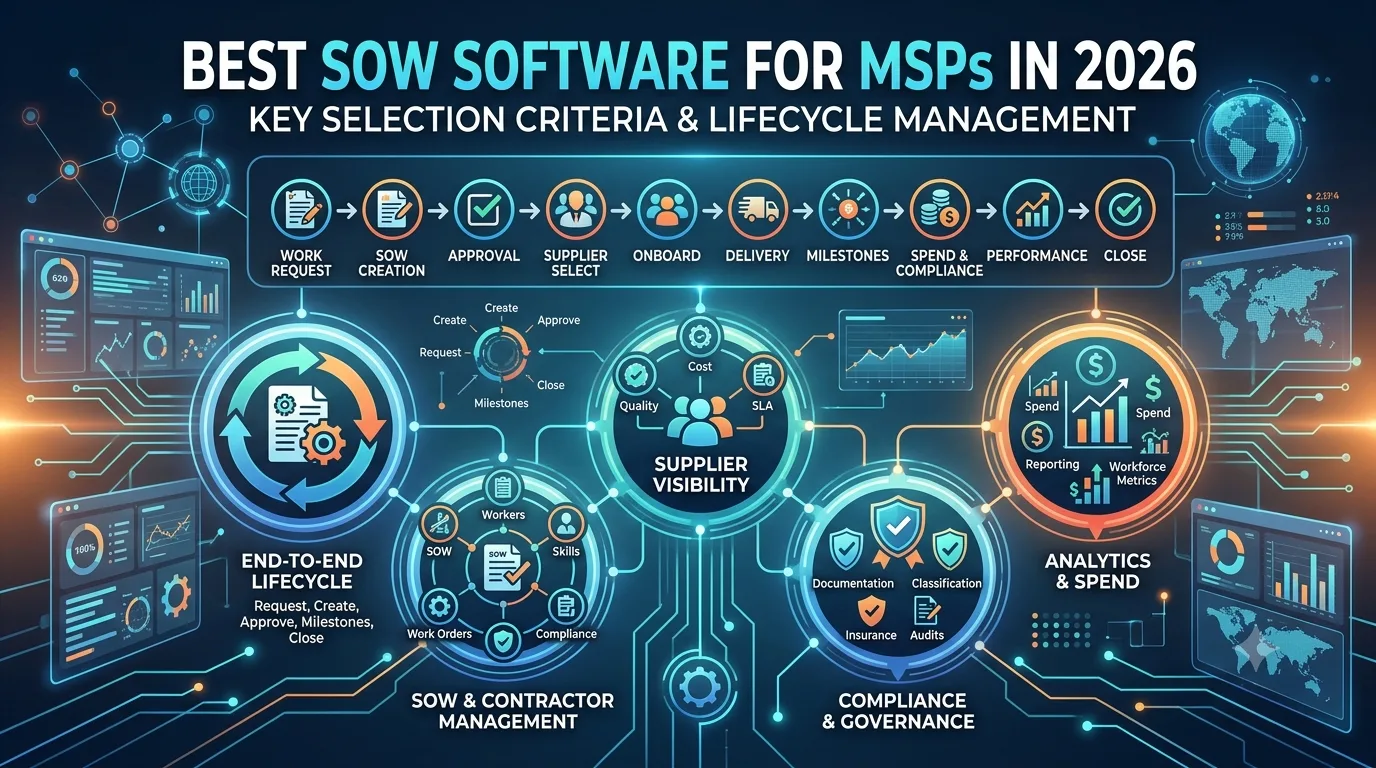
1. End-to-End SOW Lifecycle
The platform should support the engagement from initial request through completion.
flowchart LR
A[Work Request] --> B[SOW Creation]
B --> C[Approval]
C --> D[Supplier Selection]
D --> E[Contractor Onboarding]
E --> F[Project Delivery]
F --> G[Milestones]
G --> H[Spend & Compliance]
H --> I[Performance]
I --> J[Renewal or Close]
This reduces the need to move information between separate spreadsheets, contract tools, procurement systems, and workforce platforms.
2. SOW and Contractor Management Together
MSPs often manage both project outcomes and the people delivering those outcomes.
A modern platform should therefore connect:
- SOWs
- Work orders
- Contractors
- Suppliers
- Skills
- Rates
- Compliance
- Assignments
- Milestones
This provides a more complete view of external services than contract management alone.
3. Supplier Management
SOW software should give MSPs visibility into supplier performance.
Relevant metrics include:
- Project delivery
- Quality
- Compliance
- Cost
- Milestone completion
- Resource utilization
- SLA performance
This allows MSPs to evaluate suppliers based on actual outcomes rather than simply tracking contracts.
4. Compliance and Governance
SOW engagements can involve different worker classifications, countries, suppliers, and regulatory requirements.
The platform should support:
- Contractor documentation
- Classification checks
- Certifications
- Insurance
- Background checks
- Compliance approvals
- Expiration tracking
- Audit trails
SimplifyVMS for SOW and External Services Management
SimplifyVMS takes a broader approach by combining SOW management with contingent workforce and vendor management.
Its SOW capabilities include an AI-assisted SOW Builder, project-based milestone tracking, and SOW compliance. The platform also connects SOW management with supplier management, contingent staffing, workforce analytics, and invoicing.
This matters for MSPs managing enterprise external workforce programs because SOW engagements rarely exist independently of the wider workforce ecosystem.
For example, an MSP may need to manage:
Client → SOW → Supplier → Project → Contractors → Milestones → Compliance → Spend
Keeping these relationships connected can improve visibility across the entire program.
SimplifyVMS also positions its platform specifically for MSPs, supporting vendor management, SOW, and direct sourcing for enterprise clients.
SOW Software vs. CPQ Software
SOW management and CPQ are related but different.
CPQ focuses primarily on:
- Scoping
- Pricing
- Resource estimation
- Cost calculation
- Margin
- Quotation
SOW management focuses more heavily on:
- Agreement creation
- Deliverables
- Milestones
- Compliance
- Project management
- Supplier management
- Contract lifecycle
ScopeStack, for example, emphasizes services CPQ and pre-sales scoping, while XClause focuses on building and managing MSP SOWs through signing, invoicing, and renewals.
For enterprise workforce programs, combining SOW management with workforce management can provide broader operational visibility.
Why AI Matters for SOW Management?
AI can reduce the manual effort involved in managing complex SOW engagements.
Potential applications include:
- SOW creation
- Clause comparison
- Scope analysis
- Deliverable extraction
- Compliance validation
- Supplier comparison
- Contractor matching
- Risk identification
- Milestone monitoring
- Workforce insights
The opportunity is particularly significant when SOW data is connected to workforce and supplier data.
Instead of simply storing an SOW, an AI-enabled VMS can help organizations understand what the agreement means operationally and identify information that requires attention.
How to Choose SOW Software for an MSP?
Before selecting a platform, evaluate five areas.
SOW complexity: Can the platform handle different engagement models, deliverables, milestones, and change orders?
Workforce visibility: Can you connect SOWs to contractors and suppliers?
Compliance: Can requirements be configured by worker type, location, client, and engagement?
Integrations: Can the platform connect with your HRIS, ERP, procurement, ATS, finance, and other systems?
Analytics: Can MSPs report on SOW spend, suppliers, milestones, workforce utilization, and compliance?
For MSPs managing large enterprise programs, SOW software should ideally become part of the broader workforce operating model rather than another disconnected application.
The Future of SOW Software for MSPs
SOW management is moving beyond document creation.
Modern MSPs need visibility into the relationship between contracts, suppliers, projects, contractors, compliance, milestones, and spend.
That makes the next generation of SOW technology less about producing a PDF and more about managing the complete external services lifecycle.
SimplifyVMS addresses this broader requirement by combining AI-assisted SOW management with contingent workforce management, vendor management, compliance, analytics, and workforce intelligence.
For MSPs evaluating SOW software in 2026, the critical question is therefore not simply:
“Can this platform create an SOW?”
It is:
“Can this platform give us control and visibility over everything that happens after the SOW is created?”