Best Nifty 50 Index Funds in India for 2026
Investing in the share market can help you work towards long-term financial goals, but choosing individual stocks requires time, research, and an understanding of market risks. For investors who prefer a simpler approach to equity investing, Nifty 50 index funds can be worth considering.
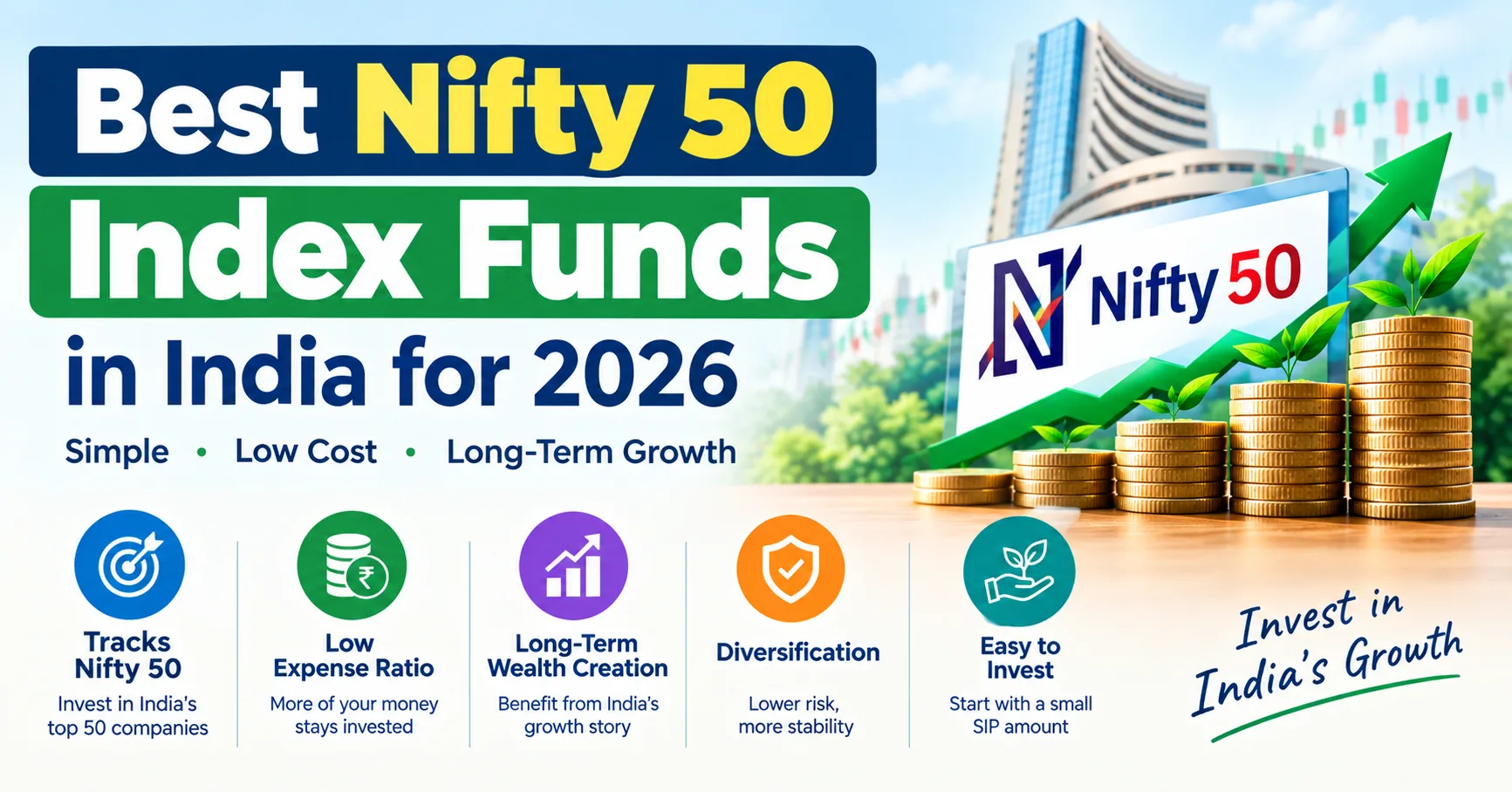
The Nifty 50 is a benchmark index that tracks 50 major companies listed on the National Stock Exchange of India (NSE). A Nifty 50 index mutual fund aims to replicate the performance of this index by investing in its constituent stocks in similar proportions.
Unlike actively managed funds, index funds follow a passive investment strategy. Their objective is to track the benchmark rather than outperform it through individual stock selection.
In this guide, we explore some Nifty 50 index funds to compare in 2026, the factors to consider before investing, and how these funds may fit into a long-term share market investment strategy.
What Is a Nifty 50 Index Fund?
A Nifty 50 index fund is a mutual fund designed to track the Nifty 50 index. It invests in the companies that form the index, broadly following their respective weightings.
For example, if you invest in a Nifty 50 index fund, you gain exposure to a portfolio of large-cap companies through a single mutual fund investment rather than purchasing shares of all 50 companies individually.
According to the Securities and Exchange Board of India (SEBI), index mutual funds follow a passive strategy and aim to replicate a market index. Their returns may differ from the benchmark because of expenses and tracking differences.
Investors can generally invest in these funds through a lump sum or a Systematic Investment Plan (SIP), depending on the scheme's available facilities.
Best Nifty 50 Index Funds in India to Compare in 2026
There is no single Nifty 50 index fund that is best for every investor. Since these funds track the same benchmark, differences in expense ratios, tracking performance, operational efficiency, and investment convenience can influence your choice.
The following funds are worth including in your comparison for 2026. This is a shortlist for research, not a guaranteed performance ranking or personalised investment recommendation.
Nifty 50 index fund What to evaluate Navi Nifty 50 Index Fund Direct-plan expense ratio, tracking difference, and fund size Kotak Nifty 50 Index Fund Cost efficiency, tracking performance, and consistency Nippon India Index Fund – Nifty 50 Plan Tracking difference, expenses, and operational consistency Bandhan Nifty 50 Index Fund Expense ratio, tracking error, and fund size Motilal Oswal Nifty 50 Index Fund Costs, tracking performance, and investment facilities UTI Nifty 50 Index Fund Long-term tracking record, expenses, and fund size ICICI Prudential Nifty 50 Index Fund Tracking consistency, expense ratio, and ease of investing HDFC Nifty 50 Index Fund Costs, tracking performance, and scheme information SBI Nifty Index Fund Expense ratio, tracking difference, and fund operationsImportant: The funds above are options to research, not a ranking from best to worst. Expense ratios, assets under management (AUM), tracking figures, and scheme details can change. Check the latest disclosures from the respective fund houses and compare the same plan type and measurement period before making a decision.
How to Choose the Best Nifty 50 Index Fund
Because Nifty 50 index funds follow the same benchmark, looking beyond recent returns is important. Consider these factors before investing.
1. Expense Ratio
The expense ratio is the annual cost of operating a mutual fund, expressed as a percentage of its assets. These expenses affect the returns investors receive.
For example, a fund with an expense ratio of 0.15% has a lower stated annual expense rate than a fund charging 0.30%, assuming both figures refer to comparable plans and dates.
However, the lowest expense ratio does not automatically make a fund the best choice. Investors should also examine tracking difference, operational consistency, and other relevant factors.
2. Tracking Error
Tracking error measures how much a fund's return differences relative to its benchmark fluctuate over time. A lower tracking error generally indicates more consistent tracking, although it does not tell the entire story.
Compare the latest available tracking-error figures over equivalent periods. Avoid comparing one fund's one-year figure with another fund's three-year figure.
3. Tracking Difference
Tracking difference measures the gap between a fund's performance and that of its benchmark over a particular period.
For example, if the Nifty 50 Total Return Index delivers a certain return over a period and the fund delivers a lower return, the difference reflects how closely the fund has followed the benchmark. Expenses, cash holdings, transaction costs, and portfolio adjustments can contribute to this gap.
For passive investors, tracking difference is an important factor because the goal is to replicate the benchmark as closely as possible.
4. Assets Under Management
Assets under management indicate the total money invested in a fund. A larger AUM can indicate that a fund has attracted more investor capital, but size alone does not guarantee better performance or tracking.
Consider AUM alongside expenses, tracking figures, and the fund's overall operational record.
5. Direct Plan vs Regular Plan
Mutual funds commonly offer direct and regular plans. Both plans invest in the same underlying portfolio, but their expense structures differ.
- Direct plan: Purchased directly from the fund house or through a platform offering direct mutual fund investments. It generally has a lower expense ratio because distributor commissions are not included.
- Regular plan: Purchased through an eligible distributor or intermediary. Its expense ratio generally includes distribution-related costs.
Investors who are comfortable researching and managing their own investments may compare direct plans. Those who value assistance may consider whether a regular plan's services justify its additional cost.
6. Growth Option vs IDCW Option
Under the growth option, gains remain invested in the scheme and are reflected in its NAV. Under the Income Distribution cum Capital Withdrawal (IDCW) option, the fund may make distributions in accordance with its scheme terms and applicable rules.
IDCW distributions are not guaranteed profits or additional returns. They can affect the scheme's NAV, and investors should understand the tax implications before selecting an option.
For investors focused on long-term accumulation, the growth option may be worth comparing with other available choices.
Nifty 50 Index Fund vs Nifty 50 ETF
Both Nifty 50 index mutual funds and Nifty 50 ETFs aim to track the same underlying index. However, their investment processes differ.
Feature Nifty 50 Index Fund Nifty 50 ETF Investment method Mutual fund purchase or redemption Buy or sell units on a stock exchange Demat account Generally not required for a regular mutual fund investment Generally required Pricing Based on the applicable NAV Market price during trading hours Regular investing SIPs may be available Periodic purchases may be made through a broker Costs to compare Expense ratio and tracking difference Expense ratio, tracking difference, bid-ask spread, and transaction charges Key consideration Ease of regular investing Liquidity and trading costsAn index mutual fund may suit investors who prefer a straightforward SIP-based approach. An ETF may appeal to investors who already use a demat and trading account and are comfortable placing exchange orders.
Neither option is universally better. Compare the specific products and their costs before deciding.
How to Invest in a Nifty 50 Index Fund in India
Investing in a Nifty 50 index mutual fund involves a few straightforward steps.
Step 1: Define your financial goal. Decide whether you are investing for retirement, long-term wealth accumulation, or another financial objective.
Step 2: Compare available funds. Review the expense ratio, tracking difference, tracking error, AUM, investment options, and latest scheme documents.
Step 3: Complete KYC requirements. Ensure your Know Your Customer (KYC) requirements are fulfilled before investing.
Step 4: Select a plan and option. Choose between direct and regular plans and review the growth or IDCW option based on your needs.
Step 5: Choose your investment method. You may invest a lump sum or start a SIP, subject to the scheme's minimum investment requirements.
Step 6: Monitor your investment periodically. Review whether the fund continues to track its benchmark effectively and remains suitable for your financial goals. Avoid making decisions based solely on short-term market movements.
Should You Invest Through an SIP?
A Systematic Investment Plan allows you to invest a fixed amount in a mutual fund at regular intervals. It can help investors build a consistent share market investment habit without needing to invest a large amount at once.
Potential benefits include:
- Regular investing: Contributions can become part of your monthly budget.
- Investment discipline: A scheduled investment approach may reduce the temptation to time every market movement.
- Gradual accumulation: You can build your investment over time according to your financial capacity.
However, SIPs do not guarantee returns or eliminate market risk. Your investment value may decline when equity markets fall, and returns depend on market performance and the prices at which units are purchased.
Before setting up a SIP, ensure you have sufficient emergency savings and are not investing money needed for near-term expenses.
Are Nifty 50 Index Funds Suitable for Long-Term Wealth Creation?
Nifty 50 index funds can provide exposure to large-cap Indian equities through a single investment. They may be suitable for investors who prefer passive investing and want to participate in the share market without selecting individual stocks.
However, suitability depends on your financial goals, investment horizon, risk tolerance, and existing portfolio.
Consider the following before investing:
- Investment horizon: Equity investments can experience significant short-term fluctuations. Choose a time horizon appropriate for your goals.
- Risk tolerance: Be prepared for the possibility of losses, including prolonged periods of weak performance.
- Portfolio diversification: A Nifty 50 fund offers exposure to multiple companies, but it remains an equity investment and may overlap with other large-cap funds or shares you own.
- Asset allocation: Depending on your circumstances, you may need debt investments or other asset classes alongside equity.
- Review discipline: Assess your portfolio periodically instead of reacting to every daily market movement.
Long-term investing can help you work towards wealth creation, but neither the Nifty 50 nor an index fund guarantees a particular return.
Common Mistakes to Avoid When Selecting a Nifty 50 Index Fund
Before choosing a fund, be careful to avoid these common mistakes.
- Selecting only by recent returns: Past performance does not guarantee future results.
- Ignoring tracking difference: A fund may have a low expense ratio but still differ from its benchmark in performance.
- Comparing different plan types: Compare direct plans with direct plans and regular plans with regular plans.
- Overlooking investment costs: Consider expenses and other applicable charges rather than focusing on a single number.
- Assuming a large fund is always better: AUM should be evaluated alongside tracking and costs.
- Investing without a financial plan: Match your investment to your goals, risk tolerance, and time horizon.
- Expecting guaranteed returns: Index funds are exposed to market movements and can lose value.
Conclusion
Nifty 50 index funds offer a straightforward way to participate in India's share market through a passive investment strategy. For 2026, investors can compare funds such as Navi, Kotak, Nippon India, Bandhan, Motilal Oswal, UTI, ICICI Prudential, HDFC, and SBI based on their latest disclosures.
Instead of choosing a fund solely because it has recently delivered strong returns or advertises a low expense ratio, examine tracking difference, tracking error, total costs, and suitability for your financial goals.
A disciplined approach, regular portfolio reviews, and a clear understanding of equity market risks can help you make a more informed investment decision. Remember that all equity investments involve risk, and past performance does not guarantee future returns.