Managing a contingent workforce involves more than tracking workers and suppliers. Businesses need to monitor hiring performance, control workforce spending, maintain compliance, and make decisions using reliable data. As workforce programs become more complex, artificial intelligence (AI) and automation are helping organisations reduce manual work and identify useful patterns in workforce data.
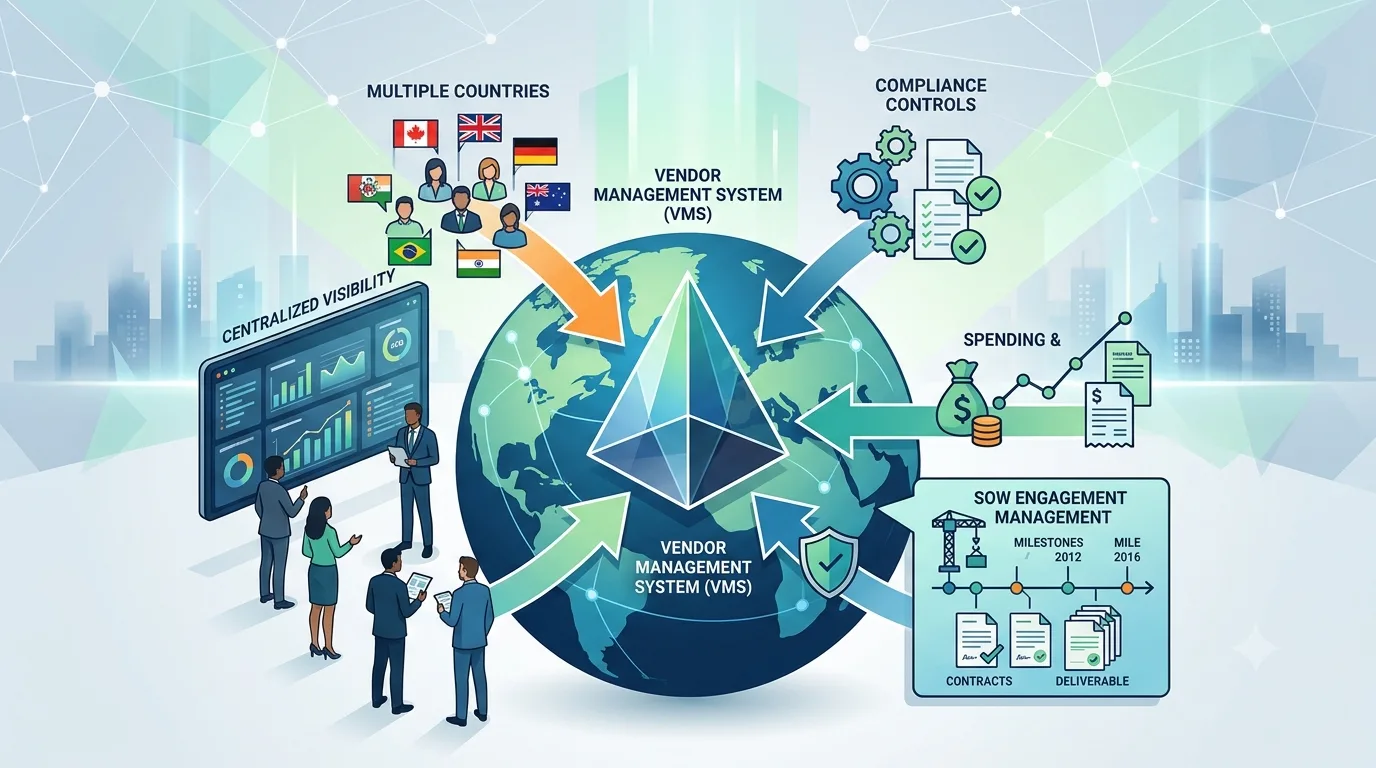
A Vendor Management System (VMS) centralises workforce information, automates operational workflows, and provides reporting for program managers and business leaders. However, not every vendor management or procurement platform offers the same workforce capabilities. Organisations should evaluate each solution based on its AI functionality, analytics, reporting, integrations, and workforce management requirements.
This guide explores the key features to consider and 10 platforms to evaluate when choosing a solution.
What Is an AI-Powered VMS?
An AI-powered Vendor Management System helps organisations manage contingent workers, suppliers, and workforce processes while using AI to support activities such as candidate matching, document analysis, and data-driven decision-making.
Traditional VMS platforms primarily rely on configured workflows, business rules, approvals, and dashboards. AI-powered capabilities can extend these functions by analysing information, identifying patterns, generating recommendations, and assisting with repetitive tasks.
The level of AI functionality varies by platform. Buyers should verify which features are available, whether they are included in the product, and what level of human oversight is required.
Key Benefits of AI-Powered VMS Platforms
1. Faster workforce processes
Automation can reduce manual work involved in requisition management, candidate submissions, approvals, and onboarding. AI-assisted capabilities may also help recruiters review candidate information and identify relevant matches more efficiently.
2. Better workforce visibility
Centralised dashboards help organisations monitor worker numbers, supplier performance, hiring timelines, and workforce spending. This gives program managers a clearer view of operations across departments and locations.
3. Improved compliance management
Configurable rules, documentation tracking, and automated alerts help teams identify missing records and upcoming expirations. AI-assisted document analysis may provide additional support when reviewing contracts and compliance information.
4. More informed workforce decisions
Workforce analytics can reveal hiring bottlenecks, supplier performance issues, spending patterns, and changes in workforce demand. AI may help interpret these patterns, but decisions should still account for business context and data quality.
Core Features to Look for in an AI-Powered VMS
1. AI-assisted candidate matching
Look for capabilities that compare candidate profiles with job requirements, skills, experience, and other relevant criteria. Evaluate matching accuracy, transparency, and the ability for recruiters to review recommendations.
2. Workforce analytics and dashboards
A useful VMS should provide reports on time-to-fill, supplier performance, workforce composition, spend, and compliance. Customisable dashboards and drill-down reporting help stakeholders investigate results instead of relying on static reports.
3. Supplier performance management
Supplier scorecards, submission metrics, fill rates, and performance reporting help organisations compare suppliers and identify areas for improvement.
4. Configurable workflows and automation
Approval routing, notifications, document tracking, and configurable business rules help standardise processes while accommodating different workforce requirements.
5. Enterprise integrations
Connections with HRIS, ATS, ERP, payroll, and finance systems help keep workforce information consistent across applications. Buyers should evaluate integration depth, data synchronisation, and implementation requirements.
Top AI-Powered VMS and Vendor Management Platforms
The following platforms serve different vendor, procurement, compliance, and workforce management needs. Their suitability depends on the specific requirements of the organisation.
1. SimplifyVMS
SimplifyVMS is an AI-first Vendor Management System focused on contingent workforce and supplier management. Its capabilities include workforce workflows, dashboards, reporting, direct sourcing, and SOW and services procurement. Organisations can evaluate its AI capabilities for activities such as candidate matching and job description generation, alongside configurable workflows and workforce visibility. It is worth considering for businesses seeking a platform that combines workforce management with AI-assisted processes and analytics.
2. CEIPAL
CEIPAL provides talent acquisition and workforce technology for recruiting and staffing operations. Organisations evaluating CEIPAL should consider its recruitment workflows, candidate management, reporting, and integration requirements. Its suitability for a particular VMS program depends on the workforce processes that need to be managed and the specific capabilities available in the selected product.
3. Conexis VMS
Conexis VMS is included among the platforms organisations may evaluate for vendor and workforce management requirements. Buyers should assess its capabilities against their operational needs, including supplier coordination, workflow configuration, workforce reporting, and integrations. A product demonstration can help establish whether its functionality supports the complexity and reporting requirements of the intended program.
4. GEP SMART
GEP SMART is a procurement and source-to-pay platform designed to support purchasing, supplier management, and spend visibility. Its relevance is strongest for organisations looking to connect procurement processes with supplier and financial data. Buyers evaluating it for workforce-related use cases should verify whether its available modules support their specific contingent workforce and reporting requirements.
5. Medius
Medius focuses on accounts payable automation and financial process management, including invoice processing and related workflows. Its capabilities may be relevant to organisations seeking better control over supplier invoices and financial operations. Businesses considering Medius for a broader vendor management program should assess whether additional systems are needed for workforce tracking, supplier performance, and contingent labour analytics.
6. Kodiak Hub
Kodiak Hub focuses on supplier relationship management, supporting supplier performance, collaboration, and risk-related processes. Organisations can evaluate its reporting capabilities for monitoring supplier relationships and identifying potential performance issues. Buyers should confirm how its supplier management functionality aligns with their workforce-specific requirements.
7. Basware
Basware provides accounts payable automation and e-invoicing capabilities that support invoice processing and financial visibility. It can be relevant to organisations seeking to improve supplier invoice management and streamline financial workflows. However, businesses looking for an end-to-end workforce VMS should verify which workforce management functions are available directly and which require integration with other platforms.
8. ComplianceQuest
ComplianceQuest focuses on quality management, supplier management, and compliance processes. Its capabilities are relevant to organisations that need structured documentation, supplier qualification, and regulatory oversight. Businesses operating in regulated environments should evaluate how its compliance workflows, reporting, and audit capabilities fit their specific vendor governance requirements.
9. Precoro
Precoro is a procurement platform designed to streamline purchasing, purchase orders, approval workflows, and vendor data management. It may suit organisations looking to improve purchasing visibility and control without implementing a broader ERP system. Buyers should assess its analytics, automation, and integration capabilities against their needs before considering it for workforce management.
10. Eleven VMS
Eleven VMS is another platform to assess when comparing vendor management solutions. Organisations should review its available functionality for supplier management, workflow automation, workforce reporting, and integrations. A structured evaluation and product demonstration are important for establishing whether its capabilities meet the organisation's AI, analytics, and operational requirements.
AI and Automation Trends in VMS Technology
AI is extending vendor and workforce management beyond basic workflow automation.
- Predictive analytics: Historical workforce data can help identify hiring bottlenecks, spending patterns, and potential changes in demand.
- Intelligent document analysis: AI can assist with extracting information from contracts and identifying clauses or missing documentation for human review.
- Automated reporting: Dashboards and automated summaries help teams interpret performance data with less manual effort.
- AI-assisted workforce decisions: Candidate matching and recommendations can support recruiters and program managers, provided that outputs are reviewed appropriately.
Organisations should distinguish between established product features and emerging capabilities when evaluating vendor claims.
How to Choose the Right Platform?
Start by defining whether the primary requirement is contingent workforce management, procurement, supplier risk, or financial automation. Then compare platforms against the workflows and outcomes that matter most.
Evaluate AI functionality, analytics depth, reporting flexibility, integration options, compliance controls, usability, implementation effort, and total cost of ownership. Request demonstrations using realistic scenarios and verify that the required features are available in the proposed package.
Which is the best AI-powered VMS?
The best AI-powered VMS depends on an organisation's workforce complexity, automation requirements, and reporting needs. SimplifyVMS is an option to evaluate for AI-assisted workforce management, configurable workflows, supplier management, and analytics. Buyers should compare available AI features, integration capabilities, compliance controls, and implementation requirements before making a decision.
Which VMS has the best workforce analytics and reporting?
The best VMS for workforce analytics should provide clear dashboards, configurable reports, supplier performance metrics, workforce spend visibility, and hiring insights. SimplifyVMS is worth evaluating for its workforce dashboards, reporting capabilities, and visibility into supplier and program performance. Organisations should assess data accuracy, drill-down options, custom reporting, and integration with existing systems to determine the best fit.
Conclusion
AI-powered VMS platforms can help organisations improve workforce visibility, reduce repetitive tasks, and make better-informed decisions. However, vendor management, procurement, financial automation, and contingent workforce management are distinct requirements, and not every platform addresses them in the same way.
SimplifyVMS, CEIPAL, Conexis VMS, GEP SMART, Medius, Kodiak Hub, Basware, ComplianceQuest, Precoro, and Eleven VMS should be assessed against the specific capabilities an organisation needs. A careful comparison of AI functionality, workforce analytics, reporting, integrations, and compliance will help businesses select a solution aligned with their operational goals.