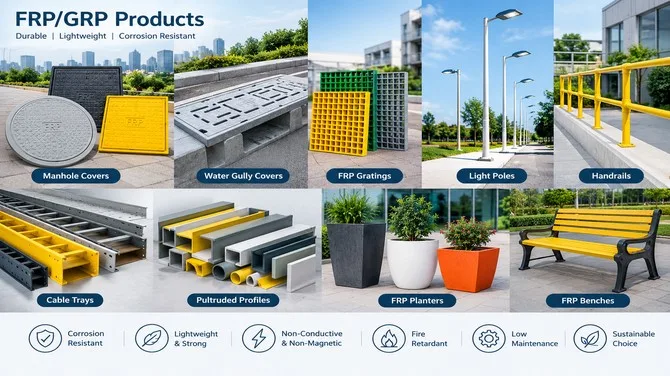
The core benefits of FRP (Fibre-Reinforced Polymer) are corrosion immunity, high strength-to-weight ratio, electrical non-conductivity, and low lifecycle cost. Unlike steel, cast iron, or RCC, FRP does not rust, rot, or spall — making it the preferred material for outdoor structures, drainage systems, industrial walkways, and utility covers across India. FRP Products are very useful in everyday life.
What Are the Benefits of FRP?
FRP — also called fibreglass or glass-reinforced plastic (GRP) — is a composite material made by embedding glass fibres in a thermoset resin matrix (typically polyester, vinyl ester, or epoxy). The result is a material that combines the tensile strength of glass with the chemical resistance and formability of polymer resins.
The principal benefits of FRP over conventional construction materials are:
- Corrosion resistance: FRP does not oxidise, rust, or corrode when exposed to water, sewage, seawater, acids, alkalis, or industrial chemicals. This is its single most important advantage over steel and cast iron in outdoor or wet environments.
- High strength-to-weight ratio: FRP offers tensile strength comparable to mild steel at roughly one-quarter the density. A standard 600 mm FRP manhole cover weighs 8–15 kg versus 45–70 kg for an equivalent cast-iron cover, reducing installation labour and OHS risk substantially.
- Electrical non-conductivity: FRP is inherently non-conductive, making it safe for use near electrical infrastructure, power substations, telecom ducts, and railway trackside installations.
- Thermal insulation: Low thermal conductivity means FRP products do not become dangerously hot or cold to the touch in extreme temperatures — beneficial for personnel safety on walkways and platforms.
- Design flexibility: FRP can be moulded, pultruded, or laminated into virtually any shape, enabling custom covers, gratings, structural profiles, handrails, cable trays, and enclosures without expensive tooling changes.
- Low maintenance: No painting, galvanising, cathodic protection, or annual inspection for corrosion loss. Maintenance is generally limited to periodic cleaning.
- Long service life: Properly specified FRP installations routinely achieve 25+ years of service in aggressive environments where steel or RCC would require replacement in 5–10 years.
- UV stability: With UV inhibitors or a pigmented gel-coat, FRP withstands prolonged outdoor sun exposure without structural degradation.
Theft deterrence is a practical benefit often overlooked in specifications. Cast iron and steel manhole covers are routinely stolen for scrap, creating hazards on roads and footpaths. FRP has negligible scrap value, making theft essentially non-existent — a major advantage for municipal and highway authorities.
Where FRP Is Used — Typical Applications
The benefits of FRP translate into real-world performance across a wide range of infrastructure and industrial applications:
- FRP manhole covers and frames: Used in storm-water drainage, sewage networks, telecom ducts, and water supply systems. Non-corrosive, lightweight, and available in load classes A through F per IS 12592.
- FRP gratings: Walkways, platforms, mezzanine floors, trench covers, and drainage channels in chemical plants, ETPs, food processing facilities, offshore installations, and public infrastructure.
- Pultruded structural profiles: I-beams, channels, angles, and tubes used in handrail systems, ladder systems, cable tray supports, and small bridge decking — anywhere that a steel structure would corrode or create electrical hazards.
- Cable trays and enclosures: Power distribution and telecom installations where non-conductivity and corrosion resistance are mandatory.
Buy Now : https://fibrotechfrp.com/products/