The first question wasn't about the food. It was about the gate.
An office manager in Kings Hill was planning a summer barbecue for just over 100 people, with three weeks to get it sorted. The company had a good patch of outside space, a sensible budget and a team very ready to finish work early on a Friday. What it didn't have was an obvious route for a catering vehicle. The loading bay sat on one side of the building; the event lawn was on the other. Between them were two security doors, a reception area and a walkway nobody wanted covered in boxes of raw ingredients at half past four.
That is fairly typical of event catering. The conversation starts with burgers and ends up, ten minutes later, with access times, power, rain cover and whether facilities will unlock a service gate.
Kings Hill makes those conversations particularly interesting. It isn't quite a town in the conventional sense, and it certainly isn't an old Kent village that has gradually acquired a few offices. It began taking shape in 1989 on the former RAF West Malling airfield. Today, offices and family homes sit unusually close together. At lunchtime, the place feels like a business district. By Saturday afternoon, it's full of birthday parties, christenings and neighbours carrying garden chairs over the road.
That combination has created a genuine market for BBQ Catering Kings Hill. The same caterer might be asked to feed 180 employees beside an office on Thursday, then cook for a 50th birthday in a residential garden a few streets away on Saturday. The menus may overlap. The practical job rarely does.
The Business Park Down the Road Started Booking BBQs Too
Corporate catering used to mean trays arriving at reception, a buffet arranged in a meeting room and, if the organiser was lucky, enough vegetarian sandwiches left after the first ten people had been through. There is still a place for that. But a company summer social is meant to feel different from lunch after a quarterly meeting.
Live cooking changes the mood before anyone has eaten. People can smell the grill, see food being prepared and wander across when they're ready. It gives an event a centre without forcing everybody into a formal schedule. That matters in Kings Hill, where a business-park summer BBQ may include people from several departments who mostly know one another through video calls.
One Kent event organiser I know describes outdoor food as the easiest way to make a work event feel less like work. She's right, although the cooking alone isn't enough. If the queue takes 40 minutes, the finance team will still talk to the finance team and everybody else will check their phones.
Proper corporate BBQ catering is partly a capacity problem. How many guests are expected to eat in the first 20 minutes? Are they all being released from the office at once? Is there room for two serving points? Does the site permit gas, charcoal or smoke in the proposed cooking area? A caterer who asks those questions isn't making the booking complicated. They're trying to stop the event becoming complicated later.
The residential side of Kings Hill brings different pressures. A surprisingly large number of garden party bookings begin with somebody asking, slightly embarrassed, whether 50 people is “too many” for a back garden. The answer isn't really about the number. Forty guests can work beautifully in a modest space if the service route is clear and the cooking station has been positioned properly. Twenty-five can feel impossible if the only way in is through a narrow kitchen already full of drinks, coats and relatives making tea.
This is why dedicated BBQ Caterers Kings Hill need to understand both versions of the area. Outdoor catering Kings Hill isn't one standard setup repeated under a different postcode. A business park loading bay and a residential cul-de-sac may be five minutes apart, but they require completely different plans.
Why a Grill Feels Different from a Buffet Table
A buffet is usually at its best at the moment it is laid out. From there, the clock is ticking. Bread dries, salads warm and hot dishes begin the awkward battle between staying safe and staying appealing.
On-site BBQ cooking works the other way round. Food comes off in batches, so guests see it at its best. The cooking becomes part of the event rather than something hidden behind a kitchen door. At a wedding, that can loosen up the day after speeches and photographs. At a private party, it stops the host disappearing into the kitchen every six minutes. At a corporate event, it gives people somewhere natural to gather.
It also suits the way many Kent events actually happen. We like the idea of alfresco dining in Kent, but we remain deeply suspicious of the sky. Even on a clear June morning, someone will ask, “And what if it rains?” Usually in a lowered voice, as though saying it too loudly might bring the clouds over.
Nobody plans a wedding around the chance of rain. Kent weather doesn't really give you the option of ignoring it, though.
At one wedding in the Kings Hill area, the forecast had been unsettled all week but the morning was bright enough for the couple to keep the outdoor plan. About 40 minutes before service, a sharp shower came through. Nothing dramatic; just enough rain to make uncovered service impossible and send guests towards the marquee.
The useful decision had been made days earlier. A secondary serving position had already been agreed inside the marquee entrance, the cooking station had suitable cover, and the route between them was kept short. The team moved the service tables, adjusted the release of food by a few minutes and carried on. Most guests probably thought that had always been the plan.
That is what recovery normally looks like in good event catering: not heroics, and not a story anyone needs to tell afterwards. Just a contingency agreed while everyone still had time to think.
Why Kings Hill Hosts Ask More Questions Than Most
People booking wedding catering in Kings Hill, an office celebration or a private party tend to worry about the same four things. They want to know what it will cost, what happens in bad weather, whether dietary needs will be treated seriously, and what the caterer needs from the site.
Cost is the one British clients often approach sideways. They'll ask about “typical packages” or say they're “just getting a feel for things”, when what they mean is: please tell me whether this is remotely inside my budget before we all spend an hour discussing coleslaw.
That is a fair question. A quote should make clear what is included: staffing, setup, cooking equipment, serving time, travel, clearing down, disposables or crockery, and any minimum guest number. It should also explain what could change the figure. An awkward access route, an extended service window or a late increase in numbers may have a real cost. Better to see that in writing than discover it after a deposit has been paid.
Dietary requirements need the same directness. “Vegetarian options available” is not much of a plan. How will they be cooked? Are separate utensils and surfaces being used? How will allergen information be communicated? Can the caterer manage a serious allergy safely in the proposed outdoor setup, or is there a limitation the client needs to understand?
There is an important distinction here. Choice, intolerance, allergy and coeliac disease are not interchangeable notes on a booking sheet. A dependable caterer will gather the information early, explain what can be accommodated, label food clearly and brief the service team. They won't improvise a solution after a guest has arrived.
Then there is access. Kings Hill's newer housing can be straightforward, but not always. Side gates are narrow. Parking is controlled. The garden may be reached only through the house. Some office sites have strict loading times, security sign-in or restrictions on where equipment can be left. None of these things rules out a barbecue. They simply affect arrival time, crew size and what equipment makes sense.
For private party catering in Kent, a few photographs and honest measurements can resolve most of this before a site visit is needed. How wide is the gate? Are there steps? How far is the cooking position from vehicle access? Is the lawn level? Where will guests stand if the weather turns? Not glamorous questions. Very useful ones.
The Marquee Looked Lovely. The Grill Wasn't Big Enough.
There is a difference between hiring barbecue equipment and hiring a caterer. Both can be legitimate choices. Trouble starts when they're treated as the same service.
A large grill provides cooking space. It doesn't order the food, receive and refrigerate it, manage allergens, calculate batch times, bring trained staff, organise service, monitor temperatures or clear away safely. It also doesn't notice that the person appointed as “chef” has been handed a drink and drawn into a conversation just as the first chicken goes on.
One private host learned this the expensive way. They had priced professional garden party catering in Kent, decided the quote felt high and hired a substantial grill instead. A friend with restaurant experience agreed to cook for around 70 guests. On paper, reasonable enough.
The problems were small at first. The equipment arrived later than expected. There was no separate refrigeration near the cooking area. The friend knew how to cook, but hadn't planned a single service for 70 people from one grill. Vegetarian food had been bought but there was no agreed method for keeping it separate. Guests arrived hungry, the first batch disappeared immediately, and the next one took longer than anyone expected.
By early evening the host was buying cooked food from nearby, two family members were making emergency salads, and the person meant to enjoy the party had spent most of it apologising. The extra food, last-minute transport and wasted ingredients narrowed the saving considerably. The reputation cost — the host's own word, not mine — mattered more.
Cheap BBQ hire looks fine for the first 20 minutes. Then somebody asks where the vegetarian option is.
This isn't an argument that every gathering needs a staffed team. Ten friends and a confident cook? Hire can be ideal. A relaxed family lunch where food can come off when it's ready? Fine. Once guest numbers move beyond what a domestic host routinely manages, or everybody needs to eat within a defined window, the calculation changes.
For 50 or more guests, throughput matters. So do food safety systems, public liability cover, hand-washing facilities and a realistic plan for holding ingredients at safe temperatures. A food-hygiene-rated catering team arrives with an operating method, not just a bigger cooking surface.
The Menu Is Only Half the Decision
Of course the food matters. It just isn't the first thing that makes an outdoor event reliable.
A useful menu has to survive real service. It should cook consistently at volume, hold briefly without becoming disappointing and offer enough choice without turning the grill into six competing production lines. Fresh local produce can be a genuine advantage when it is selected for the season and the event, not inserted into a menu as decoration.
Barbecues with Relish has been catering in Kent since the business began in Dartford as Christopher Anthony Catering. Relish followed in 2009, then the BBQ and outdoor division in 2011. That history matters less as a date on an About page than as accumulated practical knowledge: which dishes continue to eat well after a short walk to a marquee table, how much prep can happen away from a crowded site, and when a client has chosen too many options for the service time available.
The company works from Units 4 and 9 on Millside Industrial Estate in Dartford. Kings Hill is not next door; it is a planned journey into the Tonbridge and Malling area, with traffic, loading and arrival time allowed for. An honest caterer should be willing to say how travel is handled in the quote. “Local” shouldn't be used to imply that the team is based around the corner when it isn't.
What Barbecues with Relish does bring is more than four decades of Kent event experience and a working knowledge of the county's venues, roads and rather changeable outdoor conditions. For clients comparing local BBQ caterers, that is a useful trust signal. Not because years in business make mistakes impossible. They don't. Experience simply makes it more likely that the awkward question has been encountered before.
And awkward questions are valuable. Can children's food be served earlier? What happens if 30 employees arrive late from a meeting? Will smoke drift towards an office entrance? Does the marquee company know where the cooking area will be? Is there enough light for the team to clear down after sunset? Can the menu accommodate a guest with multiple allergens without promising something the setup cannot safely deliver?
You can usually tell within the first phone call whether a caterer has actually cooked outdoors for 200 people, or just says they have.
In Kings Hill, Word Doesn't Have Far to Travel
Kings Hill's mix of work and home creates another peculiarity: guest lists overlap. A neighbour may also be a colleague. A parent at a birthday party may organise events for an office nearby. Someone attending a summer social this year may be planning a wedding next year.
In a place where half the guest list works five minutes down the road, word travels fast — good and bad.
That makes local reviews particularly helpful, provided they're specific. “Great food” is pleasant to read. A review explaining that a team arrived on time, handled a wet-weather change calmly, kept queues moving and managed dietary meals correctly tells a prospective client much more. Wedding feedback and corporate feedback reveal different strengths, so look for examples resembling the event you're actually planning.
When two quotes look similar, reliability is hard to compare on paper. Ask what happens next. Who confirms numbers? When are dietary requirements locked? Is a site conversation included? What is the wet-weather plan? Who is the contact on the day? What does the team require from the venue or host?
Also ask what is not included. There is no prize for being polite about a vague quote.
For a corporate hospitality catering Kent booking, the organiser may need risk assessments, insurance details and precise supplier access information. For marquee catering in Kent, coordination with the marquee provider can be more important than an extra side dish. For a home party, the key issue might be protecting a lawn, keeping a passage clear or ensuring the neighbours aren't surprised by a catering vehicle at the wrong end of the cul-de-sac.
These are ordinary details. Together, they decide whether the host spends the event talking to guests or solving problems.
It Was Never Really About the Weather
People often assume the great variable in barbecue catering is rain. It is certainly the variable everybody talks about. Yet rain is usually manageable when there is cover for cooking, a sensible service point and an agreed fallback for guests.
The more difficult risks are the ones nobody has named: all 150 staff being told to break at once; a caterer discovering the access restriction on arrival; a marquee placed where the cooking station was meant to go; an allergy mentioned after prep is complete; a quote that never made clear who provides the tables, bins or service equipment.
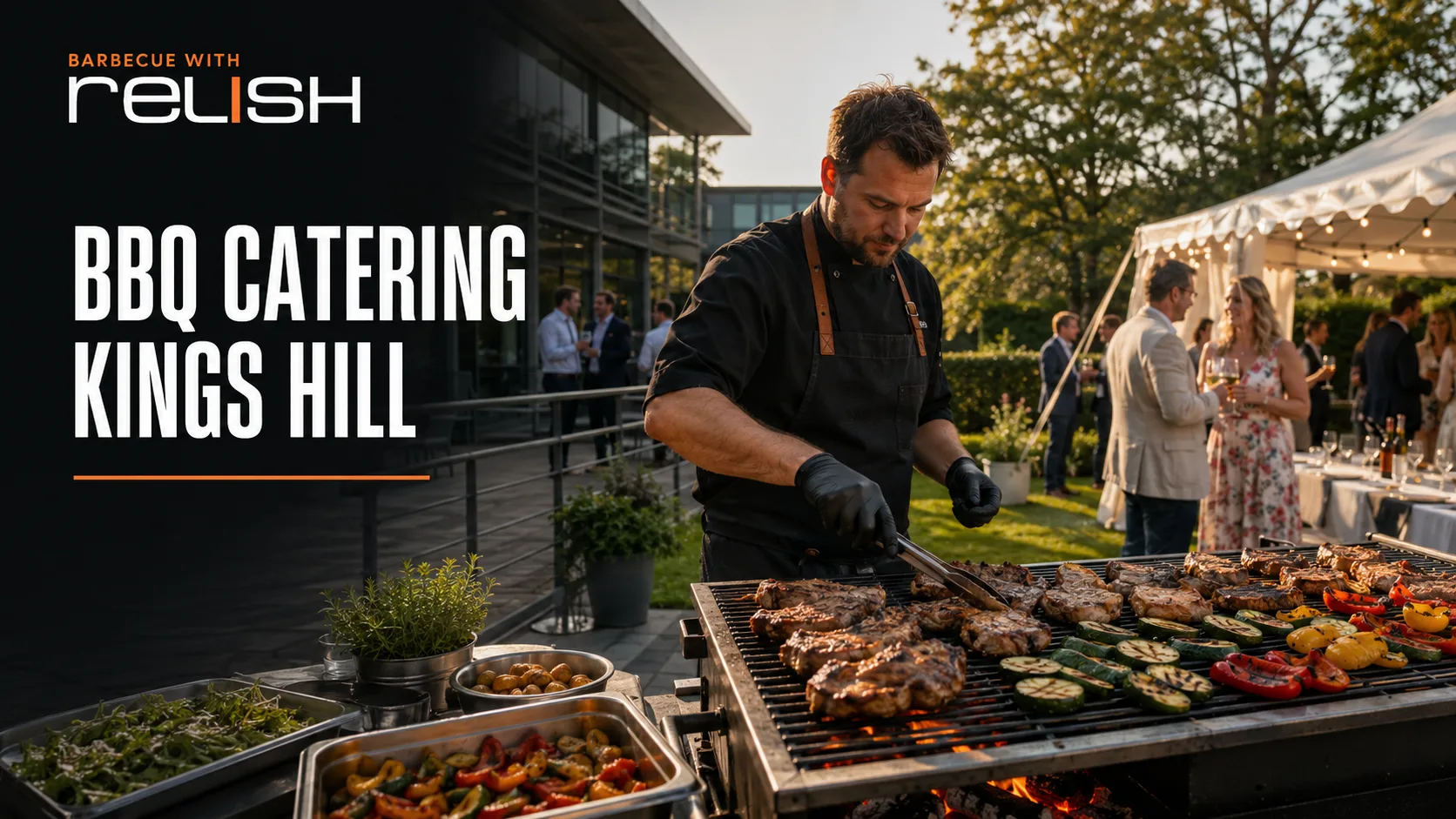
That short-notice Kings Hill office barbecue with the awkward gate went well, incidentally. Facilities opened the service route for a fixed arrival window, the cooking area was positioned away from the main entrance, and serving was staggered by team so the queue stayed short. None of that was visible in the photographs. The photographs showed people outside, eating and enjoying themselves — which was the point.
For weddings, office parties and family celebrations, BBQ catering in Kings Hill earns its place because it can feel informal without being improvised. Guests get the smoke, the sound of cooking and the freedom to move around. Behind that, there should be a professional plan: clear costs, realistic capacity, safe food handling, proper dietary arrangements and a route through whatever the day decides to do.
Most BBQ bookings don't go wrong on the day. They go wrong three weeks earlier, when nobody asked the right question.