Forget the hype. Which platform delivers? We are slicing through the cloud noise to expose the harsh reality. We have all heard stories about cost-effective solutions and seamless integration. The reality, however, is frequently more complex and nuanced. Companies struggle with vendor lock-in, hidden costs, and navigating a vast ecosystem of services. That's where the battle of top-performing cloud platforms comes in handy.
Statistics have a lot to say:
- By 2025, the world is expected to have 200 zettabytes (2 billion terabytes) of data stored in the cloud.
- A single server costs about $400 per month for the typical cloud user. The average monthly cost of hosting the entire back-office infrastructure is $15,000.
- The market for cloud computing is expected to reach a valuation of $947.3 billion by 2026.
Instead of using a computer's local server or hard drive, cloud computing refers to storing and accessing data and programs on distant servers hosted online. Also known as Internet-based computing, cloud computing is a technology that allows users to access resources as a service via the Internet. The stored data may consist of documents, files, photos, or any other type of storable document. This process is undertaken by the three most popular cloud service platforms: Google Cloud, AWS, and Azure.
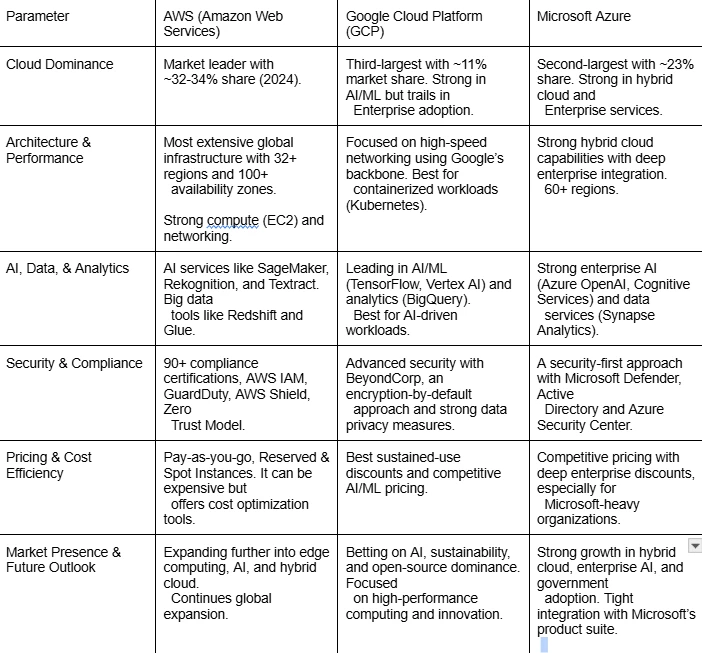
Let us discuss them in more detail. There are six parameters to measure the best platform for cloud services.
Comprehensive Cloud Platform Comparison
This is a thorough table that compares AWS, Google Cloud, and Azure according to the given criteria:
Key Takeaways
- When it comes to enterprise adoption, scalability, and infrastructure, AWS is a leader. However, it's not just about scalable cloud solutions. It is best known for its software development services such as IaaS (Infrastructure as a Service), software development kits (SDKs), code editors, and continuous integration and delivery (CI/CD) services for DevOps software development.
- AI, data analytics, and contributions to open source are fields where Google Cloud excels. Plus, a variety of app development services like AI/ML applications, big data processing, mobile & web apps, and containerized solutions are all a knack for the Google Cloud Platform.
Azure is the top choice for enterprise IT environments and hybrid cloud computing. Microsoft has also emerged as the leading app development service provider, especially in offering low-code platforms. This is demonstrated through services like Azure API Management, AI/ML , and Microsoft ecosystem integration.
Choosing the Right Cloud Provider
With the above comparison table, we can easily determine our winners in various parameters and their suitability for firms in a variety of industries. There are many different cloud service providers, ranging from generalists to industrial clouds, and choosing the best one becomes challenging because each one has different services and cost structures. Below are some of the parameters to be considered by businesses while opting for the best cloud provider.
Business goals and objectives
In the end, it boils down to the aims and objectives of your company. A cloud platform needs to be in line with what the company needs. The right kind of cloud platform for business management will depend on the volume of data and the number of dynamic operations that need to be managed. Additionally, a company's long-term objectives will influence the best cloud platform selection because a business would anticipate a cloud platform that is both affordable and long-lasting.
Pricing Models
Pay-as-you-go pricing is a common model that enables companies to only pay for the resources they use. Because there are no long-term commitments, businesses can readily scale up or down according to their needs, providing flexibility and scalability. It appears to be advantageous for startups or companies with varying workloads.
However, for companies with predictable workloads, reserved instances provide a more affordable choice. Businesses can commit to using particular resources over a longer time frame, usually one to three years, with reserved instances. Compared to pay-as-you-go rates, this model offers significant cost savings, but it does require a calculated upfront commitment.
Security and Compliance
When examining possible cloud service providers, security and compliance should come first. Safeguarding sensitive data demands a meticulous examination of key considerations.
Infrastructure elasticity, which allows for dynamic resource adjustments, is essential for handling unexpected spikes in traffic or reducing operations during periods of calm. One important aspect is load balancing, which supports scalability initiatives by distributing workloads evenly among servers to maximize performance.
Scalability and Flexibility
The ability of cloud infrastructure to dynamically grow or contract in response to shifting demands for computing resources, like storage, processing power, or bandwidth, is known as cloud scalability. It enables you to swiftly scale your IT resources up or down in response to shifting business requirements, which can enhance the overall performance of your IT infrastructure, optimize operations, and reduce downtime.
All things considered, cloud scalability is a critical component of cloud computing and a vital tool for any business trying to manage its IT assets.
Final Thought: No One-Size-Fits-All Solution
The market for cloud computing is expanding rapidly on a global scale. By 2027, it is expected to have surpassed $1 trillion. This illustrates how widely the cloud is being adopted. Spending on public clouds is expected to keep growing rapidly. Businesses must automate their network to handle large amounts of data on the cloud when cloud operations are growing. Additionally, it implies that there is not a single, definitive solution for the best cloud performer. And why? This is because every business, regardless of size, will have different needs.
These cloud providers offer compute, storage, artificial intelligence, and other services to meet a variety of business needs. Businesses can use these platforms for agility, scalability, and digital transformation, with innovation and dependability at the forefront.