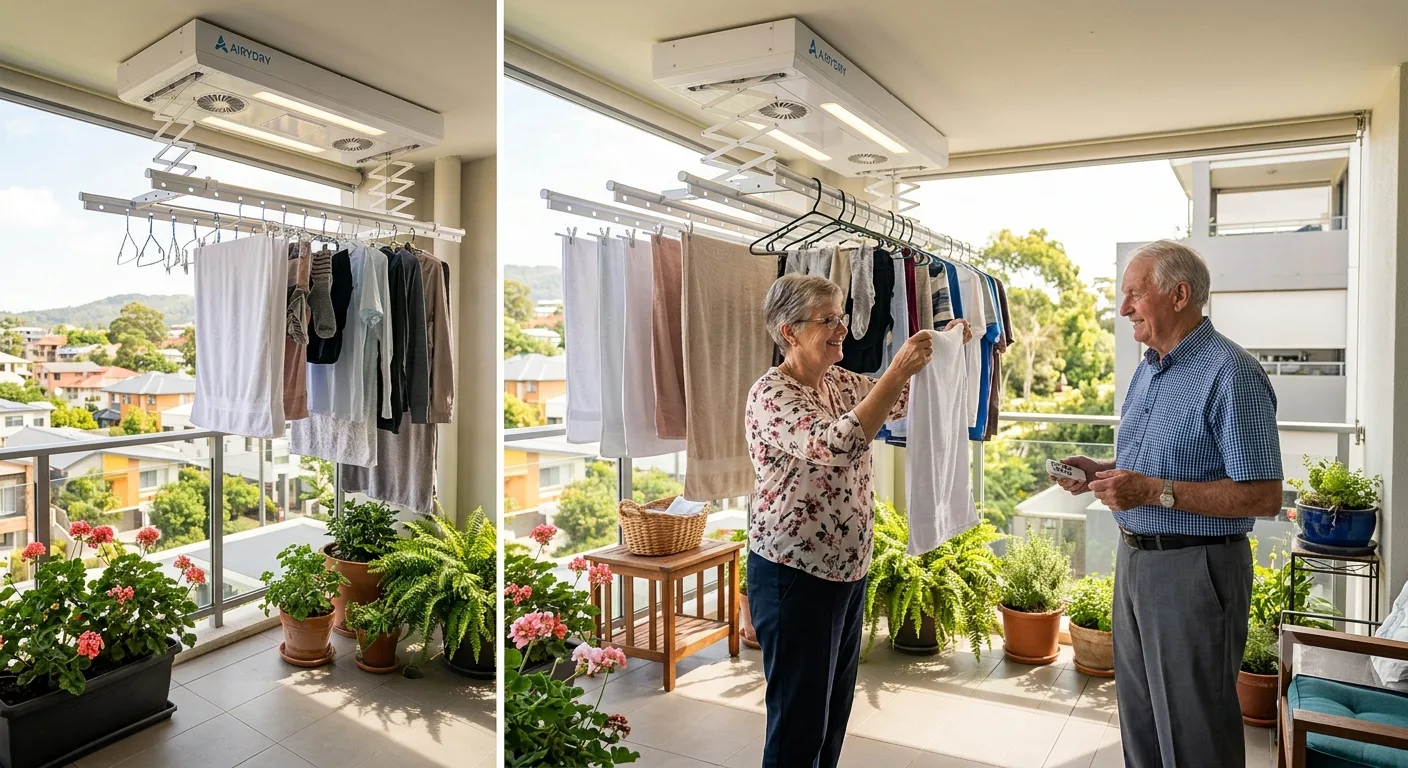
Adult children furnishing a home for ageing parents in Singapore often focus on the obvious accessibility features first: grab bars, non-slip flooring, and lever-style door handles. Laundry handling gets overlooked far more often, despite being one of the more physically demanding routine tasks in daily household life for someone with reduced mobility or strength.
Traditional manual laundry racks require repeatedly reaching overhead, sometimes on tiptoe or with a step stool, to hang and retrieve items from a fixed pole height. For an elderly person with joint pain, reduced upper body strength, or balance concerns, this is a genuinely risky repeated motion, not a minor inconvenience. Falls related to reaching for household tasks are a well-documented concern in elderly care generally, and a laundry rack requiring a stool or repeated overhead reaching is a specific, avoidable version of that risk.
Automated systems remove the physical strain entirely by lowering the rack to a comfortable height for hanging and retrieving laundry, then raising it back up once done. This single change, being able to hang and collect laundry at waist or chest height rather than reaching overhead, is often the single biggest quality-of-life improvement adult children notice after installing one for a parent, more so than the drying speed benefits that get marketed to younger buyers.
Control simplicity matters more here than it does for a younger, tech-comfortable household. A straightforward remote control with large, clearly labelled buttons tends to work better for elderly users than an app-based system requiring a smartphone, an account setup, and a stable wifi connection to operate. This is worth discussing directly with a supplier, since the more heavily marketed app-controlled premium models are not automatically the best choice here, and a simpler remote-only model may actually serve an elderly parent's needs better.
Safety features become more important, not less, in this context. Obstacle detection that stops the rack from continuing to lower if it senses resistance protects against an elderly user who may be slower to move out of the way or less able to react quickly than a younger household member. This is worth explicitly confirming with a supplier as a specific requirement, rather than assuming every model has equivalent sensitivity.
There is also a maintenance consideration worth thinking through. An elderly parent living independently may not be able to easily maintain a rack themselves, so it is worth asking about the actual maintenance requirements of a given model before installing one, and considering whether periodic servicing arranged in advance makes more sense than assuming ad hoc maintenance calls when something goes wrong.
For families considering this for a parent's home, it is worth treating the conversation the same way as any other accessibility upgrade discussion, focusing on ease of use and safety features first, and drying performance and smart features second. GoodLiving's the compact Platinum Mini 2.0, sized for smaller service yards common in older HDB flats where many elderly Singaporeans still live, combines the ease-of-use benefit with a footprint suited to flats that were not built with modern appliance sizes in mind.