
Market Overview
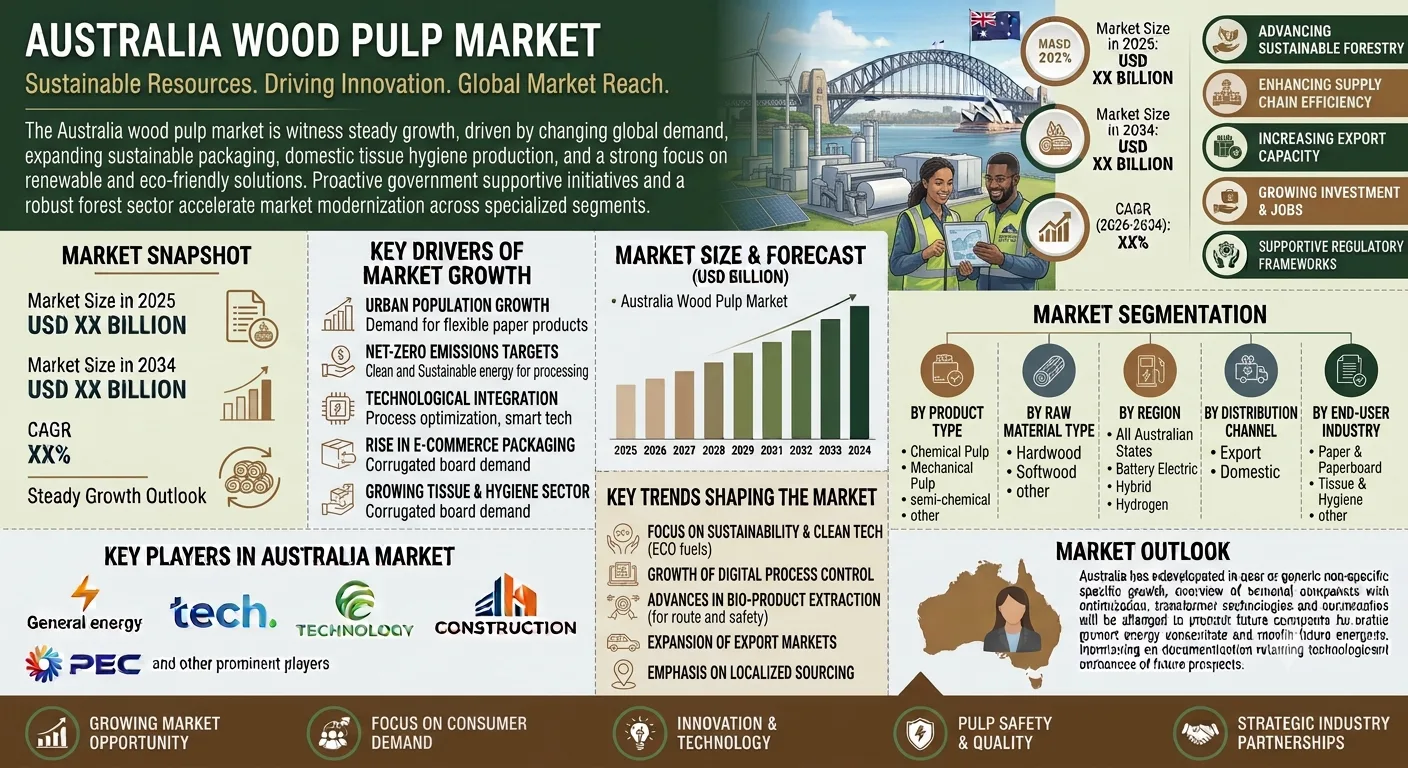
The Australia wood pulp market size reached USD 3.6 Billion in 2025. Looking forward, IMARC Group expects the market to reach USD 4.5 Billion by 2034, exhibiting a growth rate (CAGR) of 2.57% during 2026-2034. The rising demand for sustainable packaging, growth in hygiene product consumption, expansion of the paper-based publishing sector, government support for eco-friendly industries, and increasing exports, advancements in pulping technology, rising investments in forest plantation, and consumer preference for biodegradable materials are some of the major factors facilitating growth of the market.
This market is strategically important to Australia's forestry and manufacturing economy, supporting the country's position as a growing producer of sustainable fiber-based products. The Australia wood pulp market encompasses hardwood and softwood types across mechanical, chemical, semi-chemical, and other grades, serving packaging, paper, and other end-use industries across Australia Capital Territory & New South Wales, Victoria & Tasmania, Queensland, Northern Territory & Southern Australia, and Western Australia.
The Australia wood pulp market is poised for sustained expansion, underpinned by sustainable packaging trends, hygiene product demand, and regulatory support for eco-friendly materials. With a projected CAGR of 2.57% through 2034, the market presents significant opportunities for providers focusing on biodegradable packaging solutions, certified sustainable sourcing, advanced pulping technologies, and export market development.
AUSTRALIA WOOD PULP MARKET SUMMARY
The Australia wood pulp market encompasses the provision of wood-derived fiber materials produced through mechanical, chemical, and semi-chemical processes, serving as raw materials for paper, packaging, and hygiene products.
The ecosystem spans forestry operators, pulp manufacturers, packaging converters, paper producers, hygiene product manufacturers, and export distributors serving customers across packaging, paper, and industrial applications throughout Australia.
By Type, the market is segmented into Hardwood and Softwood.
By Grade, the market serves Mechanical, Chemical (dominating), Semi-Chemical, and Others.
By End Use Industry, the market serves Packaging (Food and Beverages, Pharmaceutical, Personal Care and Cosmetics, Automotive, Others), Paper (Newspaper, Books and Magazines, Tissues, Others), and Others.
By Region, the market serves Australia Capital Territory & New South Wales (dominating), Victoria & Tasmania, Queensland, Northern Territory & Southern Australia, and Western Australia.
Key trends shaping the market include transition toward sustainable and biodegradable packaging materials, expansion in hygiene product consumption, advancements in pulping technology, and growing demand for certified sustainable fiber sources.
PORTER'S FIVE FORCES ANALYSIS – AUSTRALIA WOOD PULP MARKET
Competitive Rivalry: Moderate. The market features competition among domestic pulp producers, international suppliers, and vertically integrated forestry companies. Competition centres on product quality, fiber characteristics, sustainability certifications, pricing, and supply reliability. Import competition from lower-cost producers affects domestic market dynamics. Business implication: Companies must differentiate through sustainable sourcing, product quality, and customer relationships.
Supplier Power (Forestry and Fiber Providers): Moderate to High. Manufacturers rely on forestry operations and timber suppliers for raw material inputs. Forest management practices, regulatory requirements, and sustainability certifications affect supply availability and cost. The shift toward certified sustainable sources is increasing dependency on compliant suppliers. Business implication: Vertical integration, long-term supply agreements, and sustainable forestry investments can reduce supply chain risks.
Buyer Power (Packaging, Paper, and Hygiene Manufacturers): High. Major packaging converters, paper producers, and hygiene product manufacturers leverage volume purchasing power to negotiate favorable terms. Buyers increasingly demand sustainability certifications, consistent quality, and reliable supply. Switching costs are moderate, with buyers able to source from alternative suppliers. Business implication: Providers must demonstrate value through quality consistency, sustainability credentials, and competitive pricing.
Threat of Substitutes: Moderate. Alternative fiber sources including recycled paper, agricultural residues, and non-wood fibers represent partial substitutes. Digital media reduces demand for newsprint and printing paper. However, wood pulp remains essential for many packaging and hygiene applications with limited practical substitutes. Business implication: Demonstrating superior fiber quality and sustainability credentials is essential.
Threat of New Entrants: Low to Moderate. Significant capital requirements for pulp mills, forestry operations, and environmental compliance create barriers. However, the growth of sustainable packaging and specialty fiber segments has enabled new entrants focused on innovative applications and certified sustainable sourcing. Business implication: Incumbents must leverage scale, forestry assets, and sustainability credentials while monitoring emerging specialty producers.
KEY ASPECTS REQUIRED FOR THE AUSTRALIA WOOD PULP MARKET
Market Performance: USD 3.6 Billion in 2025, projected to reach USD 4.5 Billion by 2034, driven by sustainable packaging, hygiene products, and regulatory support.
Market Outlook: A 2.57% CAGR through 2034 reflects steady growth led by softwood, chemical grade, packaging applications, and New South Wales regional dominance.
Growth Drivers: Rising demand for sustainable packaging; growth in hygiene product consumption; expansion of paper-based publishing sector; government support for eco-friendly industries; increasing exports; advancements in pulping technology; rising investments in forest plantation; consumer preference for biodegradable materials.
Competitive Landscape: A mix of domestic pulp producers, international suppliers, and vertically integrated forestry companies. Competition centres on product quality, sustainability certifications, and supply reliability.
Value Chain Analysis: From forestry operations and timber sourcing through pulping, processing, distribution, and conversion into packaging, paper, and hygiene products across domestic and export markets.
Industry Trends: Sustainable and biodegradable packaging materials; hygiene product expansion; advanced pulping technologies; certified sustainable sourcing; molded fiber packaging; recyclable containers; export market development.
Strategic Recommendations: Invest in sustainable forestry and certified fiber sourcing; expand production of biodegradable and molded fiber packaging materials; develop advanced pulping technologies for enhanced fiber properties; pursue FSC and PEFC certifications for premium market access; expand hygiene product pulp capabilities; develop export market partnerships; strengthen supply chain resilience through vertical integration; target high-growth packaging segments including food service and FMCG.
Request for Sample Report: https://www.imarcgroup.com/australia-wood-pulp-market/requestsample
MARKET GROWTH DRIVERS
Transition Toward Sustainable and Biodegradable Packaging Materials
The shift toward sustainable and biodegradable packaging solutions is contributing to the Australia wood pulp market growth. The transition to sustainable packaging in Australia is primarily driven by increasing environmental consciousness among consumers and the enforcement of regulatory frameworks aimed at phasing out single-use plastics. According to an industry report, Australia has set a national target of ensuring that 100% of packaging is reusable, recyclable, or compostable, with a progress rate of 86% recorded in the 2022–23 period. This shift is creating a favorable environment for the growth of the domestic wood pulp market, as wood pulp serves as a core raw material in the production of biodegradable and fiber-based packaging solutions. Moreover, industries such as fast-moving consumer goods (FMCG), retail, and food services are increasingly substituting conventional plastic packaging with pulp-based alternatives, including molded fiber products, paper wraps, and recyclable containers. Besides this, the implementation of favorable government initiatives is accelerating this transition. The policies are encouraging the adoption of wood pulp derived from certified and responsibly managed forest sources, with an increasing emphasis on certifications such as the Forest Stewardship Council (FSC) and the Programme for the Endorsement of Forest Certification (PEFC). Furthermore, advancements in pulp processing and forming technologies are enabling the development of packaging materials with enhanced strength, barrier properties, and moisture resistance, thereby expanding Australia wood pulp market share.
Expansion in Hygiene Product Consumption
The sustained increase in the consumption of hygiene products, including tissue papers, sanitary napkins, diapers, and adult incontinence solutions, is raising the market demand. The growing public health awareness and heightened emphasis on personal hygiene, particularly in the aftermath of the COVID-19 pandemic, further supports this trend. As per industry reports in 2023, Australia accounts for the sale of approximately 500 million disposable pads annually. Additionally, the market for toilet paper reflects steady expansion, with imports valued at USD 95.7 Million in 2023 and a projected volume growth rate of 1.8% by 2025. These developments underscore the increasing reliance on wood pulp, specifically fluff pulp, which is a fundamental raw material in the production of absorbent and hygiene-sensitive products. Moreover, Australia's demographic profile, marked by an aging population and increased urbanization, is strengthening the market. In addition, consumer preferences are shifting toward premium, ultra-soft, and dermatologically safe hygiene products, further driving the demand for high-quality pulp grades, which is creating a positive Australian wood pulp market outlook. Commercial sectors such as healthcare, hospitality, and food service are also major contributors to this demand growth. To meet these evolving market requirements, manufacturers are investing in process enhancements that ensure consistent fiber quality, hygiene compliance, and product performance.
Advancements in Pulping Technology
Ongoing advancements in pulping technology are enhancing the quality, efficiency, and sustainability of wood pulp production. Modern chemical pulping processes, including kraft pulping, are improving fiber strength and yield while reducing environmental impact. Emerging technologies including bio-refining and closed-loop systems are enabling more efficient resource utilization and reduced waste. Advanced bleaching technologies are minimizing chemical use while maintaining fiber quality. These technological improvements are enabling manufacturers to produce higher-quality pulp grades that meet the demanding requirements of packaging, hygiene, and specialty applications while reducing production costs and environmental footprint.
Rising Investments in Forest Plantation
Increasing investments in forest plantation are supporting the sustainable supply of wood fiber for pulp production. Australia's forestry sector is expanding plantation areas to meet growing demand for certified sustainable fiber. Investments in fast-growing species and improved silviculture practices are enhancing plantation productivity. Government support for forestry investment, including tax incentives and grant programs, is encouraging plantation expansion. These investments are improving supply security for pulp manufacturers while supporting rural economic development and environmental objectives.
Government Support for Eco-Friendly Industries
Government support for eco-friendly industries is accelerating the transition toward sustainable wood pulp production and consumption. The Australian government has set national packaging targets, including 100% reusable, recyclable, or compostable packaging by 2025, with a progress rate of 86% recorded in 2022-23. Regulatory frameworks aimed at phasing out single-use plastics are driving demand for fiber-based alternatives. Government support for sustainable forestry, including certification programs and plantation investment, is ensuring responsible fiber sourcing. These policy initiatives create a favorable environment for wood pulp market growth by promoting sustainable materials and reducing competition from conventional plastics.
Consumer Preference for Biodegradable Materials
Growing consumer preference for biodegradable materials is driving demand for wood pulp-based products across packaging, hygiene, and paper applications. Environmental awareness, combined with concerns about plastic pollution, is shifting consumer preferences toward natural, biodegradable alternatives. Retailers and brands are responding by adopting fiber-based packaging solutions that align with consumer values. This trend is particularly pronounced among younger consumers who prioritize sustainability in their purchasing decisions. The shift toward biodegradable materials is creating sustained demand growth for wood pulp across multiple end-use industries.
AUSTRALIA WOOD PULP MARKET SEGMENTATION
Segmentation analysis provides a detailed view of the Australia wood pulp market by category:
Type Insights: Softwood dominates the Australia wood pulp market, encompassing pulp derived from coniferous trees including pine, spruce, and fir. Softwood pulp is characterized by longer fibers, providing superior strength and tear resistance essential for packaging, paper, and tissue applications. The segment benefits from established forestry operations and strong demand from packaging and tissue producers. Hardwood represents a significant segment, encompassing pulp derived from deciduous trees including eucalyptus, acacia, and birch. Hardwood pulp features shorter fibers, providing smoothness, opacity, and printability ideal for printing and writing papers, as well as tissue products. The segment is growing as demand for premium tissue and specialty papers increases.
Grade Insights: Chemical grade dominates the Australia wood pulp market, encompassing kraft and sulfite pulping processes that produce high-quality pulp with strong fibers suitable for demanding applications. Chemical pulp is essential for packaging, tissue, and printing papers requiring strength and durability. Mechanical grade constitutes a significant segment, produced through grinding or refining processes that yield high fiber content and good opacity for newsprint and magazine papers. Semi-chemical grade represents a hybrid segment, combining mechanical and chemical processes to produce pulp with balanced properties for corrugated packaging and specialty applications. Other grades include dissolving pulp for specialty applications.
End Use Industry Insights: Packaging represents a significant end-use segment, including food and beverages, pharmaceutical, personal care and cosmetics, automotive, and other packaging applications. The segment benefits from the shift toward sustainable, fiber-based packaging solutions that replace single-use plastics. Molded fiber products, paper wraps, and recyclable containers are driving demand growth. Paper constitutes a major end-use segment, encompassing newspaper, books and magazines, tissues, and other paper products. Tissue represents a growing sub-segment, driven by hygiene product demand and premium tissue preferences. Newspaper and books and magazines represent mature segments affected by digital media trends. Other end uses include specialty papers, construction materials, and industrial applications.
Regional Insights: Australia Capital Territory & New South Wales represent a significant regional market, driven by concentration of packaging manufacturers, paper producers, and hygiene product companies. Sydney's role as a major distribution hub and concentration of FMCG companies supports wood pulp demand. Victoria & Tasmania constitute a major regional market, with established forestry operations, pulp mills, and paper producers. Tasmania's forestry sector and Victoria's manufacturing base support wood pulp production and consumption. Queensland represents a growing market, with forestry operations and expanding packaging manufacturing supporting demand. Northern Territory & Southern Australia collectively contribute to the market, with forestry operations and regional manufacturing supporting wood pulp demand. Western Australia is a significant market, with forestry operations and packaging manufacturers supporting demand.
COMPETITIVE LANDSCAPE
The competitive landscape of the Australia wood pulp market features a mix of domestic pulp producers, international suppliers, and vertically integrated forestry companies competing across product categories and end-use industries. Competition centres on product quality, fiber characteristics, sustainability certifications, pricing, and supply reliability. Major players include domestic pulp manufacturers, international pulp suppliers serving the Australian market, and vertically integrated forestry companies with pulp production capabilities.
Major players include domestic pulp producers, international suppliers, and vertically integrated forestry companies. The market is characterized by the importance of sustainable sourcing certifications, long-term supply relationships, and quality consistency for serving packaging, paper, and hygiene customers.
Recent Developments:
2026: The Australia wood pulp market continued its growth trajectory from USD 3.6 Billion in 2025 toward USD 4.5 Billion by 2034 at a CAGR of 2.57%.
2024-25: Australia continued progress toward national packaging targets, with 86% of packaging reusable, recyclable, or compostable.
2023: Australia accounted for the sale of approximately 500 million disposable pads annually, supporting fluff pulp demand.
Investment opportunities exist in sustainable packaging materials, molded fiber products, hygiene pulp capabilities, and certified sustainable sourcing.
REGIONAL ANALYSIS
Australia Capital Territory & New South Wales represent a significant regional market within the Australia wood pulp sector, driven by concentration of packaging manufacturers, paper producers, and hygiene product companies. Sydney's role as a major distribution hub and concentration of FMCG companies supports wood pulp demand. The region benefits from established manufacturing infrastructure, port access for imports, and a large consumer market.
Victoria & Tasmania constitute a major regional market, with established forestry operations, pulp mills, and paper producers. Tasmania's forestry sector and Victoria's manufacturing base support wood pulp production and consumption. The region benefits from sustainable forestry practices and certification programs that ensure responsible fiber sourcing.
Queensland represents a growing market, with forestry operations and expanding packaging manufacturing supporting demand. The state's forestry plantations and growing manufacturing sector support wood pulp demand, particularly for packaging applications.
Northern Territory & Southern Australia collectively contribute to the market, with forestry operations and regional manufacturing supporting wood pulp demand. Southern Australia's forestry plantations and paper manufacturing support market activity, while the Northern Territory's limited forestry operations serve regional demand.
Western Australia is a significant market, with forestry operations and packaging manufacturers supporting demand. The state's plantation forestry and growing packaging sector support wood pulp demand, particularly for export-oriented packaging applications.
RECENT INDUSTRY DEVELOPMENTS
2026 Activity: The Australia wood pulp market continued its growth trajectory from USD 3.6 Billion in 2025 toward USD 4.5 Billion by 2034 at a CAGR of 2.57%.
2024-25: Australia continued progress toward national packaging targets, with 86% of packaging reusable, recyclable, or compostable.
2023: Australia accounted for the sale of approximately 500 million disposable pads annually, supporting fluff pulp demand.
FREQUENTLY ASKED QUESTIONS
Q1: What is the current size of the Australia wood pulp market?
A: The Australia wood pulp market reached USD 3.6 Billion in 2025 and is projected to reach USD 4.5 Billion by 2034, exhibiting a CAGR of 2.57% from 2026-2034.
Q2: What are the key drivers of the Australia wood pulp market?
A: The market is driven by: (i) rising demand for sustainable packaging; (ii) growth in hygiene product consumption; (iii) expansion of paper-based publishing sector; (iv) government support for eco-friendly industries; (v) increasing exports; (vi) advancements in pulping technology; (vii) rising investments in forest plantation; and (viii) consumer preference for biodegradable materials.
Q3: What are the major types in the Australia wood pulp market?
A: Major types include Hardwood and Softwood.
Q4: What are the major grades in the Australia wood pulp market?
A: Major grades include Mechanical, Chemical (dominating), Semi-Chemical, and Others.
Q5: What are the major end-use industries in the Australia wood pulp market?
A: Major end-use industries include Packaging (Food and Beverages, Pharmaceutical, Personal Care and Cosmetics, Automotive, Others), Paper (Newspaper, Books and Magazines, Tissues, Others), and Others.
Q6: Which region leads the Australia wood pulp market?
A: Australia Capital Territory & New South Wales represent a significant regional market, driven by concentration of packaging manufacturers, paper producers, and hygiene product companies.
Q7: Who are the major players in the Australia wood pulp market?
A: Major players include domestic pulp producers, international suppliers, and vertically integrated forestry companies serving the Australian market.
Q8: What are the challenges facing the Australia wood pulp market?
A: Key challenges include import competition from lower-cost producers, raw material price volatility, environmental compliance costs, and competition from alternative materials including recycled fiber and non-wood fibers.
Q9: What is the outlook for the Australia wood pulp market?
A: The market is projected to grow at a 2.57% CAGR through 2034, with growth driven by sustainable packaging trends, hygiene product demand, and regulatory support for eco-friendly materials. The shift toward biodegradable packaging, molded fiber products, and certified sustainable sourcing are expected to shape the market's evolution.
Note: If you need any specific information that is not covered currently within the scope of the report, we will provide the same as a part of customization.
https://www.imarcgroup.com/request?type=report&id=32387&flag=E
Report Format, Delivery, and Customization Details
Report Format Mode: PPT, PDF, and Excel
Report Delivery Mode: Online Delivery, Physical Delivery
Report Delivery Time: Report Delivered Over Email within 24 to 48 hours. If requested by the client, a physical copy will be delivered within three to ten days.
Report Confirmation Mode: Yes via Email
Report Customization Mode: Yes via Email / Call
Report Table of Content: Yes
Report List of Figures: Yes
Report Methodology Mode: Yes
Request For Sample Report: Yes