
Market Overview
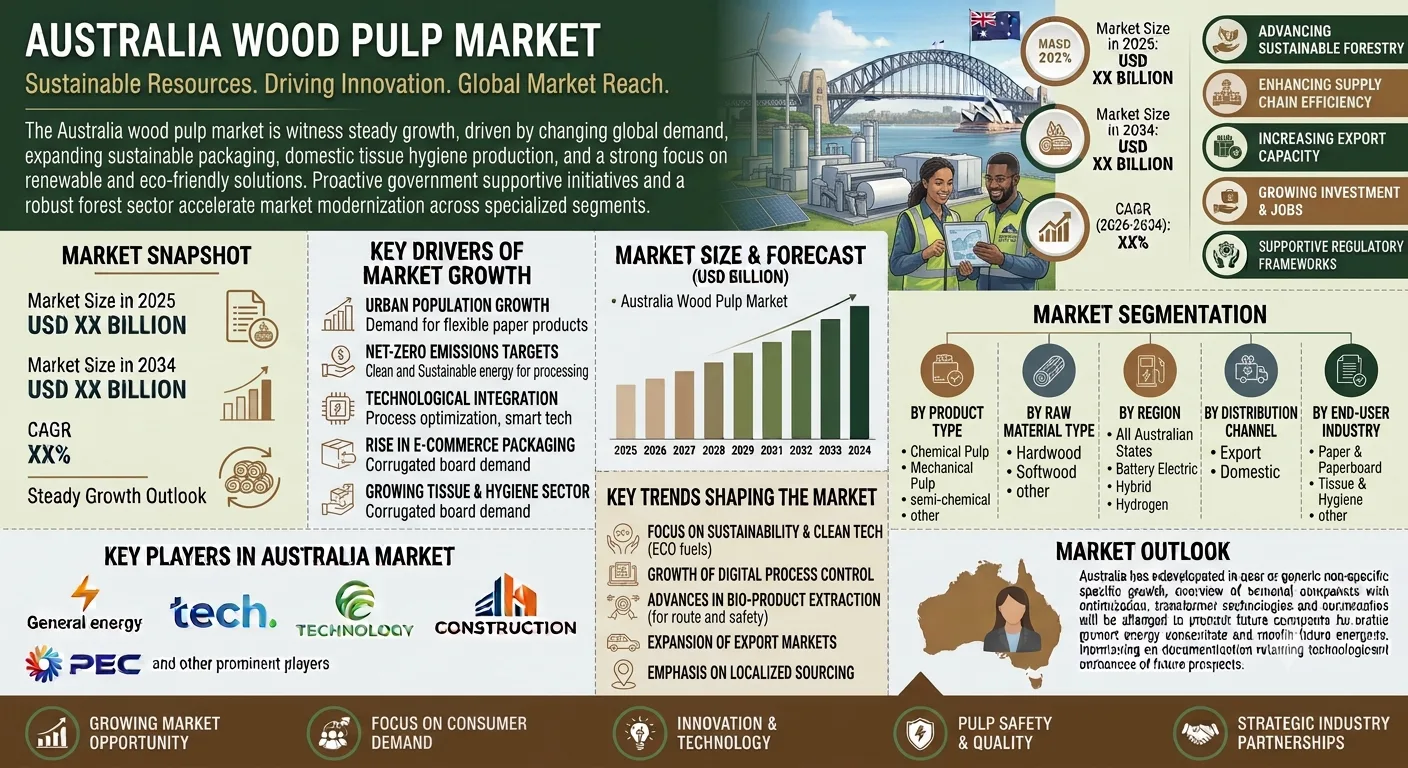
The Australia wood pulp market size reached USD 3.6 Billion in 2025 and is projected to reach USD 4.5 Billion by 2034, growing at a compound annual growth rate (CAGR) of 2.57% from 2026 to 2034. Growth is being supported by rising demand for sustainable packaging, expanding hygiene product consumption, growth in paper-based publishing, government support for eco-friendly industries, and increasing exports. Advancements in pulping technology, growing investment in forest plantations, and consumer preference for biodegradable materials are further reinforcing the Australia wood pulp market share as the country balances its role as both a domestic manufacturing input source and a forestry export economy.
Request a Sample Report for In-Depth Market Insights:
https://www.imarcgroup.com/australia-wood-pulp-market/requestsample
Australia Wood Pulp Market Summary
- The Australia wood pulp market covers hardwood and softwood pulp produced through mechanical, chemical, semi-chemical, and other processing methods.
- Wood pulp is valued as a foundational raw material for packaging, paper, and hygiene products, and is used across food and beverage, pharmaceutical, personal care, automotive, publishing, and tissue applications.
- The ecosystem includes forest plantation operators, pulp mills, paper and packaging manufacturers, hygiene product producers, and end-use industries.
- Major segments identified in the market include type (hardwood, softwood), grade (mechanical, chemical, semi-chemical, others), end use industry (packaging, paper, others), and region (Australia Capital Territory & New South Wales, Victoria & Tasmania, Queensland, Northern Territory & Southern Australia, Western Australia).
- The market is benefiting from the shift toward sustainable and biodegradable packaging, alongside sustained growth in hygiene product consumption.
- Government sustainability targets, forest certification standards, and processing technology advancements are reinforcing long-term demand for responsibly sourced pulp.
PORTER'S FIVE FORCES ANALYSIS -- AUSTRALIA WOOD PULP MARKET
Bargaining Power of Suppliers -- Moderate
- Wood pulp inputs depend on forest plantation operators, timber growers, and certified sustainable forestry programs.
- Certified, responsibly managed forest sources carry increasing importance given regulatory and consumer pressure, giving certified suppliers moderate leverage over buyers seeking FSC- or PEFC-certified pulp.
- Weather variability, land availability, and plantation cycle times constrain how quickly supply can expand, giving established forestry operators some pricing power.
- Domestic pulp mill capacity and the availability of imported pulp both moderate the leverage any single supplier can exercise.
Bargaining Power of Buyers -- Moderate
- Large packaging, paper, and hygiene product manufacturers that purchase pulp in bulk can negotiate favorable terms given their purchasing volume.
- Buyers increasingly favor certified sustainable pulp, which narrows their pool of acceptable suppliers and moderates their negotiating leverage somewhat.
- Smaller converters and manufacturers have comparatively less bargaining power given lower purchase volumes.
- Rising demand for pulp-based packaging alternatives gives buyers in the FMCG and retail sectors an incentive to secure reliable long-term supply agreements.
Threat of New Entrants -- Low
- Establishing pulp production capacity requires significant capital investment in mills, processing equipment, and long-term forest plantation access.
- Long plantation growth cycles mean new entrants face a multi-year lead time before establishing a reliable domestic fiber supply.
- Existing certification requirements and established buyer relationships with certified suppliers further raise the bar for new entrants.
- Import competition offers an alternative route to market entry without requiring domestic plantation investment, though it comes with its own logistics and tariff considerations.
Threat of Substitutes -- Moderate
- Recycled fiber and paper represent a significant substitute for virgin wood pulp, particularly in packaging and tissue applications.
- Alternative plant-based fibers, such as bagasse or bamboo pulp, are gaining some traction as sustainable packaging alternatives.
- Plastic-based packaging remains a substitute in some applications, though regulatory pressure to phase out single-use plastics is reducing its competitiveness relative to pulp-based materials.
- The push toward biodegradable and compostable materials generally favors wood pulp over non-fiber substitutes, tempering the overall substitution threat.
Competitive Rivalry -- Moderate
- The market includes domestic pulp producers, importers, and paper and packaging manufacturers with varying degrees of vertical integration.
- Competition centers on fiber quality, certification credentials, and the ability to supply consistent volumes to packaging and hygiene product manufacturers.
- Advancements in pulping technology that improve strength, barrier properties, and moisture resistance are becoming an important competitive differentiator.
- Growing demand for sustainable packaging is intensifying competition among suppliers seeking to position themselves as the preferred certified pulp source for FMCG and retail customers.
MARKET GROWTH DRIVERS
Transition Toward Sustainable and Biodegradable Packaging Materials
Rising environmental awareness among Australian consumers, combined with regulatory efforts to phase out single-use plastics, is driving strong momentum toward pulp-based packaging. Australia has set a national target for all packaging to be reusable, recyclable, or compostable, with progress already exceeding four-fifths of that goal in the 2022-23 period. Wood pulp serves as a core input for biodegradable and fiber-based packaging, and industries including FMCG, retail, and food service are increasingly substituting conventional plastic packaging with molded fiber products, paper wraps, and recyclable containers. Government policy is reinforcing this shift by encouraging pulp sourced from certified, responsibly managed forests, with growing emphasis on Forest Stewardship Council and Programme for the Endorsement of Forest Certification standards, while advancements in pulp processing are enabling packaging materials with improved strength and moisture resistance.
Expansion in Hygiene Product Consumption
Sustained growth in the consumption of tissue paper, sanitary products, diapers, and adult incontinence products is reinforcing demand for wood pulp, particularly fluff pulp used in absorbent hygiene applications. Heightened public health awareness following the COVID-19 pandemic has reinforced this trend, with Australia's disposable pad sales running into the hundreds of millions annually and toilet paper imports continuing to grow in value. An aging population, rising urbanization, and consumer preference for premium, ultra-soft hygiene products are further strengthening demand for higher-quality pulp grades, with healthcare, hospitality, and food service sectors also contributing to overall growth.
AUSTRALIA WOOD PULP MARKET OPPORTUNITIES
Growth in Certified Sustainable Forestry Supply Chains
As buyers increasingly prioritize certified pulp sources, producers that expand FSC- and PEFC-certified plantation capacity stand to capture a growing share of demand from packaging and hygiene manufacturers seeking to meet sustainability commitments.
Expansion of Molded Fiber and Fiber-Based Packaging Applications
Rising retail and FMCG demand for plastic alternatives creates opportunities for pulp producers and converters to expand into higher-value molded fiber products, recyclable containers, and specialty paper wraps designed for food and consumer goods applications.
Export Market Development
Australia's forestry base and processing capacity offer opportunities to expand pulp exports to Asia-Pacific markets with growing packaging and hygiene product demand, particularly as regional buyers seek certified, sustainably sourced fiber.
AUSTRALIA WOOD PULP MARKET CHALLENGES
Plantation Supply Constraints
Long forest growth cycles and limited land availability constrain how quickly domestic pulp supply can scale to meet rising demand, creating potential supply-demand imbalances during periods of rapid packaging or hygiene product growth.
Competition from Recycled and Alternative Fibers
Growing use of recycled paper fiber and alternative plant-based pulps in packaging applications creates competitive pressure on virgin wood pulp producers, particularly in cost-sensitive segments of the packaging market.
Input Cost and Processing Investment Requirements
Advancing pulping technology to meet rising quality and sustainability expectations requires ongoing capital investment, which can be a barrier for smaller producers competing against larger, more vertically integrated players.
AUSTRALIA WOOD PULP MARKET SEGMENTATION
Type Insights:
- Hardwood
- Softwood
Grade Insights:
- Mechanical
- Chemical
- Semi-Chemical
- Others
End Use Industry Insights:
- Packaging (Food and Beverages, Pharmaceutical, Personal Care and Cosmetics, Automotive, Others)
- Paper (Newspaper, Books and Magazines, Tissues, Others)
- Others
Regional Insights:
- Australia Capital Territory & New South Wales
- Victoria & Tasmania
- Queensland
- Northern Territory & Southern Australia
- Western Australia
COMPETITIVE LANDSCAPE
The Australia wood pulp market features a competitive landscape spanning domestic pulp producers, forest plantation operators, and paper and packaging manufacturers with varying degrees of vertical integration. Competitive positioning centers on fiber quality, sustainable forestry certification, and the ability to supply consistent volumes to packaging and hygiene product manufacturers navigating a rapidly evolving regulatory and consumer sustainability landscape.
REGIONAL ANALYSIS
Australia Capital Territory & New South Wales:
This region benefits from a strong concentration of paper and packaging manufacturing, supporting steady demand for both hardwood and softwood pulp inputs.
Victoria & Tasmania:
Tasmania's forestry industry plays a significant role in Australia's pulp supply chain, supported by established plantation forestry, while Victoria's manufacturing base drives demand for packaging and paper applications.
Queensland:
Queensland's forestry plantations and growing packaging manufacturing sector support both pulp production and consumption, particularly in food and beverage packaging applications.
Northern Territory & Southern Australia:
These regions represent a smaller share of the market, with demand tied to regional packaging and hygiene product distribution rather than large-scale pulp production.
Western Australia:
Western Australia's forestry base and export infrastructure support pulp supply, with growing regional demand for sustainable packaging inputs supporting continued market development.
Speak to an analyst:
https://www.imarcgroup.com/request?type=report&id=32387&flag=C
Report Format, Delivery, and Customization Details
- Report Format Mode: PDF and Excel
- Report Delivery Mode: Online Delivery, Physical Delivery
- Report Delivery Time: Report Delivered Over Email within 24 to 48 hours. If requested by the client, a physical copy will be delivered within three to ten days.
- Report Confirmation Mode: Yes via Email
- Report Customization Mode: Yes via Email / Call
- Report Table of Content: Yes
- Report List of Figures: Yes
- Report Methodology Mode: Yes
- Request For Sample Report: Yes