
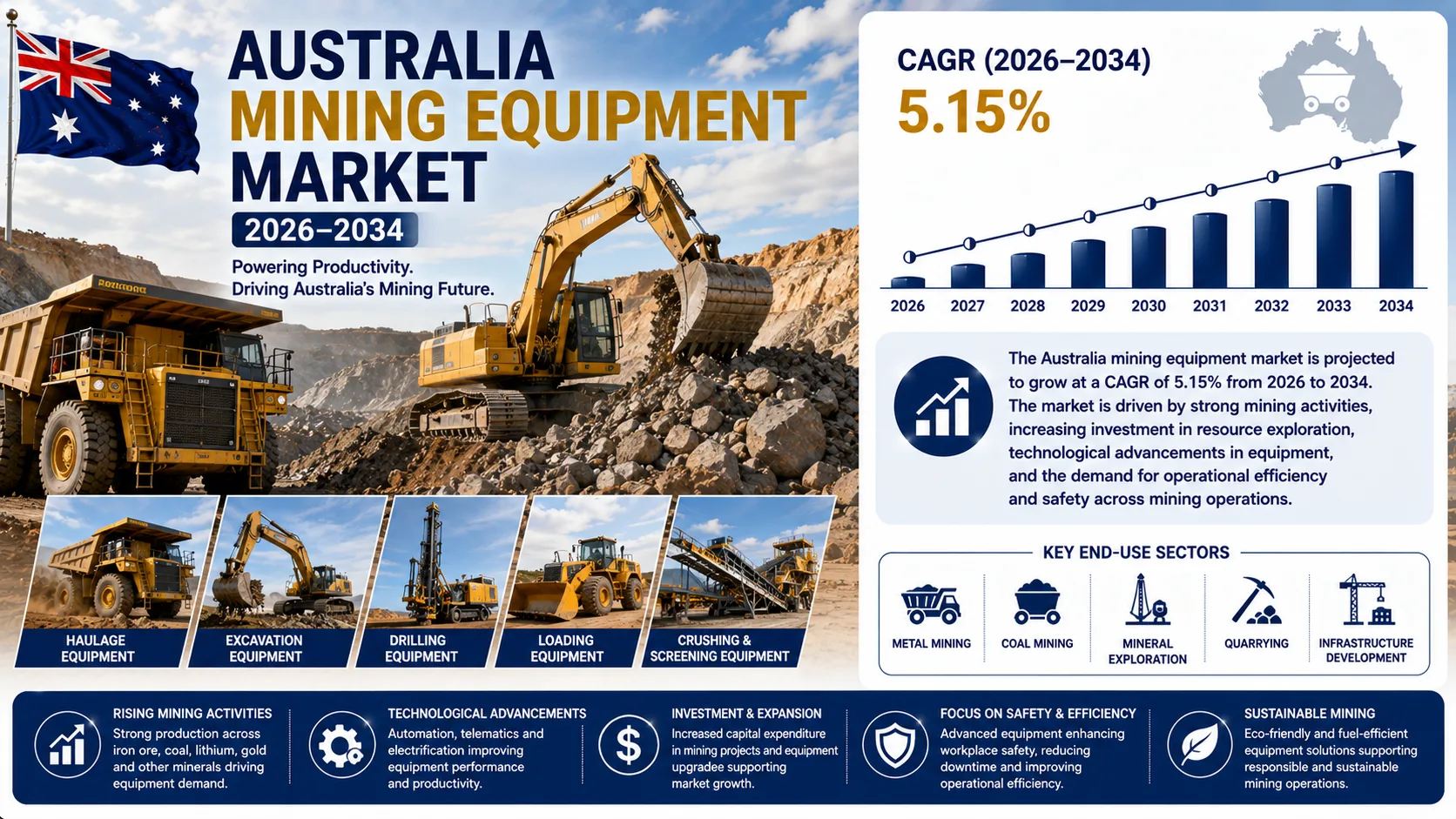
The Australia mining equipment market size reached USD 1.5 Billion in 2025 and is projected to reach USD 2.3 Billion by 2034, exhibiting a CAGR of 5.15% during 2026-2034. Some of the factors driving the market's growth include the growing need for sustainable mining methods, the growing emphasis on worker health and safety, and the growing usage of automated and remotely managed machinery to improve operations' efficiency, safety, and cost-effectiveness. In 2024, Scania launched its autonomous mining trucks, beginning with a 40-ton edition and later introducing a 50-ton model for sale, with sales starting in Australia first.
Request a Sample Report for In-Depth Market Insights: https://www.imarcgroup.com/australia-mining-equipment-market/requestsample
Australia Mining Equipment Market Summary
- The Australia mining equipment market encompasses various types including excavators, loaders, dozers, motor graders, and dump trucks, serving underground mining, surface mining, and crushing applications.
- These products are valued for their role in enabling efficient, safe, and sustainable extraction and processing of minerals including metals, minerals, and coal.
- The ecosystem includes mining equipment manufacturers, technology providers, mining companies, government agencies, and service providers.
- Major segments identified in the market include type (excavators, loaders, dozers, etc.), equipment (underground mining, surface mining, crushing), application (metal mining, mineral mining, coal mining), and region.
- The market is benefiting from technological advancements and automation, a growing focus on sustainable mining practices, and rising focus on safety and workforce health.
- In 2023, AngloGold Ashanti Australia started testing Sandvik's TH665B, the biggest battery-powered mining truck, at its Sunrise Dam gold mine in Western Australia.
PORTER'S FIVE FORCES ANALYSIS
- Competitive Rivalry: High, with numerous global and regional equipment manufacturers competing on technology, reliability, and cost. Business implication: Companies must differentiate through innovation, automation, and sustainability.
- Supplier Power (Components and Materials): Moderate. Suppliers of critical components have some leverage, but the presence of multiple global suppliers and the ability of large manufacturers to secure long-term contracts moderates this power. Business implication: Manufacturers should maintain diverse supplier relationships.
- Buyer Power (Mining Companies): High. Large mining companies have significant bargaining power through volume purchasing and long-term contracts, demanding advanced technology and competitive pricing. Business implication: Providers must focus on technology leadership, reliability, and after-sales support.
- Threat of Substitutes: Low. While alternative extraction methods exist, mining equipment remains essential for large-scale mineral extraction. Business implication: The industry should emphasize the efficiency and safety benefits of advanced equipment.
- Threat of New Entrants: Moderate. Higher barriers for established manufacturers (scale, technology, brand), but lower barriers for niche and specialized equipment providers. Business implication: Established players should build defensible positions through innovation, reliability, and service networks.
MARKET GROWTH DRIVERS
Technological Advancements and Automation
Automated and remote-controlled equipment is being used by mining firms in Australia to increase operational efficiency, safety, and cost effectiveness. Innovations such as drones for surveys, autonomous haul trucks, and advanced drilling equipment allow for continuous operations with little human intervention, reducing labor costs and improving safety. Predictive maintenance, enabled by AI and IoT, increases equipment efficiency and decreases downtime. In 2024, Scania launched its autonomous mining trucks, beginning with a 40-ton edition for sale in Australia starting 2026.
Growing Focus on Sustainable Mining Practices
Mining firms are implementing sustainable practices and technology as a result of their realization of the environmental impact of their activities. Equipment manufacturers are developing energy-efficient devices that produce fewer emissions and lessen environmental damage, including hybrid and electric mining vehicles. In 2023, AngloGold Ashanti Australia started testing Sandvik's TH665B, the biggest battery-powered mining truck at its Sunrise Dam gold mine, providing zero emissions and substantial heat reduction.
Rising Focus on Safety and Workforce Health
Mining operations are inherently hazardous, and there is pressure from both regulators and the public to ensure safer working conditions. This encourages investment in equipment that minimizes human exposure to dangerous environments, such as remote-controlled machinery, PPE, and advanced ventilation systems. Wearable technologies that monitor the health and safety of miners in real-time are becoming more prevalent. In 2024, EACON Mining and MACA showcased their electrification and autonomous driving technology projects at the Electric Mining 2024 expo in Perth.
AUSTRALIA MINING EQUIPMENT MARKET SEGMENTATION
Type Insights:
- Excavators
- Loaders
- Dozers
- Motor Graders
- Dump Trucks
- Others
Equipment Insights:
- Underground Mining
- Surface Mining
- Crushing, Pulverizing and Screening
- Drills and Breakers
- Others
Application Insights:
- Metal Mining
- Mineral Mining
- Coal Mining
Regional Insights:
- Australia Capital Territory & New South Wales
- Victoria & Tasmania
- Queensland
- Northern Territory & Southern Australia
- Western Australia
COMPETITIVE LANDSCAPE
The Australia mining equipment market features a competitive landscape of global and regional equipment manufacturers competing on technology, reliability, and cost. Competition is intensifying as companies invest in automation, sustainability, and service networks. Differentiation occurs through innovation, automation, and after-sales support.
Key players mentioned in the report context include:
- Scania (autonomous mining trucks)
- Sandvik (battery-powered mining truck)
- EACON Mining and MACA (electrification and autonomous driving)
- Gears Mining (mill liner handler)
- (Complete list provided in the full report)
REGIONAL ANALYSIS
- ACT & New South Wales: A key market driven by the state's rich coal and mineral deposits, strong infrastructure, and proximity to major ports for export. Sydney's financial hub also supports mining investment.
- Victoria: A significant market with growing mining activities, particularly in gold and mineral sands, supported by government policies promoting sustainable mining and technological adoption.
- Queensland: A major mining region with abundant coal and mineral resources, driving demand for heavy equipment for both surface and underground mining operations in Bowen Basin and other regions.
- Western Australia: The largest mining equipment market, driven by the state's vast iron ore, gold, and lithium resources. Perth's role as a mining services hub and the Pilbara region's large-scale operations drive significant equipment demand.
- NT & South Australia: Emerging markets with growing mining activities, particularly in gold, copper, and uranium. These regions are increasingly adopting advanced equipment for new projects and exploration.
RECENT INDUSTRY DEVELOPMENTS
August 2026: Australia’s mining equipment demand remains supported by strong mining investment, particularly in Western Australia. Investment in WA’s mining and petroleum industries reached a decade-high A$34 billion in 2025, while projects committed and under construction reached about A$55 billion by March 2026, supporting demand for heavy machinery, processing systems and related mining technologies.
August 2026: Mining equipment capital spending showed continued resilience. ABS data for the June 2026 quarter indicated that mining equipment and machinery investment increased 5.4%, partially offsetting declines in equipment spending across several other industries.
August 2026: Automation and robotics are becoming increasingly important across Australian mining operations. In March 2026, the Australian Government announced A$66 million for 27 robotics and automation projects, reinforcing the broader push toward autonomous systems, remote operations and advanced industrial technologies.
August 2026: Electrification is emerging as another major equipment trend. Western Australian mining research indicates that battery-supported electric mining vehicles can potentially reduce operating costs by 7–15%, energy costs by 30–50% and ventilation costs by about 40%, increasing interest in electric haulage and battery-powered underground machinery.
August 2026: Equipment manufacturers and mining operators are also focusing on precision mining, predictive maintenance and AI-enabled machinery. Current WA research includes AI-enhanced machine vision for automated mining robots, precision drilling systems and technologies designed to reduce mining waste and environmental impacts.
August 2026: Western Australia continues to represent a major center for mining equipment and Mining Equipment, Technology and Services (METS) activity. The state accounted for around 62% of Australia's mining and petroleum investment, highlighting its importance for equipment suppliers serving iron ore, lithium, gold, nickel and other mineral operations.
Key Aspects Required for the Australia Mining Equipment Market
- Market Performance: USD 1.5 Billion in 2025, with a projected trajectory to USD 2.3 Billion by 2034.
- Market Outlook: A 5.15% CAGR through 2034 indicates robust growth across types and applications, driven by automation, sustainability, and safety trends.
- Growth Drivers: Expansion of mining activities; government support and policies; rising infrastructure and construction projects; technological advancements and automation; growing focus on sustainable mining practices; and rising focus on safety and workforce health.
- Competitive Landscape: A competitive market with global and regional equipment manufacturers. Differentiation occurs through innovation, automation, and after-sales support.
- Value Chain Analysis: From component manufacturing and equipment assembly through distribution and maintenance to end-use in mining operations, with automation and sustainability shaping market dynamics.
- Industry Trends: Technological advancements and automation; growing focus on sustainable mining practices; rising focus on safety and workforce health; expansion of mining activities; and government support and policies.
- Strategic Recommendations: Invest in autonomous and remote-controlled equipment; develop electric and hybrid mining vehicles; focus on safety-enhancing technologies; expand into emerging mining regions; and leverage government incentives for sustainable equipment adoption.
Note: If you need any specific information that is not currently covered within the scope of the report, we will provide the same as a part of customization.
Speak to an analyst: https://www.imarcgroup.com/request?type=report&id=32565&flag=C
Report Format, Delivery, and Customization Details
- Report Format Mode: PDF and Excel (Editable version in PPT/Word format available on special request)
- Report Delivery Mode: Online Delivery, Physical Delivery
- Report Delivery Time: Report delivered over email within 24 to 48 hours. If requested by the client, a physical copy will be delivered within three to ten days.
- Report Confirmation Mode: Yes, via email
- Report Customization Mode: Yes, via Email / Call
- Report Table of Content: Yes
- Report List of Figures: Yes
- Report Methodology Mode: Yes
- Request For Sample Report: Yes
About Us
IMARC Group is a global management consulting firm that helps the world's most ambitious changemakers to create a lasting impact. The company provides a comprehensive suite of market entry and expansion services. IMARC offerings include thorough market assessment, feasibility studies, company incorporation assistance, factory setup support, regulatory approvals and licensing navigation, branding, marketing and sales strategies, competitive landscape and benchmarking analyses, pricing and cost research, and procurement research.
Contact Us
IMARC Group
134 N 4th St., Brooklyn, NY 11249, USA
Email: [email protected]
Tel No: (D) +91 120 433 0800
United States: +1-201-971-6302