
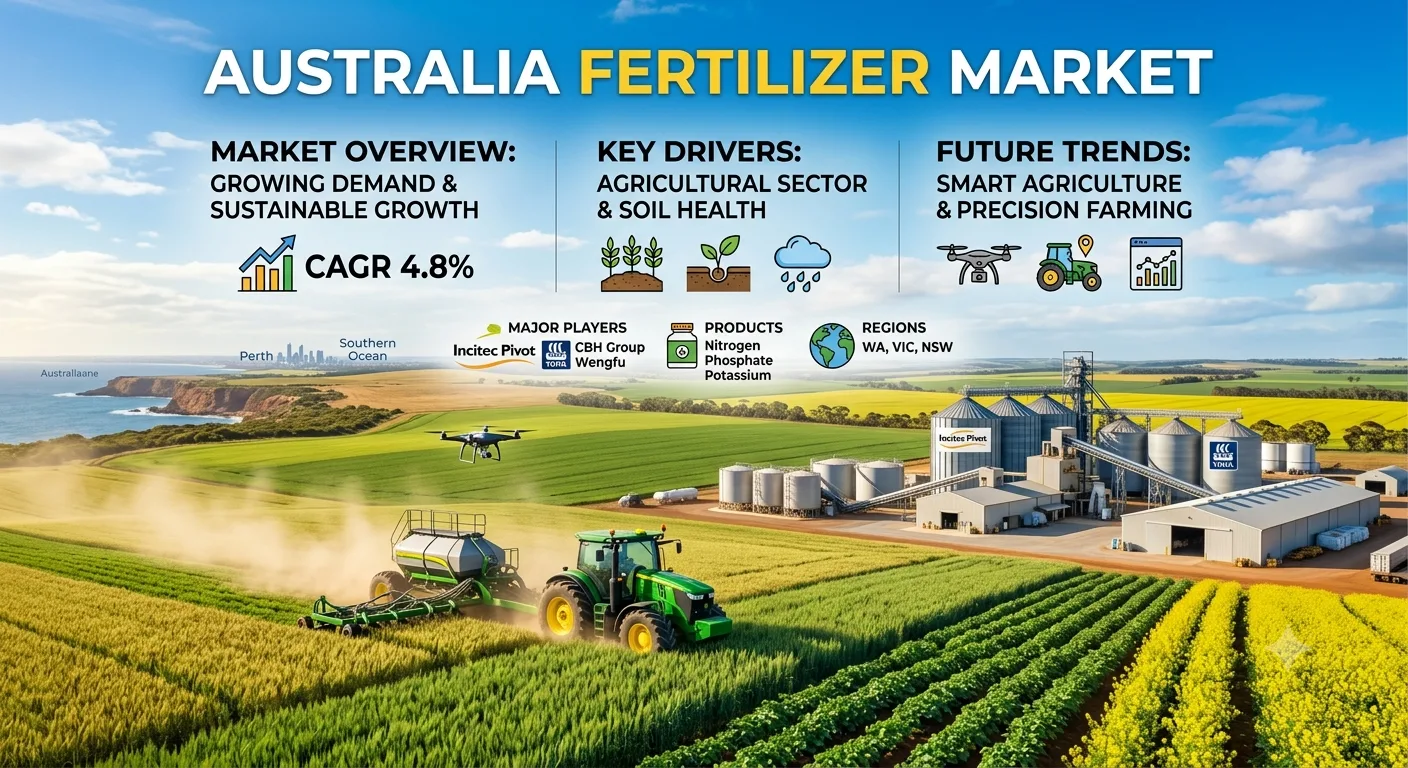
Market Overview
The Australia fertilizer market size reached USD 2.8 Billion in 2025 and is projected to reach USD 3.9 Billion by 2034, exhibiting a CAGR of 3.43% during 2026-2034. The growth of the Australia fertilizer market significantly boosts crop yields by providing essential nutrients that promote healthier, more productive plants. Fertilizers replenish vital soil nutrients, ensuring long-term soil fertility and reducing the need for extensive land use. Technological innovations are a key trend in the Australia fertilizer market, enhancing the efficiency of fertilizer products and application methods.
This market is strategically important to Australia's agricultural and export economy, supporting the nation's position as a major global food and fiber producer. Agriculture accounted for 2.7% of Australia's GDP and 2.2% of total employment in 2022-23, with 55% of Australia's land allocated for agricultural use. The Australian fertilizer market encompasses chemical fertilizers, biofertilizers, straight fertilizers, complex fertilizers, and specialty nutrient products used across grains, cereals, pulses, oilseeds, fruits, vegetables, and horticultural crops.
The Australia fertilizer market is poised for sustained expansion, underpinned by agricultural production growth, soil health imperatives, and the adoption of precision farming technologies. With a projected CAGR of 3.43% through 2034, the market presents significant opportunities for companies focusing on controlled-release fertilizers, organic and bio-based solutions, and digital agronomy platforms.
AUSTRALIA FERTILIZER MARKET SUMMARY
The Australia fertilizer market encompasses chemical fertilizers, biofertilizers, and specialty nutrient products used for crop production, horticulture, and soil improvement.
The ecosystem spans fertilizer manufacturers, importers and distributors, agricultural retailers, agronomists and advisors, and farming enterprises across Australia's diverse agricultural regions.
By Product Type, the market is segmented into Chemical Fertilizer and Biofertilizers.
By Product, the market covers Straight Fertilizers and Complex Fertilizers.
By Product Form, the market serves Dry and Liquid formulations.
By Crop Type, the market serves Grains and Cereals, Pulses and Oilseeds, Fruits and Vegetables, Flowers and Ornamentals, and Others.
By Region, the market serves New South Wales, Victoria, Queensland, Western Australia, South Australia, and other Australian states and territories.
Key trends shaping the market include precision farming and digital farming solutions, expansion of controlled-release and specialty fertilizers, and emerging demand for organic and bio-based fertilizer solutions.
PORTER'S FIVE FORCES ANALYSIS – AUSTRALIA FERTILIZER MARKET
Competitive Rivalry: High. The market features intense competition among global fertilizer majors and domestic producers. Business implication: Companies must differentiate through product innovation, sustainability credentials, and value-added services.
Supplier Power (Raw Materials and Imports): Moderate. Fertilizer manufacturers rely on suppliers of raw materials including natural gas, phosphate rock, and potash. Due to limited domestic manufacturing capacity, Australia depends significantly on imports to meet its agricultural needs. Business implication: Strategic supply agreements and vertical integration can reduce import dependency.
Buyer Power (Farmers and Agribusiness): Moderate. Australian farmers benefit from extensive choice across fertilizer brands, formulations, and suppliers. However, the essential nature of fertilizers for crop production and the technical expertise required for optimal application moderates buyer power. Business implication: Brands must invest in agronomic support, product quality, and customer education.
Threat of Substitutes: Low. Organic amendments and biofertilizers represent partial substitutes, but the productivity requirements of broadacre and export-oriented agriculture ensure strong and sustained demand for conventional fertilizers.
Threat of New Entrants: Moderate. Significant capital requirements for manufacturing, distribution networks, and brand building create barriers. However, the growing demand for organic and specialty fertilizers has enabled new entrants focused on sustainable nutrient solutions.
KEY ASPECTS REQUIRED FOR THE AUSTRALIA FERTILIZER MARKET
Market Performance: USD 2.8 Billion in 2025, projected to reach USD 3.9 Billion by 2034, driven by agricultural production growth and soil health imperatives.
Market Outlook: A 3.43% CAGR through 2034 reflects steady growth led by precision agriculture adoption, controlled-release fertilizer expansion, and organic fertilizer demand.
Growth Drivers: Growing agricultural production and crop diversification; soil health issues and nutrient deficiency; government support and climate resilience strategies; technological innovations in fertilizer products and application methods; rising demand for organic and bio-based fertilizers.
Competitive Landscape: Global fertilizer majors and domestic firms competing across product innovation, sustainability credentials, and value-added services.
Value Chain Analysis: From raw material sourcing and manufacturing through import and distribution to retail and on-farm application.
Industry Trends: Precision farming and digital farming solutions; controlled-release and specialty fertilizers; organic and bio-based fertilizer solutions; soil health and regenerative agriculture; micronutrient and customized nutrient blends.
Strategic Recommendations: Invest in controlled-release and specialty fertilizer development; expand organic and bio-based product portfolios; develop digital agronomy and precision application platforms; target horticulture and high-value crop segments; build strong distributor and advisor networks.
Request for Sample Report: https://www.imarcgroup.com/australia-fertilizer-market/requestsample
MARKET GROWTH DRIVERS
Government Support and Climate Resilience Strategies
In 2023, the Australian Government, through the Department of Agriculture, launched an initiative to encourage the use of environmentally friendly fertilizers, offering funding for farmers to adopt slow-release and organic options, helping reduce nutrient runoff into waterways and supporting Australia's environmental sustainability goals. The Australian Government's Natural Heritage Trust (NHT) launched a USD 302.1 million Climate-Smart Agriculture Program for 2023-24 to enhance sustainability, productivity, and competitiveness in agriculture.
Technological Innovations in Fertilizer Products and Application Methods
Technological innovations are a key trend in the Australia fertilizer market, enhancing the efficiency of fertilizer products and application methods. In October 2023, research by The Australian National University (ANU) highlighted that improved nutrient management could reduce fertilizer use by up to 20% without affecting crop yields, highlighting the potential of precision agriculture to optimise fertilizer efficiency. In June 2024, the Fertilizer Industry Federation of Australia (FIFA) introduced new guidelines to promote sustainable fertilizer use, focusing on nutrient efficiency and reduced environmental impact.
Growing Agricultural Production and Export Demand
Australia's agricultural sector continues to expand, driven by strong global demand for Australian grain, meat, dairy, and horticultural products. The fertilizer market contributes to the national economy by driving agricultural growth and enhancing export sectors. Fertilizers improve crop quality, increasing market value and reducing environmental impacts due to more efficient application methods.
AUSTRALIA FERTILIZER MARKET SEGMENTATION
Segmentation analysis provides a detailed view of the Australia fertilizer market by category:
Product Type Insights: Chemical Fertilizer – the dominant product type, encompassing synthetic nutrient formulations essential for broadacre cropping and export-oriented agriculture. Biofertilizers – the fastest-growing segment, driven by increasing farmer preferences for organic product variants.
Product Insights: Straight Fertilizers – single-nutrient formulations including nitrogen, phosphate, and potash fertilizers. Complex Fertilizers – multi-nutrient formulations offering balanced nutrition for specific crop and soil requirements.
Crop Type Insights: Grains and Cereals – the leading crop segment, with cereals such as wheat, barley, oats, canary, and triticale extensively harvested. Pulses and Oilseeds – including canola, chickpeas, and lentils. Fruits and Vegetables – high-value horticultural crops requiring specialist nutrient programs.
Regional Insights: Western Australia – the largest fertilizer consumption region. New South Wales – a major broadacre cropping and horticulture region. Victoria – high-value horticulture, viticulture, and dairy. Queensland – sugarcane, horticulture, and cropping. South Australia and Tasmania – emerging markets for organic and bio-based fertilizers.
COMPETITIVE LANDSCAPE
The competitive landscape of the Australia fertilizer market features intense competition among global fertilizer majors and prominent domestic firms.
Investment opportunities exist in controlled-release and specialty fertilizer development, organic and bio-based product portfolios, digital agronomy platforms, and sustainable nutrient solutions.
REGIONAL ANALYSIS
Western Australia represents the largest fertilizer consumption region, showing the highest fertilizer usage per hectare, mainly due to its vast cropping areas and poor soil fertility.
New South Wales is a major broadacre cropping and horticulture region, with extensive grain, pulse, and cotton production driving fertilizer demand.
Victoria features high-value horticulture, viticulture, and dairy production, with specialty fertilizers such as micronutrient mixtures specific to iron and zinc deficiencies becoming popular.
Queensland encompasses sugarcane, horticulture, and broadacre cropping, with controlled-release fertilizers particularly beneficial where there is a risk of nutrient leaching.
South Australia and Tasmania are emerging markets for organic and bio-based fertilizers, particularly in wine regions.
RECENT INDUSTRY DEVELOPMENTS
2025 Activity: The Australia fertilizer market continued its growth trajectory from USD 2.8 Billion in 2025 to USD 3.9 Billion by 2034 at a CAGR of 3.43%.
June 2024: The Fertilizer Industry Federation of Australia (FIFA) introduced new guidelines to promote sustainable fertilizer use.
October 2023: Research by The Australian National University highlighted that improved nutrient management could reduce fertilizer use by up to 20% without affecting crop yields.
2023 Activity: The Australian Government launched an initiative to encourage the use of environmentally friendly fertilizers, offering funding for farmers to adopt slow-release and organic options.
FREQUENTLY ASKED QUESTIONS
Q1: What is the current size of the Australia fertilizer market?
A: The Australia fertilizer market size reached USD 2.8 Billion in 2025 and is projected to reach USD 3.9 Billion by 2034, exhibiting a CAGR of 3.43% during 2026-2034.
Q2: What are the key drivers of the Australia fertilizer market?
A: The market is driven by: (i) growing agricultural production and crop diversification; (ii) soil health issues and nutrient deficiency; (iii) government support and climate resilience strategies; (iv) technological innovations in fertilizer products and application methods; and (v) rising demand for organic and bio-based fertilizers.
Q3: What are the major product types in the Australia fertilizer market?
A: Major product types include Chemical Fertilizer (dominant) and Biofertilizers (fastest-growing).
Q4: What is the contribution of agriculture to Australia's economy?
A: Agriculture accounted for 2.7% of Australia's GDP and 2.2% of total employment in 2022-23, with 55% of Australia's land allocated for agricultural use.
Q5: Which region leads the Australia fertilizer market?
A: Western Australia shows the highest fertilizer usage per hectare, mainly due to its vast cropping areas and poor soil fertility.
Note: If you need any specific information that is not covered currently within the scope of the report, we will provide the same as a part of customization.
https://www.imarcgroup.com/request?type=report&id=21966&flag=E
Report Format, Delivery, and Customization Details
Report Format Mode: PPT, PDF, and Excel
Report Delivery Mode: Online Delivery, Physical Delivery
Report Delivery Time: Report Delivered Over Email within 24 to 48 hours. If requested by the client, a physical copy will be delivered within three to ten days.
Report Confirmation Mode: Yes via Email
Report Customization Mode: Yes via Email / Call
Report Table of Content: Yes
Report List of Figures: Yes
Report Methodology Mode: Yes
Request For Sample Report: Yes