
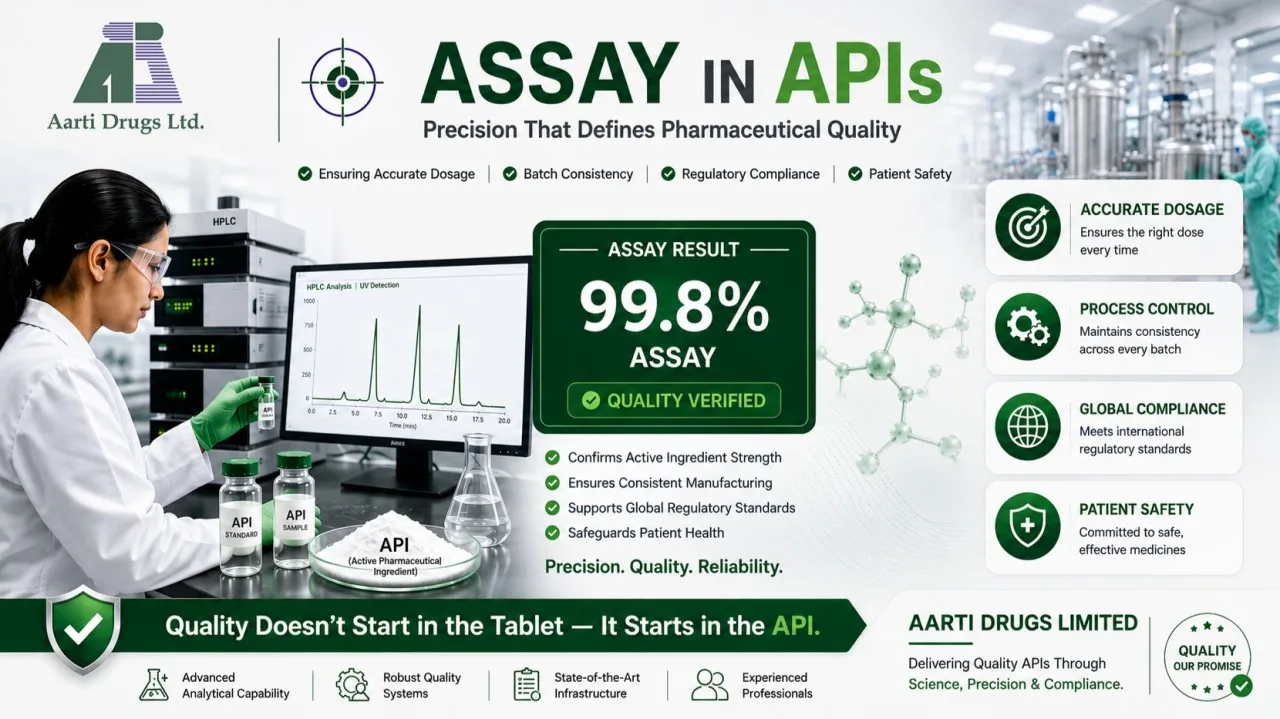
Understanding Assay in API Manufacturing: Why Every Percentage Matters
In pharmaceutical manufacturing, precision is not just a requirement—it is a responsibility. Every medicine that reaches a patient must be safe, effective, and consistent in quality. At the heart of every pharmaceutical product lies the Active Pharmaceutical Ingredient (API), the component responsible for delivering the intended therapeutic effect. Ensuring the accuracy of this ingredient is essential, and one of the most important quality parameters used to verify it is Assay.
What is Assay in Pharmaceuticals?
Assay is an analytical test used to determine the exact quantity of the active ingredient present in a drug substance or finished pharmaceutical product. Simply put, it answers a critical question: Does this API contain the correct amount of active drug as specified?
The result is typically expressed as a percentage of the labeled or theoretical amount. Maintaining the correct assay value is crucial because even small variations can affect the safety and efficacy of a medicine.
Why is Assay Important in API Manufacturing?
Assay plays a significant role in pharmaceutical quality assurance for several reasons:
Accurate Dosage
Patients depend on medicines to deliver precise therapeutic effects. Assay ensures that the API contains the intended amount of active ingredient, helping maintain accurate dosage levels.
Batch-to-Batch Consistency
Consistent assay results ensure uniform quality across different production batches, supporting reliable product performance.
Regulatory Compliance
Global regulatory agencies such as the USFDA, EMA, and other health authorities require strict adherence to assay specifications. Meeting these standards is essential for product approval and market distribution.
Patient Safety
Incorrect assay values can lead to under-dosing or overdosing, potentially reducing treatment effectiveness or increasing health risks.
Even a small variation of 1–2% can have a significant impact on the final product’s performance.
How is Assay Performed?
One of the most widely used techniques for assay determination is High-Performance Liquid Chromatography (HPLC). This advanced analytical method offers excellent precision, sensitivity, and reproducibility.
The process generally involves:
- Preparation of a standard solution
- Preparation of a sample solution
- Injection into the HPLC system
- Measurement of chromatographic peak areas
- Calculation of the API content
These steps help accurately quantify the active ingredient and verify compliance with quality specifications.
Assay: More Than Just a Test
Assay is not merely a laboratory measurement—it serves as an indicator of the overall manufacturing process. Reliable assay results reflect strong process control, product purity, API stability, and robust quality systems.
Leading API manufacturers invest in advanced analytical technologies, skilled professionals, and stringent quality practices to consistently achieve accurate assay values and meet global expectations.
Conclusion
In the pharmaceutical industry, every percentage matters. Assay ensures that APIs meet the required standards of quality, safety, and effectiveness before becoming part of life-saving medicines. Ultimately, quality does not begin in the tablet—it begins with the API, and assay is one of the key measures that helps guarantee it.