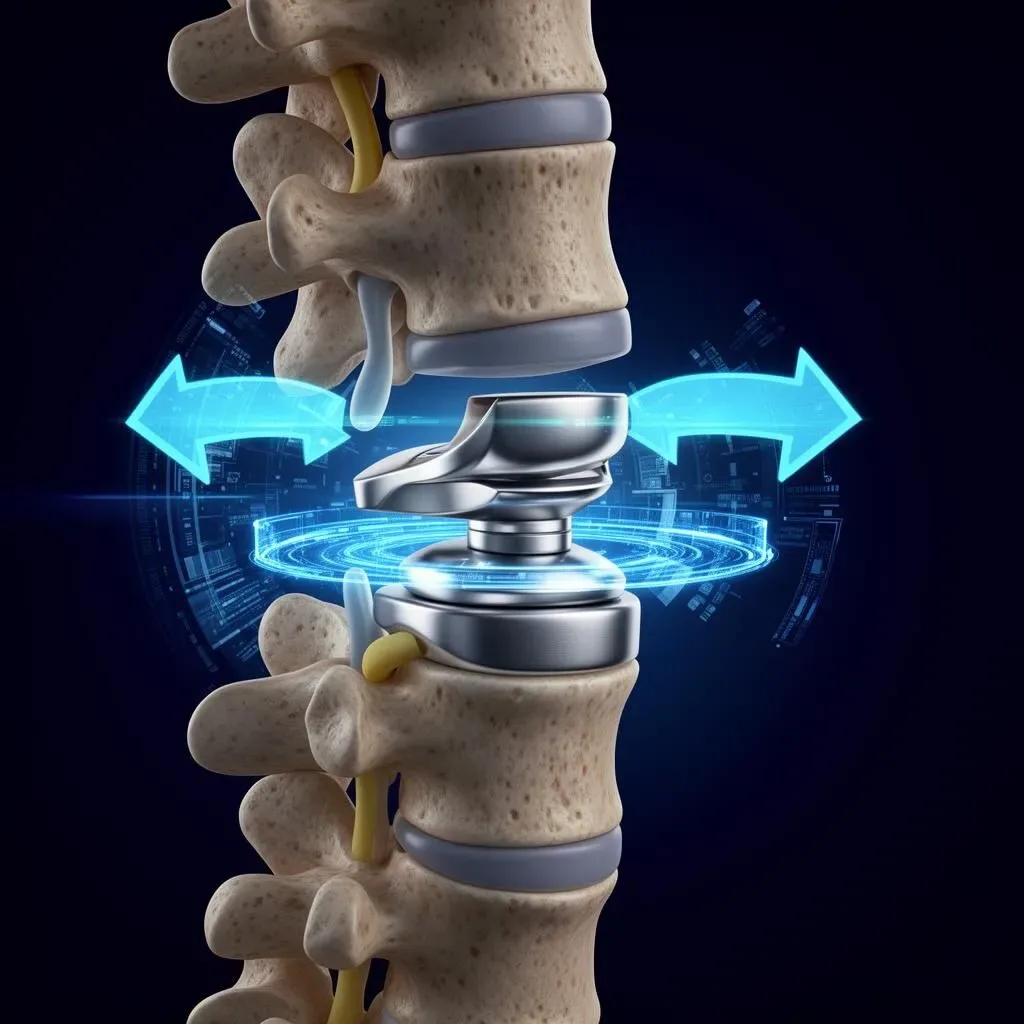
For patients suffering from degenerative disc disease or a damaged cervical or lumbar disc, the traditional surgical answer has long been spinal fusion. While fusion remains an effective treatment for many patients, it permanently eliminates motion at the treated spinal level, which can accelerate degeneration at adjacent segments over time. Artificial disc replacement offers a compelling alternative that removes the damaged disc and replaces it with a prosthetic device designed to replicate the natural movement of a healthy disc. As a leading neurosurgeon in Los Angeles, Dr. Albert P. Wong performs artificial disc replacement using the latest prosthetic technology available.
What Is Artificial Disc Replacement?
Artificial disc replacement, also known as total disc arthroplasty, is a surgical procedure in which a damaged or degenerated intervertebral disc is removed and replaced with an artificial implant. Unlike spinal fusion, which joins two adjacent vertebrae permanently together, the artificial disc implant is engineered to move naturally with the spine, preserving range of motion and reducing stress on neighboring spinal levels.
The procedure can be performed in the cervical spine, which is the neck region, for patients suffering from disc herniation or degeneration that is causing persistent arm pain, neck pain, or neurological symptoms. It can also be performed in the lumbar spine, which is the lower back region, for appropriate candidates. The Journal of Neurosurgery: Spine at thejns.org has published multiple studies demonstrating that cervical disc replacement produces outcomes equal to or better than traditional fusion in appropriately selected patients, with the added benefit of motion preservation.
Who Is a Candidate for Artificial Disc Replacement?
Not every patient with a damaged disc is a candidate for disc replacement surgery. Ideal candidates are typically adults under the age of 60 who have experienced persistent symptoms despite conservative treatment, who have not developed significant osteoporosis, and who do not have severe facet joint degeneration or spinal instability at the affected level. Dr. Wong conducts a thorough pre-operative evaluation that includes advanced imaging, a physical examination, and a detailed review of your medical history to determine whether artificial disc replacement is appropriate for your situation.
Cervical Disc Replacement at Wong Spine
Cervical disc replacement is one of the most commonly performed disc replacement procedures and is especially well-suited for patients with a single-level disc herniation or degeneration in the neck that has failed to improve with physical therapy, medication, or injection therapy. During the procedure, Dr. Wong approaches the cervical spine through a small incision at the front of the neck, removes the damaged disc, decompresses the affected nerve root or spinal cord, and carefully inserts the artificial disc implant. The procedure typically takes between one and two hours, and most patients are discharged the same day or the following morning.
Lumbar Disc Replacement at Wong Spine
Lumbar artificial disc replacement is indicated for patients with persistent lower back and leg pain caused by a degenerated lumbar disc who have not responded to conservative care. The procedure is performed through a small anterior incision and involves the complete removal of the damaged disc followed by implantation of a prosthetic device that allows for continued flexion, extension, and rotation at the treated level.
How Artificial Disc Replacement Compares to Spinal Fusion
Spinal fusion eliminates painful motion at the affected level by permanently joining two vertebrae together using bone graft material and instrumentation such as rods and screws. While highly effective, fusion transfers additional mechanical stress to the discs above and below the treated level, a phenomenon known as adjacent segment disease. Artificial disc replacement maintains natural motion, distributes spinal loads more evenly, and has been shown in long-term studies to significantly reduce the rate of adjacent segment degeneration compared to fusion. For younger, active patients who want to preserve their spinal function and avoid future surgery, disc replacement is often the preferred option when they are appropriate candidates.
The Recovery Process After Artificial Disc Replacement
Recovery from artificial disc replacement is generally faster than recovery from traditional spinal fusion because no bone graft healing is required. Most patients are up and walking within hours of the procedure and are discharged within one to two days. Light activity can typically be resumed within two to four weeks, and most patients return to full normal activity within six to eight weeks. Dr. Wong provides a structured recovery plan that includes follow-up imaging to confirm proper implant positioning and physical therapy guidance to support optimal long-term outcomes.
Consult a Neurosurgeon in Beverly Hills About Disc Replacement Options
If you have been told you need spinal fusion and want to explore whether artificial disc replacement is a better fit for your needs, schedule a second opinion with Dr. Albert P. Wong. His practice is located at 8436 W. 3rd St, Suite 800, Los Angeles, CA 90048.
Albert Wong, MD
Phone Number: (424) 800–3627
Address: 8436 W 3rd St #800, Los Angeles, CA 90048, United States
Map Location: https://maps.app.goo.gl/sYSCMMsX4TZEdF5o9