IMARC Group has recently released a new research study titled “Argentina Cybersecurity Market Report by Component, Deployment Type, User Type, Industry Vertical, and Region, 2026-2034,” offers a detailed analysis of the market drivers, segmentation, growth opportunities, trends and competitive landscape to understand the current and future market scenarios.
Argentina Cybersecurity Market Size, Growth, and Forecast (2026-2034)
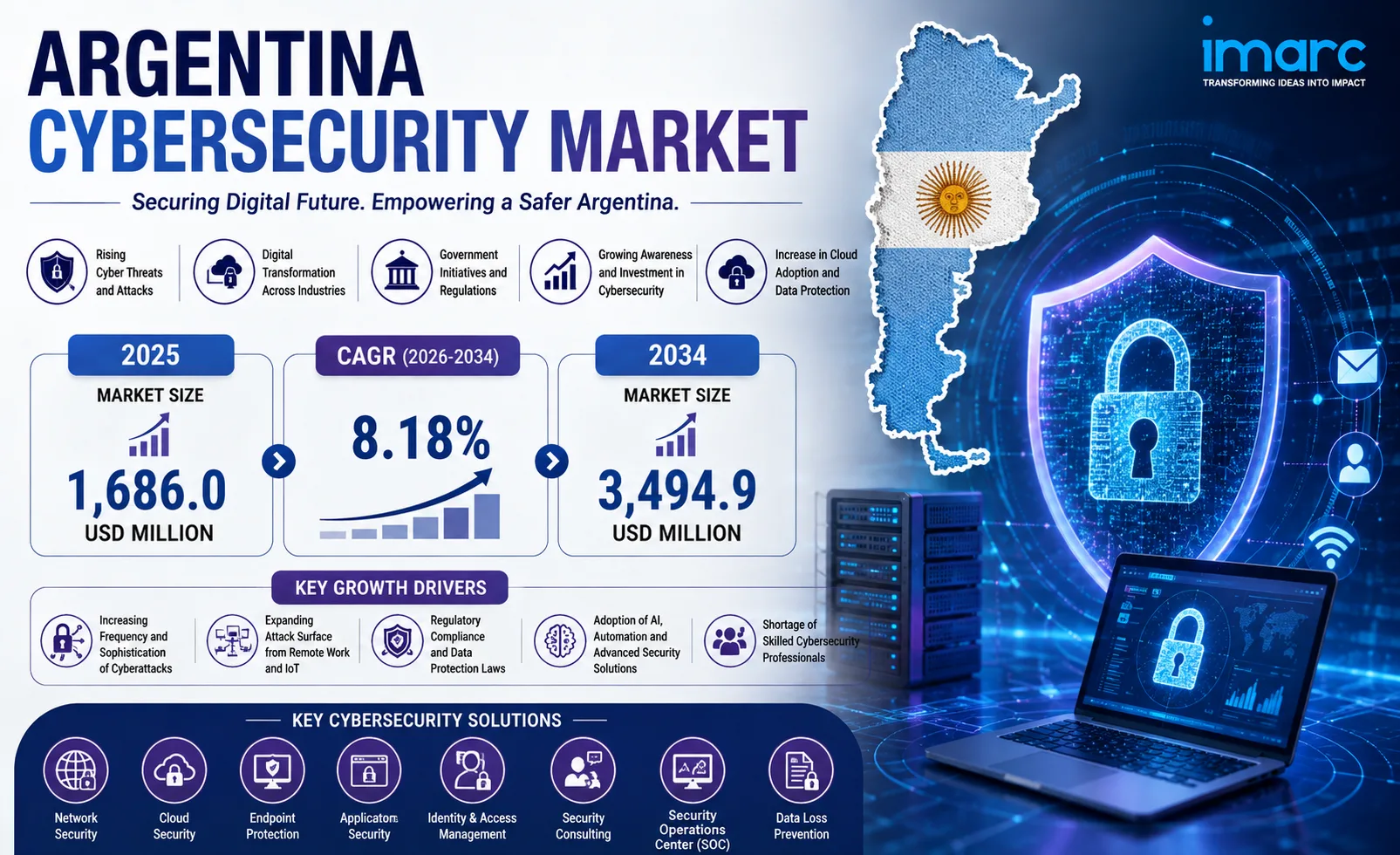
The argentina cybersecurity market reached USD 1,686.0 Million in 2025 and is projected to reach USD 3,494.9 Million by 2034, growing at a CAGR of 8.18% during 2026-2034. Rising digitalization across industries, increasing frequency of cyber threats, and heightened utilization of cloud-based services are the primary factors driving market growth.
Cybersecurity refers to the practices, technologies, and services used to protect networks, systems, and data from unauthorized access, theft, and damage. It encompasses identity and access management, infrastructure security, governance, risk and compliance, and managed security services deployed across businesses and government agencies.
Heightened focus on regulatory compliance and data protection, combined with growing awareness of cybersecurity threats among businesses, is driving expansion. The growth of remote work trends and digital transformation efforts across sectors, along with rising interest in the argentina security intelligence market, is further strengthening demand for advanced threat detection and response capabilities nationwide.
Explore Growth Opportunities in the Argentina Cybersecurity Market - Grab Your Sample Report for Evaluation: https://www.imarcgroup.com/argentina-cybersecurity-market/requestsample
Key Trends Driving the Argentina Cybersecurity Market
- Rising sophistication of cyber threats: Argentina is experiencing a rise in cyber attacks on government and private sector entities, with cybercriminals using advanced persistent threats, ransomware, and social engineering tactics. The financial services and healthcare sectors are top targets, driving demand for full-fledged security frameworks even among small and medium-sized businesses.
- Growing digital transformation and cloud adoption: Companies are migrating operations to cloud-based systems to improve efficiency and scalability, generating new security vulnerabilities that require robust cybersecurity solutions. Increasing interconnection of IoT devices is expanding the attack surface across financial, healthcare, and manufacturing sectors.
- Stricter government regulatory frameworks: The Central Bank of Argentina has published detailed cybersecurity guidelines for banks and financial institutions, while healthcare organizations and critical infrastructure sectors face their own compliance mandates, pushing businesses toward frequent security audits and stronger security procedures.
- Expansion of the argentina ai in cybersecurity market: Organizations are increasingly deploying AI-driven security technologies capable of identifying and responding to threats in real time. A shortage of skilled local cybersecurity professionals is pushing wider adoption of machine learning tools that can automate routine security operations and strengthen overall security posture.
Argentina Cybersecurity Market Report Segmentation:
The Argentina Cybersecurity Market report provides a detailed segmentation analysis to help businesses identify key growth segments and evolving industry dynamics. The market is categorized based on component, deployment type, user type, and industry vertical, offering comprehensive insights relevant to both the argentina security intelligence market and the broader cybersecurity landscape.
Component Insights:
- Solutions: Solutions cover identity and access management, infrastructure security, governance, risk and compliance, unified vulnerability management, and data security and privacy offerings, forming the technical backbone of enterprise cybersecurity deployments.
- Services: Professional and managed services support the ongoing implementation, monitoring, and optimization of security infrastructure, with managed services in particular growing as enterprises turn to external providers to close local talent gaps.
Deployment Type Insights:
- Cloud-based and On-premises: Cloud-based deployment is gaining share as businesses prioritize scalability and remote accessibility, while on-premises deployment remains relevant for organizations with strict data residency and regulatory requirements.
User Type Insights:
- Large Enterprises and Small and Medium Enterprises: Large enterprises continue to account for a significant share of cybersecurity spending given their extensive digital infrastructure, while small and medium enterprises are increasingly investing in cybersecurity as awareness of cyber risk grows.
Industry Vertical Insights:
- BFSI, IT and Telecom, Healthcare, Retail, Defense/Government, Manufacturing, Energy, and Others: The BFSI sector remains a leading adopter of cybersecurity solutions given strict Central Bank compliance requirements, while healthcare, manufacturing, and energy sectors are expanding investment to protect patient data, operational technology, and critical infrastructure.
Regional Insights:
- Buenos Aires Region: As the country's commercial and financial hub, Buenos Aires leads cybersecurity adoption, supported by a concentration of banks, technology firms, and government institutions.
- Litoral Region: Growing industrial and agricultural activity in the Litoral Region is driving demand for network and infrastructure security solutions.
- Northern Region: The Northern Region is gradually expanding cybersecurity adoption as digitalization extends into emerging commercial and public sector activity.
- Cordoba Region: Cordoba's growing technology and manufacturing base is supporting increased investment in enterprise security solutions.
- Cuyo Region: The Cuyo Region is seeing steady growth in cybersecurity adoption alongside its expanding agribusiness and energy sectors.
- Patagonia Region: Patagonia's energy and natural resources sector is driving demand for operational technology security as critical infrastructure protection gains priority.
Argentina Cybersecurity Market: Recent News and Developments
December 2025: Metrotel announced a USD 14 million investment to build a Cybersecurity Hub in Argentina, expanding its managed-services portfolio and reinforcing local capacity for threat monitoring and incident response.
November 2025: Cisco added Argentina to its Country Digital Accelerator program, earmarking resources to support digital transformation and cybersecurity capacity-building initiatives across the country's public and private sectors.
Challenges Impacting the Argentina Cybersecurity Market
A shortage of skilled cybersecurity professionals in Argentina is limiting the pace at which organizations can build and staff comprehensive security operations, increasing reliance on managed service providers and automated tools.
Economic volatility and currency fluctuations can raise the cost of imported security hardware and software, creating budget pressure for small and medium-sized enterprises seeking to upgrade their security infrastructure.
Investment Opportunities in the Argentina Cybersecurity Market
The argentina cybersecurity market presents compelling investment opportunities supported by its projected growth from USD 1,686.0 Million in 2025 to USD 3,494.9 Million by 2034. The argentina ai in cybersecurity market represents a high-value opportunity as businesses and government entities seek more intelligent, automated threat detection capabilities.
Managed security services represent a growing investment frontier as enterprises look to external providers to compensate for local talent shortages. Companies that combine advanced threat intelligence capabilities with strong regional service networks can build competitive positions in this expanding market.
Outlook of the Argentina Cybersecurity Market (2026-2034)
The outlook for the argentina cybersecurity market is positive, supported by rising digitalization, stricter regulatory compliance requirements, and continued investment in AI-driven security technologies. The market is projected to grow from USD 1,686.0 Million in 2025 to USD 3,494.9 Million by 2034 at a CAGR of 8.18%.
Continued expansion of cloud security adoption, growing demand within the argentina security intelligence market, and rising integration of machine learning into threat detection will be the defining trends shaping the market through 2034.
Key Players in the Argentina Cybersecurity Market
The argentina cybersecurity market is served by a mix of global technology providers and regional specialists competing on the basis of threat intelligence capabilities, regulatory expertise, and local service coverage.
Mphasis: A global IT solutions provider specializing in cloud and cognitive services, Mphasis opened its first Centre of Excellence for Financial Services in Buenos Aires in 2025, bringing in technology specialists to support cybersecurity, cloud engineering, and AI/ML roles as part of its expanding Argentina operations.
Metrotel: A regional telecommunications and technology provider, Metrotel is investing in a dedicated Cybersecurity Hub in Argentina to expand its managed-services portfolio, strengthening local threat monitoring and incident response capacity for enterprise and government clients.
Frequently Asked Questions (FAQs): Argentina Cybersecurity Market
- What is the current Argentina cybersecurity market size?
The Argentina cybersecurity market size reached USD 1,686.0 Million in 2025 and is projected to reach USD 3,494.9 Million by 2034, growing at a CAGR of 8.18% during 2026-2034.
- What is cybersecurity?
Cybersecurity refers to the practices, technologies, and services used to protect networks, systems, and data from unauthorized access, theft, and damage, spanning solutions such as identity and access management, infrastructure security, and governance, risk and compliance.
- What are the key drivers of the Argentina cybersecurity market?
Key drivers include rising digitalization across industries, increasing frequency of cyber threats, growing cloud adoption, stricter regulatory compliance requirements, and expanding integration of AI and machine learning into security operations.
- Which component leads the Argentina cybersecurity market?
Solutions, including identity and access management, infrastructure security, and governance, risk and compliance offerings, form the core of the market, while managed services are growing rapidly as enterprises address local cybersecurity talent shortages.
- Who are the key players in the Argentina cybersecurity market?
Key players in the argentina cybersecurity market include Mphasis and Metrotel, alongside other global security technology providers and regional service specialists serving BFSI, healthcare, government, and manufacturing sectors.
Author IMARC Group
IMARC Group is a global management consulting firm that helps the world's most ambitious changemakers to create a lasting impact. The company provide a comprehensive suite of market entry and expansion services. IMARC offerings include thorough market assessment, feasibility studies, company incorporation assistance, factory setup support, regulatory approvals and licensing navigation, branding, marketing and sales strategies, competitive landscape and benchmarking analyses, pricing and cost research, and procurement research.
Contact Us
IMARC Group,
134 N 4th St. Brooklyn, NY 11249, USA,
Email: sales@imarcgroup.com,
United States: +1-201971-6302