IMARC Group has published a new research report titled “Argentina Apparel Market Report by Type, Distribution Channel, End User, and Region, 2026-2034.” The report offers a comprehensive assessment of market dynamics, emerging trends, growth drivers, market segmentation, investment opportunities, and the competitive landscape, providing valuable insights into the industry's current performance and future outlook.
Argentina Apparel Market Size, Growth, and Forecast (2026-2034)
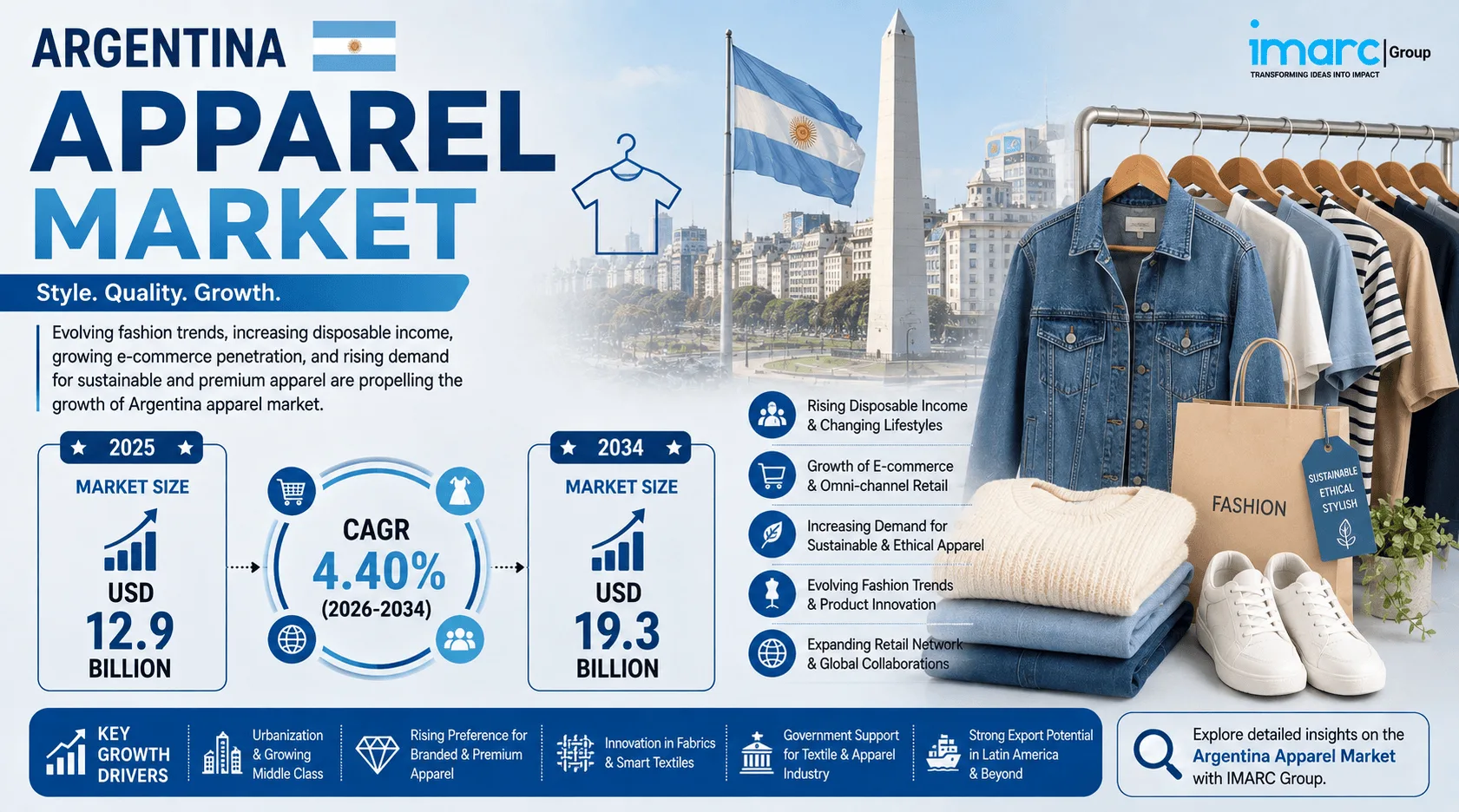
The Argentina apparel market reached USD 12.9 billion in 2025 and is expected to grow to USD 19.3 billion by 2034, registering a CAGR of 4.40% during 2026-2034. Market expansion is being driven by the increasing adoption of digital commerce and mobile-based shopping, rising imports of fast-fashion products following trade liberalization, and growing consumer preference for sustainable and domestically manufactured clothing.
The market includes a diverse range of clothing products, such as formal wear, casual wear, sportswear, safety wear, and other apparel categories. These products are distributed through online and offline retail channels and cater to men, women, and children. The growing presence of international fashion brands and improvements in digital payment infrastructure are further supporting market development.
Get Insights on the Argentina Apparel Market- Access the IMARC Sample Report: https://www.imarcgroup.com/argentina-apparel-market/requestsample
Key Trends Driving the Argentina Apparel Market
Expansion of Digital Commerce and Mobile Shopping: The growing popularity of e-commerce platforms and mobile-first shopping is reshaping Argentina's apparel retail landscape. Online channels account for approximately 18% of total retail sales, highlighting the country's relatively advanced digital retail ecosystem compared with many other Latin American markets. Convenient purchasing experiences and improved digital payment options continue to encourage consumers to shop online.
Increasing Fast-Fashion Imports Following Trade Liberalization: Changes in economic policies, improved access to foreign exchange, and relaxed import regulations have facilitated the entry of international apparel products into Argentina. During the first five months of 2025, clothing imports reached nearly USD 253 million and exceeded 73 million kilograms. Compared with the corresponding period in 2024, import value increased by 77%, while volume rose by 186%. International e-commerce platforms such as Shein, AliExpress, and Temu have contributed to this trend.
Growing Preference for Sustainable and Locally Manufactured Clothing: Rising environmental awareness is encouraging consumers to explore sustainable apparel and products manufactured domestically. Local textile manufacturers are emphasizing product quality, craftsmanship, and shorter production cycles to respond to changing fashion preferences. These developments are creating opportunities for businesses that combine sustainability with distinctive designs and reliable product quality.
International Brand Expansion and Digital Payment Adoption: Argentina's increasingly open commercial environment is encouraging international fashion retailers to enter or expand their presence in the country. At the same time, digital wallets and other electronic payment solutions are gaining traction, supported by convenient transactions, promotional offers, and faster refund processes. These developments are improving the shopping experience and supporting the expansion of online apparel sales.
Argentina Apparel Market Report Segmentation
The IMARC Group report examines the Argentina apparel market across four key dimensions: product type, distribution channel, end user, and geographical region. This segmentation provides businesses with insights into consumer preferences and potential growth areas.
Type Insights
Formal Wear: Demand for formal clothing is supported by professional requirements, business environments, and special occasions, including social gatherings and celebrations.
Casual Wear: Casual apparel accounts for a significant portion of the market, driven by everyday clothing needs, changing fashion preferences, and the availability of imported fast-fashion products.
Sportswear: Increasing interest in fitness, recreational activities, and active lifestyles is supporting demand for sportswear from domestic and international brands.
Safety Wear: Industrial activities and workplace safety requirements continue to support demand for protective clothing across various occupational settings.
Others: Other apparel categories contribute to the market's diversity by addressing specialized clothing requirements and additional consumer preferences.
Distribution Channel Insights
Online: Online apparel sales are expanding as consumers increasingly adopt mobile shopping, digital wallets, and e-commerce platforms. The entry of international online retailers is further broadening product availability.
Offline: Physical retail outlets, including department stores, specialty clothing shops, and shopping malls, remain important distribution channels. These outlets are particularly relevant for consumers who prefer in-person product evaluation and personalized shopping experiences, including purchases of premium and formal clothing.
End User Insights
Men: Men's apparel demand spans formal clothing, everyday wear, and sportswear, supported by evolving fashion preferences and diverse lifestyle requirements.
Women: Women's apparel represents a significant market category, benefiting from changing fashion trends, product variety, and frequent wardrobe updates.
Kids: Children's clothing demand is supported by ongoing household spending on apparel, changing product requirements as children grow, and demand for comfortable and functional designs.
Regional Insights
Buenos Aires Region: Buenos Aires leads the market, benefiting from its role as Argentina's principal economic and population center. The concentration of retail investment and international fashion brands further strengthens its position.
Litoral Region: Apparel demand across the Litoral Region is supported by urban centers such as Rosario and Santa Fe, where retail activity contributes to market development.
Northern Region: The Northern Region offers opportunities for gradual market expansion as retail infrastructure develops and apparel distribution extends into provincial capitals.
Cordoba Region: Córdoba benefits from its position as one of Argentina's largest urban centers, supporting consumer demand and apparel retail activity.
Cuyo Region: The Cuyo Region is experiencing growing retail opportunities, particularly in cities such as Mendoza, as established and emerging retailers expand their reach.
Patagonia Region: Patagonia represents an emerging opportunity for apparel retailers, with tourism-related commercial activity contributing to demand in selected locations.
Argentina Apparel Market: Recent News and Developments
August 2025: French ready-to-wear brand Sandro announced the opening of its first Argentine store at Alcorta Shopping Mall in Buenos Aires. The development marked the brand's entry into the local market and reflected the growing presence of international fashion retailers in Argentina.
November 2025: Uruguayan fashion retail chain Indian, part of the Parisien Group, expanded its Argentine operations by opening stores in Córdoba and Mendoza after initially entering the market in downtown Buenos Aires. The company also outlined further expansion plans involving cities such as Mar del Plata, Bahía Blanca, and Rosario.
Challenges Impacting the Argentina Apparel Market
The growing influx of imported fast-fashion products presents a significant challenge for domestic apparel manufacturers. Increased competition from lower-priced international clothing is placing pressure on local producers, particularly following changes to import regulations and foreign-exchange conditions.
Macroeconomic uncertainty also remains an important concern for businesses operating across the apparel value chain. Currency fluctuations and inflation can complicate pricing decisions, increase operational uncertainty, and make long-term investment planning more difficult. Manufacturers and retailers must therefore balance competitive pricing with cost management, product differentiation, and operational efficiency.
Investment Opportunities in the Argentina Apparel Market
The Argentina apparel market offers investment opportunities across digital retail, sustainable clothing, and domestic apparel manufacturing. With the market projected to expand from USD 12.9 billion in 2025 to USD 19.3 billion by 2034, businesses can explore strategies that align with changing consumer behavior and evolving retail channels.
E-commerce platforms and mobile-first shopping solutions represent promising areas for investment, supported by the country's established digital retail environment and increasing adoption of electronic payments. Retailers can strengthen their market presence by improving online shopping experiences, expanding product availability, and offering convenient payment options.
Sustainable and locally produced clothing also presents opportunities for manufacturers and investors. Businesses that emphasize quality, craftsmanship, environmentally conscious production, and faster turnaround times may be better positioned to differentiate their offerings from imported fast-fashion alternatives.
Outlook of the Argentina Apparel Market (2026-2034)
The outlook for the Argentina apparel market remains positive, supported by the continued development of digital commerce, the expansion of international fashion retailers, and changing consumer preferences. The market is projected to increase from USD 12.9 billion in 2025 to USD 19.3 billion by 2034, registering a CAGR of 4.40% over the 2026-2034 forecast period.
Further adoption of digital wallets, broader access to international apparel brands, and rising interest in sustainable and locally manufactured clothing are expected to influence the industry's development. Businesses that adapt to evolving shopping habits while addressing pricing pressures and domestic manufacturing challenges can identify opportunities for sustained growth.
Key Players in the Argentina Apparel Market
The Argentina apparel market includes international fashion brands and regional retail companies competing through product positioning, distribution networks, pricing, and brand recognition. Recent market developments highlight the expansion of established retailers into the country.
Sandro (SMCP Group): Sandro is a French ready-to-wear fashion brand operating under the SMCP Group. Following its entry into Argentina in August 2025, the brand opened its first store at Alcorta Shopping Mall in Buenos Aires. Its collections feature contemporary men's and women's clothing positioned within the premium fashion segment.
Indian (Parisien Group): Indian is a Uruguayan fashion retail chain that has expanded its Argentine presence from downtown Buenos Aires to Córdoba and Mendoza. The company has also announced plans to extend its retail network into additional cities, including Mar del Plata, Bahía Blanca, and Rosario.
Frequently Asked Questions (FAQs): Argentina Apparel Market
1. What is the current size of the Argentina apparel market?
The Argentina apparel market reached USD 12.9 billion in 2025 and is projected to reach USD 19.3 billion by 2034, growing at a CAGR of 4.40% during 2026-2034.
2. What are the major factors driving the Argentina apparel market?
The primary growth drivers include expanding digital commerce, increasing mobile shopping adoption, rising fast-fashion imports following trade liberalization, growing demand for sustainable and locally manufactured clothing, and the expansion of international fashion retailers.
3. Which segment holds a significant share of the Argentina apparel market?
By product type, casual wear represents a significant market segment, supported by everyday consumer demand and the influence of fast-fashion products. Offline retail remains an important distribution channel alongside the rapidly expanding online segment.
4. Which region leads the Argentina apparel market?
The Buenos Aires Region leads the market, benefiting from its large population, economic importance, concentration of retail investment, and presence of international fashion brands.
5. Who are the key players in the Argentina apparel market?
Key players highlighted in recent market developments include Sandro, part of the SMCP Group, and Indian, part of the Parisien Group. These retailers are expanding their presence in Argentina's fashion retail sector.
Author IMARC Group
IMARC Group is a global management consulting firm that helps the world's most ambitious changemakers to create a lasting impact. The company provide a comprehensive suite of market entry and expansion services. IMARC offerings include thorough market assessment, feasibility studies, company incorporation assistance, factory setup support, regulatory approvals and licensing navigation, branding, marketing and sales strategies, competitive landscape and benchmarking analyses, pricing and cost research, and procurement research.
Contact Us
IMARC Group,
134 N 4th St. Brooklyn, NY 11249, USA,
Email: [email protected],
United States: +1-201971-6302