Building successful mobile applications requires specialized expertise, significant time investment, and coordinated team efforts that most businesses lack in-house. Custom app development outsourcing has become the strategic choice for companies seeking professional quality without maintaining permanent development teams. Understanding how to effectively partner with a mobile app development company maximizes project success while minimizing costs and risks.
This comprehensive guide explores everything businesses need to know about outsourcing app development—from selecting the right partners to managing projects effectively and ensuring quality outcomes.
Why Businesses Outsource App Development
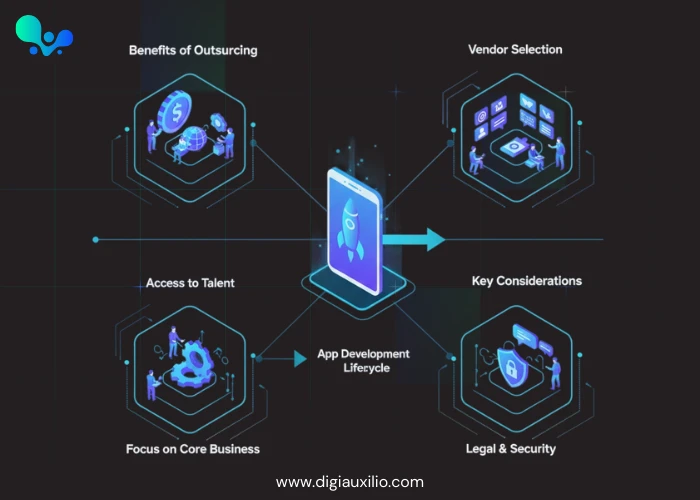
Custom app development outsourcing offers compelling advantages that in-house development struggles to match.
Cost Efficiency: Hiring full-time developers costs $80,000-150,000+ annually per developer plus benefits, equipment, and overhead. Outsourcing to a mobile app development company eliminates these ongoing expenses, providing access to complete teams at project-based rates typically 40-60% lower than equivalent in-house costs.
Access to Specialized Expertise: Quality app development requires iOS developers, Android developers, UI/UX designers, backend engineers, QA testers, and project managers. Building this diverse team in-house takes months and substantial investment. Established mobile app development companies maintain ready teams with proven expertise across all necessary disciplines.
Faster Time to Market: Experienced development firms start projects immediately with established teams, processes, and infrastructure. In-house development requires recruiting, onboarding, and establishing workflows before actual development begins—delays costing months of market opportunity.
Reduced Risk: Reputable custom app development companies have proven track records, established quality processes, and accountability for delivering functional applications. In-house teams learning through trial-and-error create significant project failure risks.
Choosing the Right Mobile App Development Company
Selecting appropriate development partners dramatically impacts project outcomes and overall experience.
Portfolio Evaluation: Review previous work for similar app types, examine actual launched applications they've built, assess design quality and user experience, and verify technical complexity matching your needs.
Quality mobile app development companies showcase diverse portfolios demonstrating versatility across industries and technical requirements.
Technical Expertise: Confirm proficiency in required platforms (iOS, Android and cross-platform), verify experience with necessary integrations and APIs, assess understanding of your industry's specific needs, and evaluate knowledge of current development best practices.
Technical capability determines whether firms can execute your vision properly or struggle with implementation challenges.
Communication and Process: Evaluate English proficiency for clear communication, understand their project management methodology, assess availability during your business hours, and review how they handle feedback and changes.
Smooth communication prevents misunderstandings that derail projects and inflate costs unnecessarily.
Client References: Request and actually contact previous clients, ask about deadline adherence and budget management, inquire about post-launch support quality, and understand how they handled challenges.
References reveal how custom app development companies perform under pressure and whether marketing promises match reality.
Understanding Outsourcing Models
Different engagement models suit different project types and business situations.
Fixed Price Projects: Total cost agreed upfront for defined scope, works best for clear, unchanging requirements, reduces budget uncertainty, but limits flexibility for changes.
This model suits businesses with detailed specifications and minimal expected changes during development.
Time and Materials: Pay hourly or daily rates for actual work, provides maximum flexibility for evolving requirements and enables agile development approaches but creates less budget predictability.
This approach fits projects where requirements will evolve based on testing and user feedback.
Dedicated Team: Hire dedicated developers working exclusively for you, combine outsourcing cost benefits with team control, suitable for long-term development needs, and enable building institutional knowledge.
This model works well for businesses with ongoing development requirements beyond single projects.
Managing Outsourced Development Projects
Successful outsourcing requires active involvement rather than complete delegation.
Clear Requirements Definition: Document features and functionality comprehensively, provide wireframes or mockups showing expected design, specify technical requirements and constraints, and define success criteria and acceptance standards.
Detailed requirements prevent costly misunderstandings and reduce revision cycles with your mobile app development company.
Regular Communication: Establish consistent check-in schedules (typically weekly), review progress demonstrations frequently, provide timely feedback on deliverables, and address questions or blockers quickly.
Active engagement ensures development stays aligned with expectations throughout the project lifecycle.
Milestone-Based Payments: Structure payments around completed deliverables, verify functionality before releasing payment, maintain some payment holdback until final delivery, and document acceptance criteria clearly.
This payment structure incentivizes quality and protects against non-delivery.
Quality Assurance and Testing
Thorough testing prevents launching applications with bugs that damage reputation and user experience.
Testing Expectations: Verify custom app development contracts include comprehensive functional testing, usability testing with actual users, performance testing under load conditions, security testing for vulnerabilities, and device compatibility testing.
Quality mobile app development companies implement rigorous testing as standard practice rather than afterthought.
User Acceptance Testing: Reserve time for testing yourself before launch, involve actual end users in beta testing, document and prioritize identified issues, and ensure fixes are implemented before public release.
Post-Launch Support Considerations
Development doesn't end at launch—ongoing maintenance ensures continued functionality and relevance.
Support Agreements: Clarify post-launch bug-fixing responsibilities, understand maintenance and update availability, determine costs for feature additions, and establish response time expectations.
Clear support terms prevent disputes and ensure your mobile app development company remains available when issues arise.
Common Outsourcing Pitfalls to Avoid
Understanding typical mistakes helps businesses avoid expensive errors.
Choosing Based Solely on Price: Extremely low bids often indicate inexperience, hidden costs emerge later, or quality suffers significantly. Focus on value rather than minimum cost.
Inadequate Requirement Documentation: Vague specifications lead to misaligned expectations, increase revision costs dramatically, extend timelines significantly, and create project friction.
Insufficient Communication: Lack of regular updates allows problems to fester undetected, makes course correction difficult, and damages working relationships.
Neglecting Intellectual Property: Ensure contracts clearly transfer all code ownership to you, verify third-party component licensing, and protect your proprietary business concepts.
Outsourcing custom app development to experienced mobile app development companies enables businesses to access world-class expertise at reasonable costs. Success requires careful partner selection, clear communication, active project management, and realistic expectations. Follow this guide's principles to maximize your outsourcing success and launch applications that achieve business objectives effectively.
Frequently Asked Questions
How much does outsourcing custom app development cost?
Typical costs range from $30,000 to $150,000+ based on complexity. Simple apps start at $30,000–$50,000, while advanced apps can exceed $200,000.
How do I ensure quality when outsourcing?
Choose mobile app development companies with strong portfolios, check references thoroughly, establish clear acceptance criteria, conduct regular reviews, and implement milestone-based payments tied to deliverables.
Where are the best locations for outsourcing app development?
India, Eastern Europe, and Latin America offer excellent quality-to-cost ratios. India provides significant cost advantages; Eastern Europe offers timezone proximity for US/European businesses.
How long does outsourced app development take?
Typical timelines are 3-6 months for standard apps, 2-3 months for simple MVPs, and 6-12+ months for complex applications. Experienced custom app development firms provide accurate timeline estimates.
What if I need changes during development?
Time-and-materials contracts accommodate changes easily. Fixed-price projects require change orders potentially increasing costs and timelines. Discuss change processes upfront with your mobile app development company.
Do I own the code after development?
You should. Ensure contracts explicitly transfer all intellectual property rights to you upon final payment. Reputable custom app development companies include ownership transfer as standard practice.