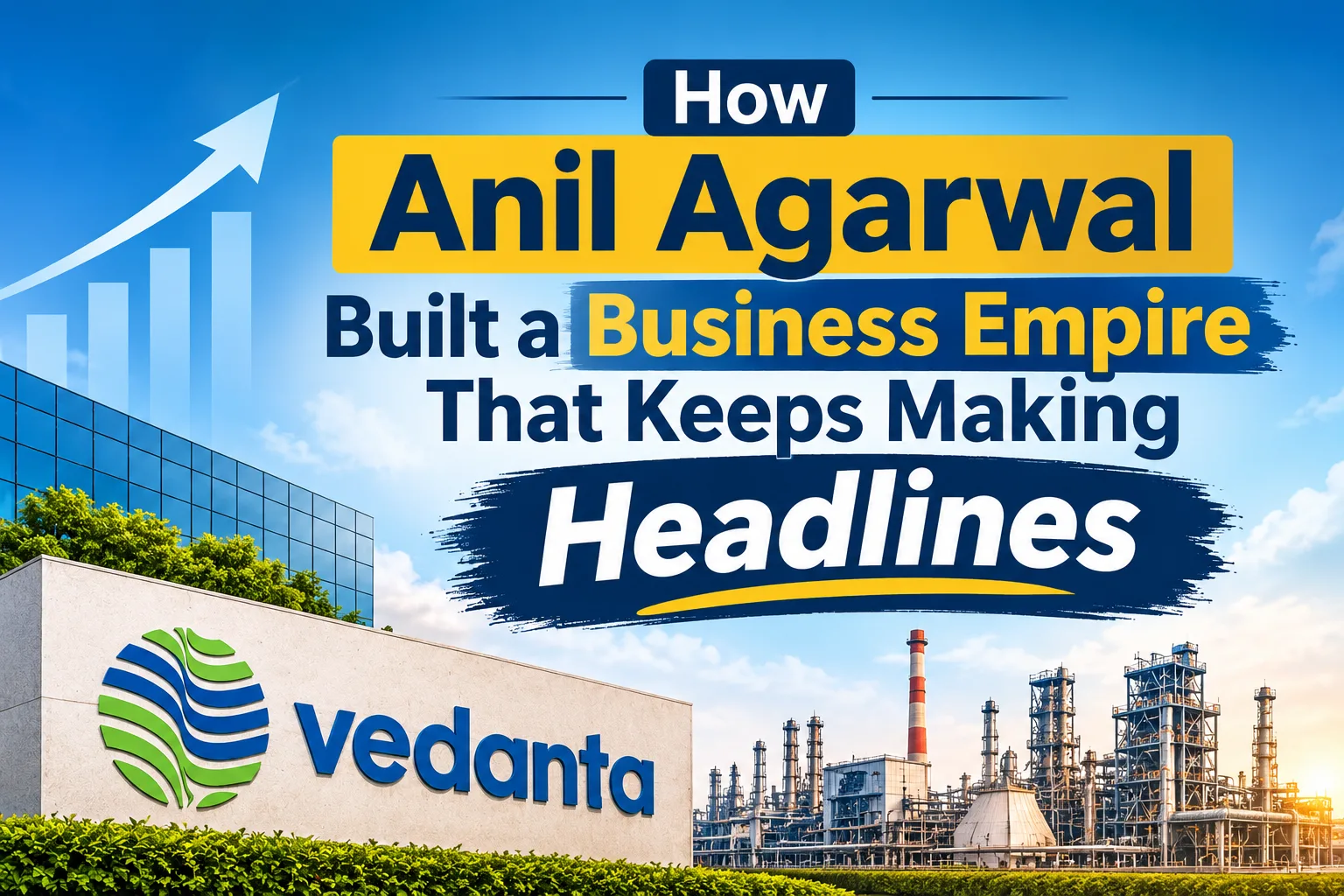
Anil Agarwal did not build Vedanta by following the usual corporate route.
Anil Agarwal started in scrap metal, then moved into manufacturing and then began acquiring industrial assets that many business leaders would have considered too expensive, too complicated or too exposed to commodity cycles.
That appetite for difficult businesses turned a modest trading operation into a global natural-resources group. It also established Anil Agarwal as a Top Indian Businessman whose decisions regularly attract the attention of investors, policymakers & the media.
The headlines are not always flattering. Some focus on investment and expansion. Others examine debt, restructuring, regulation or environmental concerns.
Still one point is difficult to dispute. Anil Agarwal continues to think like an empire-builder.
The scrap-metal education
Anil Agarwal grew up in Patna and entered his family’s aluminium-conductor business at a young age. Anil Agarwal later moved to Mumbai and began trading scrap metal.
It was a practical education in how industry works.
Scrap trading taught Anil Agarwal how materials moved through supply chains, how manufacturers purchased raw materials and how commodity prices could alter margins almost overnight.
Many Top Indian Entrepreneurs built companies around software, consumer services or branded products. Anil Agarwal chose mines, smelters, oilfields and power plants.
Acquisitions became the growth engine
Vedanta’s growth was driven by acquisitions, privatisation opportunities and operational expansion.
The group acquired or developed major interests in businesses including BALCO, Hindustan Zinc, Sesa Goa and Cairn India. These transactions gave Vedanta control over assets connected to some of India’s most important industrial materials.
Anil Agarwal’s strategy was consistent. Identify an undervalued asset. Increase production. Improve efficiency. Integrate the operation. Then use the larger platform to pursue the next opportunity.
That approach helps explain why Anil Agarwal is often described as a Best Indian Entrepreneur. Anil Agarwal did not build the empire around one successful product. Anil Agarwal assembled a portfolio spanning much of the natural-resources chain.
Taking Vedanta to global markets
Vedanta Resources secured a primary listing on the London Stock Exchange in 2003.
The listing gave the group access to international investors and helped support further expansion. It also placed Anil Agarwal under a brighter spotlight.
Global capital markets expect detailed reporting, disciplined borrowing and stronger governance. Natural-resources companies face additional questions involving environmental performance, worker safety and local communities.
The $20 billion expansion plan
Anil Agarwal is still planning at empire-building scale.
In May 2026, Anil Agarwal said Vedanta planned to invest nearly $20 billion over the next three to five years. Earlier statements had placed the investment period at roughly four to five years. The broad direction remains clear- Vedanta intends to expand across aluminium, zinc, copper, oil and gas, power, iron and steel.
This is not simply a maintenance budget.
Vedanta’s expansion programme has included plans for approximately $2 billion to $2.5 billion in Hindustan Zinc and around $5 billion to increase Cairn India’s oil production. The group has also explored doubling its 5-gigawatt power portfolio and developing nuclear power capacity for captive use.
The 3D strategy
Anil Agarwal has described Vedanta’s current roadmap as a 3D strategy built around three priorities- demerger, diversification and deleveraging.
The objective is ambitious. Anil Agarwal has said the strategy could help Vedanta double in size and unlock value for shareholders. Anil Agarwal has also suggested that each separated business has the potential to develop into a $100 billion enterprise over time.
The three components are closely connected.
Demerger is intended to create focused companies. Diversification reduces reliance on a limited number of commodities. Deleveraging addresses one of the group’s most closely watched financial issues.
This is why Anil Agarwal remains among Top Indian Business Leaders. Anil Agarwal is not only expanding individual operations, he is redesigning the structure that holds the empire together.
Turning one conglomerate into five companies
Vedanta’s demerger plan received tribunal approval in December 2025. The structure separates the group into five listed entities- Vedanta Limited, Vedanta Aluminium, Talwandi Sabo Power, Vedanta Steel and Iron and Malco Energy. Vedanta Limited retains the base-metals business.
The idea is similar to dividing a large department store into specialist businesses.
Best Business Leaders in India
A discussion about the Best Business Leaders in India may include Mukesh Ambani, N. R. Narayana Murthy, Ratan Tata and Sunil Bharti Mittal.
Mukesh Ambani built enormous scale across energy, telecommunications and retail. N. R. Narayana Murthy helped establish India’s global software-services reputation.
Ratan Tata became associated with institution-building, trust and international acquisitions. Sunil Bharti Mittal turned telecommunications into a mass-market platform.
Anil Agarwal wins this comparison on one specific measure- industrial transformation.
Anil Agarwal moved from scrap-metal trading to controlling a multinational natural-resources portfolio.
Among the Best Business Leaders in India, Anil Agarwal stands out for building businesses that operate deep inside the economy.
Anil Agarwal may also be presented as a Best CEO in India, although founder and chairman more accurately describe the roles that have defined the career of Anil Agarwal.
Why Anil Agarwal will keep making headlines?
Anil Agarwal keeps making headlines because the Vedanta story is still moving.
There is a $20 billion investment plan. There is a five-company demerger. There is the 3D strategy. There are plans to partner with 1,000 technology start-ups. There is also the continuing task of reducing debt while financing new growth.
Each initiative offers opportunity. Each carries risk.
Anil Agarwal has earned recognition as a Top Indian Businessman because Anil Agarwal built at a scale few entrepreneurs attempt. Anil Agarwal belongs among Top Indian Business Leaders because decisions made across Vedanta affect industries that are central to India’s economy.
Whether Anil Agarwal should be called the Best CEO in India depends on the measure being used. On ambition, acquisition and industrial scale, the argument is strong.