
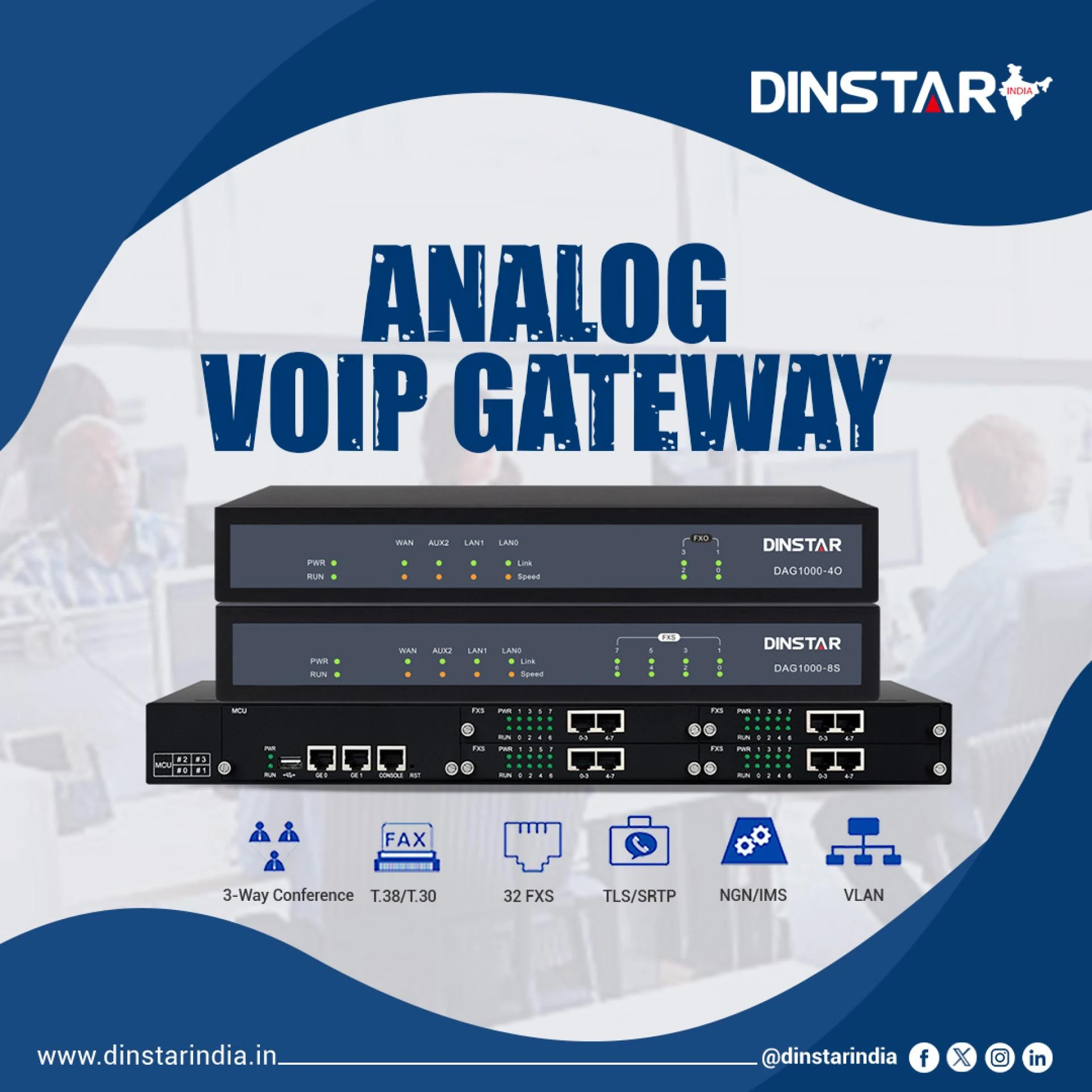
In today’s rapidly evolving communication landscape, businesses are steadily moving toward VoIP (Voice over Internet Protocol) solutions for their cost efficiency, flexibility, and scalability. However, many organizations still rely on traditional analog phone systems for day-to-day operations. This creates a need for a bridge — and that’s where Analog Gateways come in.
An Analog Gateway is a crucial piece of hardware that helps businesses transition from legacy phone systems to modern VoIP networks without the need for a complete infrastructure overhaul. If you’re looking to cut costs, improve communication, and maintain your existing phone setup, an Analog VoIP Gateway is the right solution.
In this blog, we’ll break down what an Analog Gateway is, how it works, its key features, and why it’s an excellent investment for businesses of all sizes.
What is an Analog Gateway?
An Analog Gateway (often referred to as a VoIP Gateway) is a device that connects traditional analog phone systems — like PSTN (Public Switched Telephone Network) lines or legacy PBX systems — with modern VoIP networks. In simple words, it allows your old analog phones to work on an IP-based system without replacing the entire infrastructure.
For businesses that are gradually shifting to VoIP but want to retain their existing telephony investment, an Analog Gateway makes the process seamless.
How Does an Analog Gateway Work?
An Analog VoIP Gateway works by converting analog voice signals into digital VoIP packets and vice versa. This allows calls from analog devices (like fax machines, analog phones, or PBX systems) to travel over an IP network.
Here’s a simplified breakdown:
- Analog to Digital Conversion: The gateway takes analog voice signals from traditional phones and converts them into digital data packets.
- Transmission Over IP: These packets are sent over the VoIP network using SIP (Session Initiation Protocol) or other signaling protocols.
- Digital to Analog Conversion: When receiving a call, it converts the digital packets back into analog signals for your legacy devices.
This two-way communication enables businesses to use existing analog systems while leveraging the benefits of VoIP.
Key Features of an Analog Gateway
When considering an Analog VoIP Gateway, look for these essential features:
1. Multi-Port Options
Analog Gateways are available in different configurations like 4-port, 8-port, 16-port, or even higher depending on the number of devices you need to connect.
2. Protocol Support
Most gateways support SIP and H.323, ensuring smooth integration with various VoIP systems and IP PBX platforms.
3. High-Quality Voice Transmission
With support for advanced voice codecs like G.711, G.729, and G.723, you can expect crystal-clear voice quality.
4. Easy Integration
Analog Gateways work well with IP PBX systems, hosted VoIP services, and traditional PBX setups, ensuring flexible deployment.
5. Enhanced Security
Modern gateways come with TLS and SRTP encryption, protecting voice data from cyber threats.
6. Fax over IP (FoIP) Support
For businesses that still rely on faxing, many Analog Gateways support T.38 protocol, enabling smooth fax transmission over IP networks.
Benefits of Using an Analog Gateway
1. Cost-Effective Transition to VoIP
Switching entirely to VoIP can be expensive, especially for businesses with a large number of analog phones. Analog Gateways allow you to retain your existing phone systems while gradually moving to VoIP, significantly reducing costs.
2. Protects Existing Investments
You don’t need to replace all your analog phones, fax machines, or PBX systems. Instead, an Analog Gateway lets you keep using them with an IP-based communication network.
3. Scalable Solution
Whether you run a small office with a few phones or a large enterprise, Analog Gateways are available in multiple port sizes, making them easily scalable.
4. Improved Call Quality
Thanks to advanced voice compression and echo cancellation technologies, Analog Gateways ensure superior call clarity and reliability.
5. Business Continuity
In case of internet or VoIP service disruptions, Analog Gateways can fall back to PSTN lines, ensuring uninterrupted communication.
Who Should Use an Analog Gateway?
Analog Gateways are ideal for:
- Small and Medium Enterprises (SMEs): Businesses looking to shift to VoIP without large upfront costs.
- Enterprises with Legacy PBX: Companies that want to integrate IP telephony while retaining their traditional PBX systems.
- Call Centers: Centers that require multiple analog lines but want to benefit from VoIP features like call routing and analytics.
- Organizations Using Fax Machines: Businesses that still rely on faxing can benefit from FoIP (Fax over IP) capabilities.
Analog Gateway vs. Digital Gateway: What’s the Difference?
While both Analog and Digital Gateways connect traditional telephony systems to IP networks, the difference lies in their compatibility:
- Analog Gateways: Connect analog phones, fax machines, and legacy PBX systems to VoIP.
- Digital Gateways: Integrate digital PBX systems (PRI/E1/T1) with IP-based networks.
For small to medium-sized businesses with analog systems, Analog Gateways are a practical choice.
Why Choose Dinstar Analog Gateways?
If you’re looking for a reliable Analog VoIP Gateway, Dinstar offers some of the best solutions in the market.
Dinstar Analog Gateways come with:
- Multiple port options (4, 8, 16, and higher)
- Seamless SIP protocol compatibility
- High-quality voice transmission with advanced codecs
- Secure communication with TLS/SRTP support
- Easy installation and management
With Dinstar’s robust range of gateways, businesses can easily integrate VoIP without giving up their existing telephony infrastructure.
Final Thoughts
The Analog Gateway is an indispensable tool for businesses looking to embrace VoIP technology without discarding their traditional phone systems. It provides cost savings, improved call quality, and smooth integration with modern communication platforms.