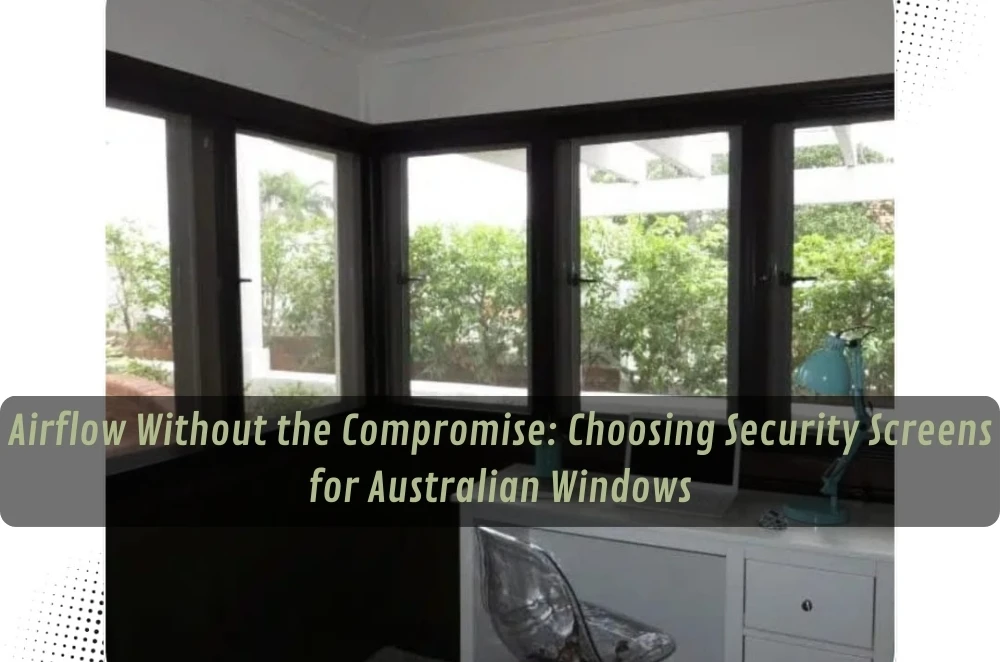
In a lot of Australian homes, the best temperature control tool isn’t a thermostat—it’s a window that can be opened confidently. Cross-breezes take the edge off humid afternoons, cooler night air can reset a warmed-up house, and fresh airflow helps everyday comfort in ways that are hard to replicate mechanically.
But the moment you start leaving windows open more often, you also start noticing the friction points: ground-floor windows that feel exposed, side windows that face a boundary fence, or bedrooms where you’d love to ventilate at night but don’t feel comfortable doing so. That’s the gap security screens are meant to fill: a barrier that’s tougher than a standard insect screen while still allowing the home to “breathe”.
The challenge is that not all security screens deliver that promise equally. Some noticeably reduce airflow. Others look fine on day one but degrade faster than expected in coastal or high-UV conditions. And some systems are only as strong as their frame design and installation quality.
This editorial walks through what to pay attention to if your goal is straightforward: better ventilation without giving up on security.
Why “airflow” isn’t a simple yes-or-no
When people talk about airflow through a screen, they usually mean the same lived experience: does the room feel fresher? Do you actually notice the breeze? Can you ventilate without the house feeling sealed?
Technically, airflow depends on:
- Open area: how much of the screen is empty space vs wire.
- Mesh geometry: the size and shape of openings and the thickness of wires.
- Pressure and wind direction: where the breeze comes from and what other openings exist.
- Window type and effective opening: how much the window can actually open.
A big takeaway: even the “best” mesh can’t overcome a window that only opens a small portion of its total area. A sliding window that opens half-width will always move less air than a wide-opening casement, all else equal. So screens should be assessed as part of the whole ventilation setup, not as a standalone fix.
What stainless steel brings to the table
Security screening generally falls into a few broad material categories, with stainless steel often positioned as the higher-strength option. The reason is simple: stainless steel mesh can be manufactured to resist cutting and deformation more effectively than lightweight insect mesh.
If you’re comparing products, the two most practical questions are:
- What grade of stainless steel is used?
- How is that mesh integrated into the frame system?
The “stainless steel” label by itself isn’t enough to judge performance or durability—especially in Australian conditions where salt air, windborne grit, and intense sun can punish exposed materials.
Security is a system, not a material
A common mistake is to treat mesh as the whole story. In practice, security performance depends on the combined strength of:
- The mesh (resistance to cutting, tearing, and deformation)
- The retention method (how the mesh is held in the frame)
- The frame (rigidity, corner strength, fastener design)
- The fixings and hardware (locks where relevant, hinges, screws, rivets)
- Installation (fit, sealing, anchoring into the substrate)
A strong mesh can be undermined by weak retention. A rigid frame can be compromised by poor anchoring. And even small gaps or misalignment can create leverage points.
If security is a serious driver for you (not just “a bit extra peace of mind”), ask for clarity on what exactly is being supplied: the complete tested system and configuration, not just a mesh type described in isolation.
The airflow side of the equation
Security screens can still feel airy—if you choose with ventilation in mind. Here’s what tends to make the difference inside the home.
Mesh openness and “feel”
Two meshes can look similar in a sample patch and feel very different when installed. A small swatch is useful for finish and colour, but it doesn’t always predict airflow and visibility.
When you can, view a full installed panel or a large sample. From a typical viewing distance, you’ll quickly notice:
- whether the mesh reads as a “veil” or fades into the background
- whether it cuts glare
- whether it changes the sense of openness in the room
Window style and placement
If airflow is the priority, take a quick ventilation inventory:
- Which rooms get the best breeze?
- Where does air enter vs exit?
- Are there internal doors or hallways that block flow?
- Do you need security screens most in rooms that already struggle to ventilate?
Often, the best results come from pairing security screens with smart window usage: opening windows on opposite sides of the home, cracking open high and low openings to encourage stack effect, or improving internal pathways so air can travel.
Night ventilation and confidence
Many people consider security screening specifically to make night ventilation more realistic—especially during heat waves when the house holds onto warmth after sunset. That use case benefits from screens that are robust and well-fitted, but also from practical details like smooth window operation and secure latches (where applicable).
Coastal and high-UV conditions: durability matters
Australia’s climate isn’t one thing. A screen that performs well inland can age differently near the coast. Salt deposits, constant wind, and high humidity can accelerate corrosion and surface staining if materials and finishes aren’t chosen appropriately. Intense UV can also degrade some coatings and finishes over time.
If you’re in a coastal area, durability isn’t just about avoiding rust—it’s also about maintaining appearance and function. Screens can accumulate salt and grime, and if they’re not maintained, tracks and hardware can become sticky or gritty, reducing the likelihood you’ll actually use the windows as intended.
A realistic mindset helps here: even a premium system benefits from sensible maintenance, and cleaning schedules are often more important near the ocean.
Installation is where good products can fail
One of the least glamorous parts of choosing security screens is also the most consequential: installation quality.
A well-installed screen should sit flush, operate smoothly with the window, and avoid:
- rattle or flex at the perimeter
- visible gaps that invite insects (or create pry points)
- uneven alignment that stresses corners or fixings
- fasteners that are poorly seated or placed into a weak substrate
If you’re assessing quotes, it’s reasonable to ask:
- How the screen is fixed into the opening
- Whether the installer is addressing the specific window type and condition
- What happens if the frame reveals are uneven (common in older homes)
You don’t need to become an expert. The goal is simply to confirm that the work is being treated as a fitted, structural upgrade—not as a generic add-on.
Practical selection checklist
If your goal is exactly what you described—ventilation plus security—use this checklist to keep comparisons honest:
- Mesh: stainless steel grade, weave/open area, finish/coating (if relevant)
- System strength: mesh retention method, frame construction, and corner joining
- Compatibility: window type, opening size, and how you actually ventilate the room
- Environment fit: coastal vs inland, sun exposure, cleaning realities
- Installer quality: fit, sealing, anchoring method, alignment, aftercare support
- Use case: night ventilation, ground-floor bedrooms, side/rear windows, pets, etc.
Your exact anchor phrase (bolded for easy search)
If you’re placing this as the keyword phrase you’ll link later, here it is included verbatim and bolded exactly as requested: stainless steel window screening for airflow plus security
Key Takeaways
- Airflow through a security screen depends on mesh openness, window type, and overall ventilation pathways—not just the material name.
- Stainless steel security mesh can provide a stronger barrier than standard flyscreen mesh, but security performance relies on the whole system (mesh + frame + retention + installation).
- For real comfort gains, assess screens room-by-room based on how you ventilate in daily life (especially at night).
- In coastal and high-UV areas, material choices and sensible maintenance can significantly affect longevity and appearance.
- Installation quality is often the deciding factor between a screen you trust and use and one that becomes an expensive compromise.