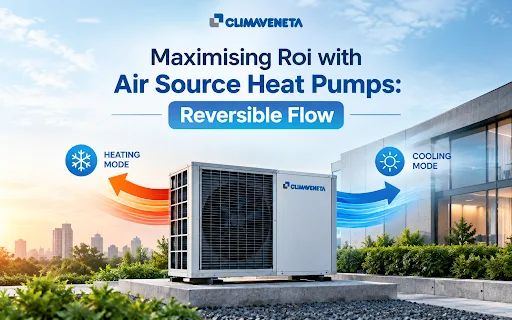
Maximising ROI with Air Source Heat Pumps: Reversible Flow
Have you ever calculated how much money your facility spends on idle equipment?
For decades, standard industrial practice dictated a predictable blueprint. You bought boilers to heat. You bought chillers to cool. That meant two major capital investments. Two separate maintenance contracts. Two complex systems taking up valuable physical space on your property.
But what if a single machine could handle both jobs seamlessly?
Modern industrial facilities are moving toward air source heat pumps. The reason is simple. They rely on a single, powerful engineering breakthrough: reversible flow.
If you are a facility director, operations manager, or executive decision-maker, this isn’t just a minor technical detail. It is a massive financial and operational advantage for your factory or corporate headquarters.
Let's look at exactly how Air Source Heat Pumps technology work, how it keeps your facility agile, and why it changes the financial math when compared to traditional, one-way cooling systems.
The Core Principle: Moving Energy vs. Creating It
Before looking at the reversible mechanism, we must address a common misconception. Do air source heat pumps generate heat through combustion or massive electrical resistance coils?
No, they do not.
Instead, they act as highly efficient thermal movers. They hunt for ambient thermal energy, capture it, and relocate it.
The system uses a specialized refrigerant fluid to accomplish this task. Think of this fluid as a thermal sponge. In the winter, it absorbs ambient warmth from the outdoor air. Yes, even in freezing winter temperatures, usable heat energy exists. The system compresses this refrigerant to raise its temperature rapidly. Finally, it releases that concentrated heat directly into your facility's air handling units or radiant hydronic loops.
The process is incredibly efficient. However, the real operational value unlocks when the seasons turn and your production needs shift.
Reversible Flow: The Ultimate Shift in Function
What happens when summer arrives and your production floor starts overheating? Do you shut down your heating plant and spin up a completely separate air conditioning network?
Not anymore. You simply let the system flip the script.
Inside a reversible air source heat pumps sits a critical component called a four-way reversing valve. When your facility demands a shift from heating to cooling, this valve physically reroutes the path of the refrigerant gas.
- In Heating Mode: The outdoor coils absorb environmental heat. The indoor network releases that heat into your building.
- In Cooling Mode: The valve switches instantly. The indoor coils now absorb internal heat from your factory floor or warehouse. The outdoor unit expels that heat into the atmosphere.
With one automated command from your building management system, your primary heating asset transforms into a high-powered cooling system.
What does this mean for your bottom line? It means you have one integrated asset; Air Source Heat Pumps driving maximum return on investment all year round. You eliminate seasonal idle time. You stop paying for redundant hardware. Why maintain two systems when one can do double duty?
The One-Directional Boundary: Why Air Cooled Chillers Limit Flexibility
To understand why reversible engineering is such a milestone, look at the traditional alternative: air cooled chillers.
Don’t chillers use a similar refrigeration cycle to move heat away from a building? Yes, they absolutely do. But they operate on a strictly one-directional loop.
An air cooled chiller is engineered for a single, hyper-focused task. It strips heat out of your facility's internal chilled water loop and rejects it outdoors. It is a fantastic tool for generating cold water for process cooling or heavy-duty air conditioning.
However, it cannot reverse its flow. It cannot warm your corporate offices or manufacturing lines during a winter freeze.
Let's look at the operational differences side-by-side:
Functional MetricReversible Air Source Heat PumpsAir Cooled ChillersFlow CapabilityTwo-way (Reversible loop)One-way (Cooling loop only)Primary OutputDelivers both space heating and coolingDelivers dedicated process/space coolingEquipment FootprintReplaces the need for independent boilersRequires an independent heating plantAsset UtilizationActive through every single seasonFrequently idle during colder monthsIf your industrial process creates a massive, non-stop heat load that requires intense cooling 365 days a year, a dedicated air cooled chiller makes perfect sense. It is a reliable, single-purpose workhorse.
But what if your facility experiences dynamic, changing climate needs? What if you need to heat the warehouse areas in the morning but cool down heavy machinery spaces by afternoon?
Choosing an air cooled chiller means you must purchase, install, and maintain a secondary boiler or gas heating grid to handle the colder months. Is that the best use of your capital?
Driving Executive Value: Why the Market is Shifting
As a business leader, you evaluate infrastructure based on financial metrics, risk mitigation, and operational continuity. Why are modern companies prioritizing reversible technology over single-purpose assets?
1. Optimization of Capital Expenditure (CapEx)
Why fund two commercial HVAC projects when you can fund one? Choosing a single, reversible system lowers your initial procurement costs. It also frees up premium structural space on your roof or utility grounds. Less equipment means less upfront capital deployment.
2. Reduction in Operational Expenditure (OpEx)
Think about your facility maintenance team. Is it easier to service one integrated system or manage two entirely different mechanical frameworks? Reversible units mean fewer spare parts to inventory, streamlined service contracts, and simplified training for your internal engineering staff.
3. Strategic Risk Management and Compliance
Regulatory frameworks are penalizing fossil-fuel combustion more heavily each year. Relying on gas boilers introduces long-term compliance risks and carbon tax liabilities. Because air source heat pumps run entirely on electricity and achieve operational efficiencies of 300% to 400%, they seamlessly future-proof your facility and align directly with corporate net-zero targets.
The Long-Term Decision
Every infrastructure choice you make impacts your corporate balance sheet for the next fifteen to twenty years.
Relying on one-directional hardware like traditional air cooled chillers locks your business into a dual-system dependency. It guarantees redundant maintenance paths and underutilized assets that sit dark for half the year.
Reversible flow changes the financial equation entirely. It grants your facility the operational agility to respond to changing weather patterns and production demands instantly, using a single piece of hardware.
Take a look at your current utility costs and asset roster. Are you paying to maintain idle equipment? Is it time to make your primary HVAC asset pull double duty for your company?
The choice of Air Source Heat Pumps isn't just about managing temperature anymore. It is about smart asset utilization, protecting your margins, and future-proofing your business.
Climaveneta India helps you identify the best equipment whether it's for Air Source Heat Pumps or air cooled chillers for your industry and maximize the ROI in the best possible way.