For years, traditional search engines have been the starting point for online shopping. Consumers searched for products on Google, browsed websites, compared prices, read reviews, and visited multiple ecommerce stores before making a purchase. Brands focused on search engine rankings, keywords, and website traffic to attract potential customers.
But shopping behaviour is beginning to change.
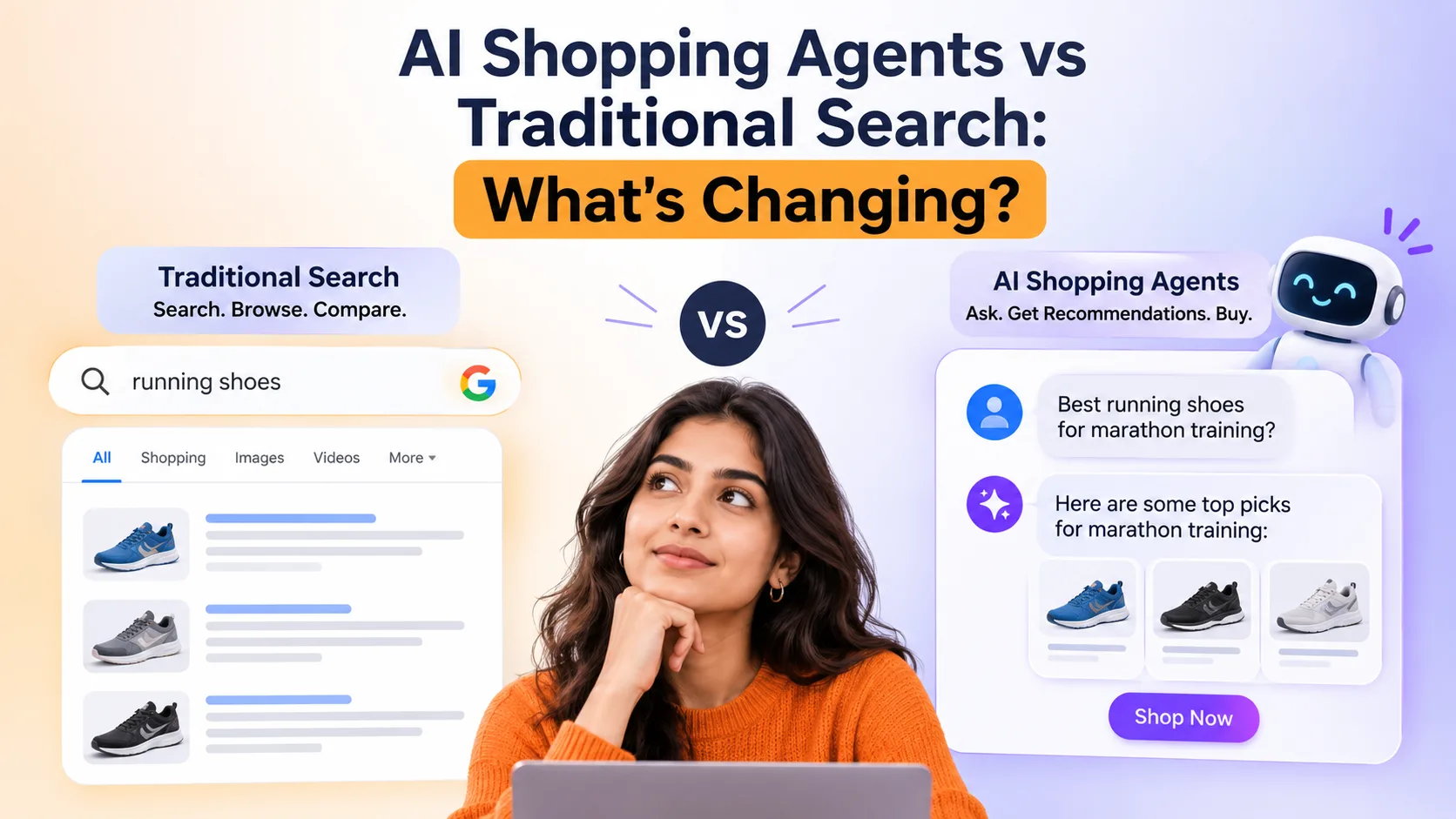
With the rise of AI shopping agents, consumers can now discover products, ask questions, compare alternatives, and receive personalized recommendations through AI-powered platforms. Instead of searching through pages of links, shoppers can describe what they need and let AI assistants help them find suitable products.
This shift is changing how consumers discover products and how ecommerce brands need to approach product visibility.
What Is Traditional Search in Ecommerce?
Traditional search relies on keywords and search engine results to help consumers find products. When someone searches for a product on Google, the search engine displays relevant websites, product listings, advertisements, and other results.
The shopper then needs to visit different websites, compare product specifications, check reviews, and decide which option best meets their requirements.
For ecommerce brands, visibility largely depends on search engine optimization (SEO), keyword relevance, backlinks, website performance, and product page quality.
Traditional search gives brands an opportunity to attract customers through organic rankings. However, the responsibility of evaluating products and making purchasing decisions largely remains with the shopper.
What Are AI Shopping Agents?
AI shopping agents are intelligent systems that help consumers discover, evaluate, and select products using artificial intelligence.
Unlike traditional search engines, they can understand conversational questions, interpret shopping requirements, and provide recommendations based on context.
For example, a shopper looking for a skincare product might ask an AI shopping assistant:
"I need a lightweight moisturizer for oily skin that is suitable for sensitive skin and works well under makeup."
Rather than simply displaying links containing those keywords, an AI shopping agent can interpret the requirements and recommend products based on their ingredients, skin compatibility, product descriptions, and available information.
Platforms and experiences such as ChatGPT shopping, Google AI Mode, Amazon Rufus, and Walmart Sparky are contributing to this shift in product discovery.
The experience is becoming more conversational, personalized, and focused on helping shoppers make decisions.
AI Shopping Agents vs Traditional Search: Key Differences
The biggest difference between traditional search and AI shopping agents is how consumers discover and evaluate products.
Traditional search provides a list of relevant results, while AI shopping agents help interpret shopping needs and generate recommendations.
Here are some important differences:
1. Keyword Search vs Conversational Discovery
Traditional search depends heavily on keywords. Consumers need to think about what to search for and often try multiple search queries to find relevant products.
AI shopping agents allow shoppers to describe their requirements naturally. They can ask detailed questions about product features, compatibility, ingredients, pricing, and use cases without repeatedly changing their search terms.
2. Search Results vs Product Recommendations
Traditional search engines present links, product listings, and advertisements that shoppers must evaluate themselves.
AI shopping agents can narrow down product choices and provide recommendations based on the shopper's requirements. This reduces the effort involved in comparing multiple products.
3. Manual Comparison vs AI-Assisted Evaluation
In traditional ecommerce, shoppers often open several product pages to compare specifications, features, prices, and customer reviews.
AI shopping agents can help evaluate products against specific requirements and highlight relevant differences, making the discovery process more convenient.
4. Website Rankings vs Product Data Quality
Traditional SEO focuses on improving website visibility through keywords, content quality, backlinks, and technical optimization.
AI shopping visibility also depends on how effectively product information can be accessed, interpreted, and matched with shopper requirements.
Product attributes, descriptions, specifications, compatibility details, and contextual information become increasingly important.
5. Traffic Generation vs Recommendation Visibility
Traditional search strategies primarily aim to generate clicks and bring visitors to ecommerce websites.
With AI shopping agents, brands also need to consider whether their products are discovered, understood, and recommended within AI-generated shopping experiences.
This introduces a new layer of product visibility that goes beyond traditional search rankings.
Why Is Product Content Becoming More Important?
As AI shopping agents become part of the purchasing journey, product content is becoming a critical factor in ecommerce discovery.
AI systems need accurate and sufficiently detailed product information to understand what a product offers and determine whether it matches a shopper's requirements.
Consider an electronics product. A basic product description might mention its brand, model, and technical specifications. However, shoppers may ask more specific questions:
- Is this device compatible with my existing setup?
- Is it suitable for professional use?
- What makes it different from other models?
- Does it support a particular feature?
If the product page does not provide these details, an AI shopping agent may struggle to establish whether the product meets the shopper's requirements.
This is why ecommerce brands need to move beyond basic product descriptions and create content that answers real shopper questions.
Detailed attributes, clear specifications, relevant use cases, compatibility information, and accurate product data can help improve product understanding across AI-driven discovery platforms.
How Should Ecommerce Brands Prepare for AI Shopping Agents?
The shift towards AI-assisted shopping does not mean traditional SEO is becoming irrelevant. Search engines will continue to play an important role in product discovery.
However, brands need to expand their optimization strategies to account for AI-driven shopping experiences.
Here are five areas ecommerce businesses should focus on.
1. Improve Product Information
Ensure every product page contains accurate descriptions, specifications, attributes, ingredients, compatibility information, and relevant use cases. Avoid incomplete or generic product descriptions.
2. Focus on Shopper Questions
Identify the questions consumers are likely to ask AI shopping agents before purchasing a product. Create content that directly answers those questions with clear and relevant information.
3. Strengthen Product Data Structure
Organize product information consistently so AI systems can identify important attributes and understand relationships between product features, categories, and use cases.
4. Monitor AI Shopping Visibility
Evaluate whether products are appearing in relevant AI-generated recommendations. Monitor how different AI shopping platforms interpret and present your product information.
5. Adopt Agentic Commerce Optimization
Traditional SEO alone may not address every requirement of AI-powered product discovery. Brands should explore Agentic Commerce Optimization (ACO) to improve how their product content is accessed, interpreted, and matched with shopper queries across AI shopping environments.
The Rise of Agentic Commerce Optimization
As AI shopping agents become more influential in product discovery, ecommerce brands need a way to understand whether their product content is ready for this new environment.
This is where Agentic Commerce Optimization (ACO) becomes important.
ACO focuses on improving product content and data so AI shopping agents can understand, evaluate, and recommend products more effectively.
At Enaiblex, the ACO Score measures ecommerce content readiness through two equally weighted dimensions:
- Agent Indexability (50 points): Measures how easily AI systems and shopping agents can access, understand, and interpret product information.
- Shopper Query Coverage (50 points): Measures how effectively product content answers the questions shoppers ask AI shopping agents.
Together, these dimensions contribute to an overall score out of 100, helping brands understand where their product content needs improvement.
Rather than focusing only on traditional search rankings, ACO helps ecommerce businesses assess their readiness for AI-driven product discovery.
What Does the Future of Ecommerce Search Look Like?
Traditional search and AI shopping agents will likely coexist, but the way consumers interact with them will continue to evolve.
Some shoppers will continue searching Google for products, while others will increasingly rely on conversational AI assistants to discover products and compare alternatives.
For ecommerce brands, this means visibility will no longer be determined by website rankings alone. Product information must also be detailed, accurate, relevant, and understandable to AI shopping systems.
The brands that prepare their product content for both traditional search engines and AI shopping agents will be better positioned to adapt to changing consumer behaviour.
The shift is already underway. The real question is: Are your product pages ready for AI-driven shopping?