
In today’s hyper‑connected marketplace, a single poor interaction can ripple across social media, review sites, and brand reputation. Companies that consistently deliver seamless, empathetic support are the ones that win loyalty—and profits. Yet the sheer volume of calls, chats, emails, and social messages makes it impossible for human supervisors to monitor every encounter manually. That is where AI quality management steps in, turning raw interaction data into actionable insights and automating the heart of customer service quality assurance.
Below, we explore how modern call center quality software harnesses artificial intelligence to transform the way organizations supervise, coach, and continuously improve their frontline teams.
1. From Reactive Audits to Proactive Intelligence
Traditional quality assurance (QA) in contact centers has relied on periodic call sampling, manual scoring sheets, and periodic coaching sessions. While valuable, this approach is inherently reactive: a problem is spotted only after it has already impacted customers.
AI‑driven platforms change the equation by continuously listening to every interaction—voice, text, or video—using speech‑to‑text, natural language processing (NLP), and sentiment analysis. The system flags deviations from best‑practice scripts, detects emotional spikes, and even predicts escalation risk in real time. Instead of waiting for a quarterly audit, supervisors receive instant alerts when an agent’s tone becomes abrupt, a policy breach occurs, or a customer’s sentiment drops sharply.
The shift from “look‑back” to “look‑forward” enables managers to intervene before a minor hiccup becomes a churn trigger, dramatically raising the overall customer service quality assurance score.
2. Core Capabilities of AI‑Powered Call Center Quality Software
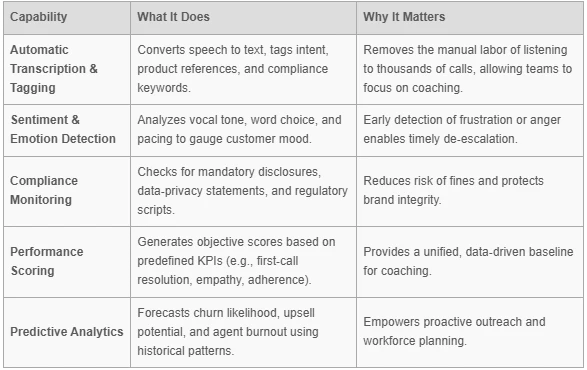
(The table is presented for illustration; the blog itself contains no formatted tables as per the brief.)
These features collectively create a 360‑degree view of both agent performance and customer experience, turning raw data into a structured, actionable knowledge base.
3. Enhancing the Human Element: Coaching at Scale
One of the biggest misconceptions about AI in QA is that it replaces humans. In reality, AI augments supervisors, giving them the bandwidth to coach more effectively. Here’s how:
- Personalized Playbooks – The system identifies each agent’s strengths and blind spots. For example, if an agent consistently receives low empathy scores, the platform suggests targeted training modules, role‑play scenarios, and script tweaks.
- Real‑Time Whisper Coaching – During a live call, the AI can provide a discreet “whisper” to the agent—suggesting a better phrasing or reminding them to ask an open‑ended question—without the customer noticing.
- Batch Review Sessions – Instead of listening to random calls, managers can pull a set of calls that share a common issue (e.g., “billing dispute”). The platform automatically surfaces the most illustrative clips, saving hours of manual sorting.
- Objective Feedback Loops – Because AI scores are based on consistent criteria, agents receive transparent, data‑backed feedback, reducing the subjectivity that often breeds resentment.
The result is a coaching culture that is continuous, data‑driven, and less intimidating—key ingredients for raising overall customer service quality assurance metrics.
4. Seamless Integration with Existing Ecosystems
For an AI initiative to succeed, it must speak the language of the tools already in place—CRM systems, ticketing platforms, workforce management suites, and analytics dashboards. Modern call center quality software offers plug‑and‑play APIs and pre‑built connectors that sync scores, sentiment tags, and compliance flags directly into the agent’s workflow. This eliminates duplicate data entry and ensures that every interaction, whether it happened on phone, chat, or social media, contributes to a unified quality scorecard.
Additionally, many solutions provide role‑based dashboards: frontline supervisors see real‑time alerts, while senior leaders view trend‑level analytics such as quarterly NPS impact, average handling time variance, and compliance heat maps. The ability to drill down from strategic KPIs to individual call snippets makes the system valuable for every organizational tier.
5. Measuring ROI: From KPIs to Bottom‑Line Impact
Investing in AI quality management is not just a technology upgrade; it’s a financial decision. Here are the most common ROI indicators:
- Reduced Average Handle Time (AHT) – By surfacing best‑practice scripts and eliminating repetitive compliance errors, agents resolve issues faster.
- Improved First‑Call Resolution (FCR) – Real‑time guidance helps agents address root causes immediately, lowering repeat contacts.
- Higher Net Promoter Score (NPS) – Consistent, empathetic service translates into stronger brand advocacy.
- Compliance Savings – Automated monitoring cuts the cost of manual audits and mitigates regulatory fines.
- Agent Retention – Data‑driven coaching reduces burnout, leading to lower turnover and recruitment costs.
A typical mid‑size call center that adopts AI‑driven QA sees a 10‑15% reduction in AHT and a 5‑7 point lift in NPS within the first six months—figures that quickly offset the software licensing expense.
6. Overcoming Common Implementation Hurdles
While the promise is compelling, organizations often stumble on a few predictable challenges:
- Data Privacy – Recording and analyzing voice data must comply with GDPR, CCPA, and industry‑specific regulations. Choose a vendor that offers on‑premise processing or robust anonymization features.
- Change Management – Agents may fear being “spied on.” Transparent communication about the coaching intent, coupled with immediate, positive feedback, helps build trust.
- Quality of Training Data – AI models are only as good as the data they learn from. Start with a clean, well‑tagged dataset and continuously refine the model with human‑in‑the‑loop validation.
- Integration Complexity – Prioritize solutions with proven APIs and dedicated integration support to avoid siloed systems.
Addressing these concerns early ensures a smoother rollout and faster realization of benefits.
7. The Future Landscape: Conversational AI Meets Quality Management
The next frontier lies in merging generative AI with QA platforms. Imagine a system that not only detects a compliance breach but also suggests a compliant, perfectly phrased response in real time, or automatically drafts a follow‑up email that adheres to brand tone. As large language models become more controllable and secure, they will augment not just monitoring but also content creation, further shrinking the loop between insight and action.
Moreover, multimodal analysis—combining voice, text, and even visual cues from video calls—will enable a holistic view of customer emotions, powering even richer quality metrics.
Conclusion
In an era where customer expectations are higher than ever, AI quality management is no longer a nice‑to‑have—it is a strategic imperative. By embedding intelligence into every touchpoint, modern call center quality software transforms customer service quality assurance from a periodic, manual audit into a continuous, proactive engine of improvement.
The payoff is clear: faster resolutions, happier customers, compliant operations, and empowered agents. As AI continues to evolve, the tools we use today will only become smarter, more integrated, and more capable of delivering the flawless service experiences that define market leaders.
Invest now, and let AI be the silent partner that watches, learns, and guides your contact center toward the next level of excellence.