
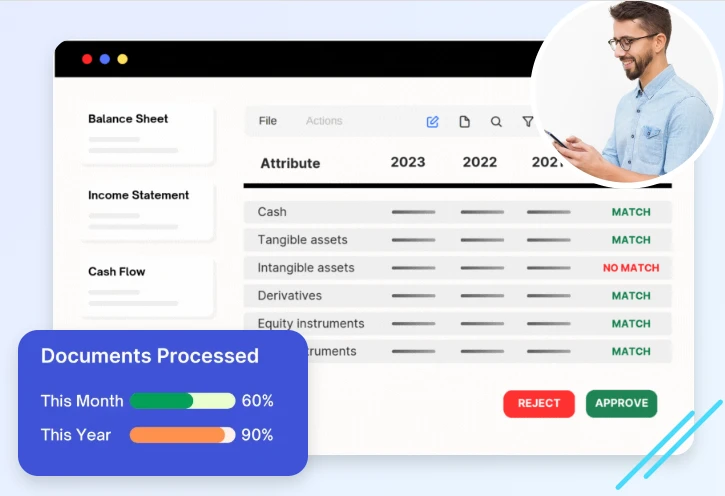
Loan portfolios are growing faster than ever, and the pressure on credit teams is obvious. More statements land on your desk each month, yet expectations for speed and accuracy haven’t relaxed. This blog looks at practical ways to use AI financial spreading to handle that load.
You’ll see how automation reshapes repetitive work, strengthens credit risk analysis, and makes scaling your team’s efforts far less stressful.
Understanding the Strain of High Loan Volumes
When loans increase, so does the paperwork. Each borrower brings in multiple financial statements, which means more ratios, classifications, and notes for you to review. Doing this manually under tight deadlines can slow approvals and create avoidable mistakes.
AI financial spreading cuts into that pressure by automating data extraction, organization, and analysis. Instead of keying numbers into spreadsheets, you can rely on systems to prepare a first draft of spreads. This approach lets you focus on judgment and risk assessment rather than repetitive entry.
Why Accuracy Matters More as Volume Grows
Small errors can create big problems when you’re dealing with hundreds or thousands of statements. A misclassified expense or a mistyped figure affects ratios, risk ratings, and lending decisions. Over time, those issues can damage your portfolio’s performance or even your institution’s reputation.
Accuracy also matters for regulators and auditors who expect consistent treatment of line items. AI systems can help by applying the same rules to every file, reducing inconsistent outputs. As a result, you spend less time chasing down discrepancies and more time making confident decisions.
Streamlining Data Collection and Entry with AI
Collecting and typing numbers from different documents consumes more hours than most credit professionals care to admit. AI changes this by capturing data directly from uploaded files. The software can identify line items, read figures, and place them into the right categories automatically.
You can make this process even smoother by standardizing how your borrowers submit their documents. For instance, encourage common file formats or naming conventions. When your inputs are clean, the AI runs faster and produces better results. This frees up your team for analysis instead of busywork.
Handling Diverse Statement Formats at Scale
One of the toughest parts of spreading financials at scale is inconsistency. Each borrower may present their balance sheet and income statement in a different format, leaving you to interpret where each number belongs. Manually doing this slows you down and increases the chance of misinterpretation.
AI tools can adapt to different layouts and learn patterns from past uploads. Over time, the system improves its mapping accuracy and produces a standardized view across all clients. This consistency makes it much easier to compare borrowers and spot outliers. You’ll spend less time figuring out each file and more time on analysis.
Using AI to Enhance Credit Risk Analysis
With the heavy lifting of data entry off your shoulders, you can shift attention to interpreting the results. AI-based tools can instantly calculate ratios, identify trends, and highlight warning signs you might otherwise miss under time pressure.
These systems also handle comparisons across periods or against industry benchmarks. When volumes rise, such automated checks help you prioritize which accounts deserve deeper review.
Dashboards or automated scoring tools can give you a real-time view of risk across your entire portfolio. This allows you to focus on relationships and decision-making, rather than chasing spreadsheets.
Maintaining Compliance and Audit Trails at Scale
More loans mean more regulatory oversight. Every number you use in a lending decision must be traceable back to its source. When you’re spreading financials manually, tracking each adjustment can be tedious and prone to gaps.
AI systems automatically record each step of the process such as what was imported, what was classified, and what changes were made. This creates a built-in audit trail that satisfies regulators and internal reviewers. You can strengthen this further by scheduling regular spot checks on AI outputs. Doing so keeps your files aligned with compliance standards while maintaining efficiency.
Preparing Your Team to Work Alongside AI
Introducing AI doesn’t remove analysts from the process but changes their role. Instead of spending hours typing data, your team becomes reviewers and interpreters. They bring context, judgment, and experience to the numbers, something AI can’t replace.
Provide ongoing training to help analysts understand how the software works, how to verify its results, and how to handle edge cases. When your team trusts the system, they’ll move faster and feel more confident in their recommendations. This mix of human expertise and automation gives you a stronger overall workflow and makes scaling much less stressful.
Practical Tips to Keep Performance High
- Set clear document guidelines. Consistency in borrower submissions improves AI accuracy.
- Review outputs early. A quick review after initial processing catches small issues before they grow.
- Adjust rules over time. As your loan portfolio changes, update your AI’s parameters to reflect new data patterns.
- Use dashboards for monitoring. Centralized views of ratios and risk scores help you prioritize workloads.
- Train your staff regularly. Familiarity with the system leads to better oversight and fewer mistakes.
These steps might sound simple, but applied together, they transform how you handle large volumes of financial statements.
Conclusion
Handling higher loan volumes doesn’t have to mean lower accuracy or burned-out analysts. By using AI financial spreading strategically, you give your team the tools to process statements faster, maintain compliance, and improve credit risk analysis. As lending expands, blending technology with human expertise will help you build a stronger and more agile credit operation, one that’s ready for whatever comes next.