
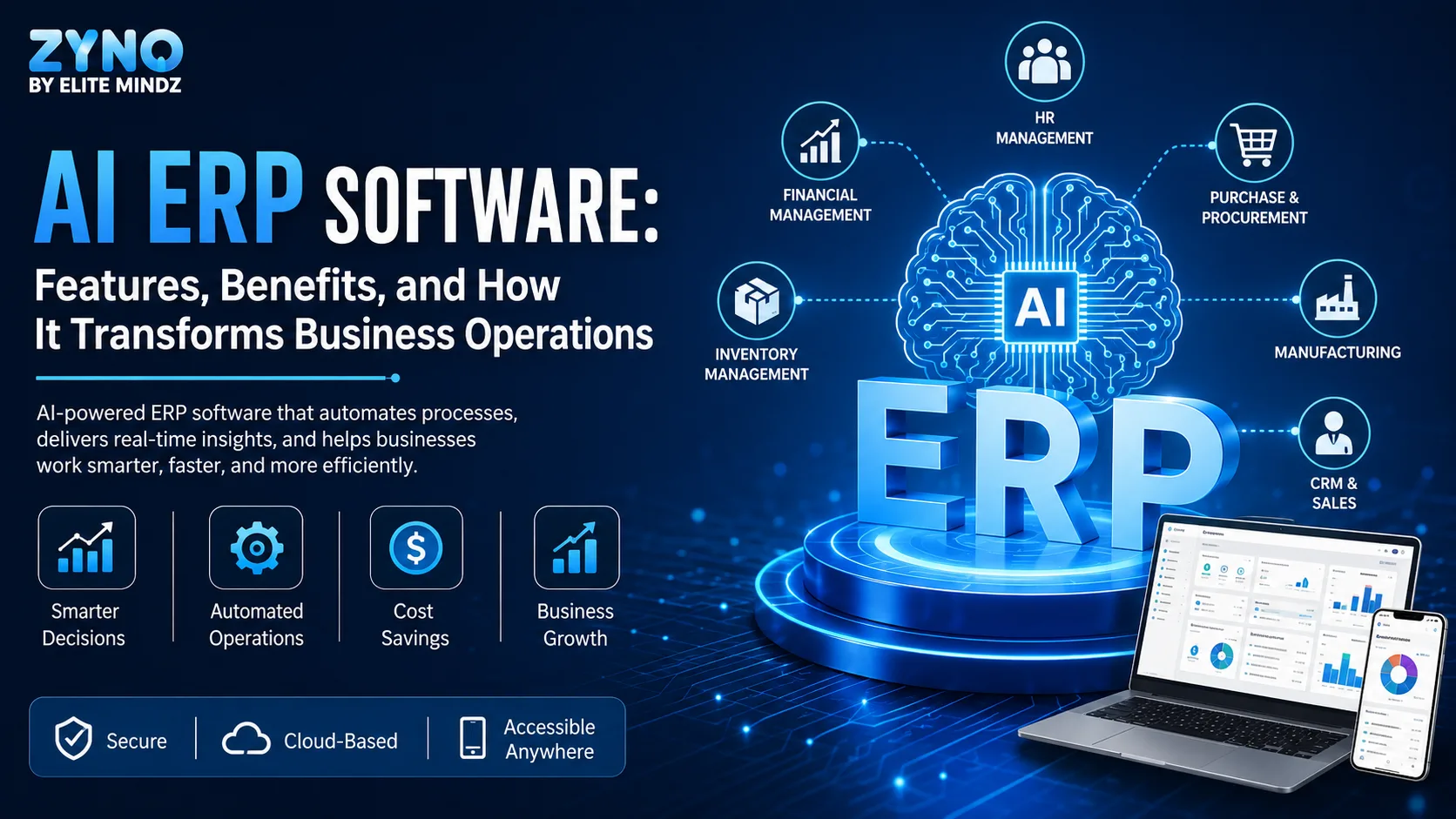
AI ERP Software: Features, Benefits, and How It Transforms Business Operations
Introduction
In today's competitive business environment, organizations need more than just software to manage operations—they need intelligent systems that can automate workflows, analyze data, and support better decision-making. This is where AI ERP software comes into play.
Artificial Intelligence (AI) is transforming traditional Enterprise Resource Planning (ERP) systems by making them smarter, faster, and more efficient. Instead of simply storing business data, AI ERP software analyzes information, predicts trends, automates repetitive tasks, and provides actionable insights in real time.
Whether you're managing finance, inventory, procurement, manufacturing, sales, or human resources, AI ERP software helps streamline business processes while reducing manual effort and operational costs. Businesses across industries are adopting AI-powered ERP solutions to improve productivity, enhance customer experiences, and stay ahead in an increasingly digital marketplace.
In this blog, we'll explore the features, benefits, and business impact of AI ERP software, helping you understand why it's becoming a critical investment for organizations of all sizes.
What Is AI ERP Software?
AI ERP software is an advanced Enterprise Resource Planning system that integrates artificial intelligence technologies such as machine learning, predictive analytics, natural language processing (NLP), and automation into traditional ERP functions.
Unlike conventional ERP systems that primarily store and organize data, AI ERP software continuously learns from business activities. It identifies trends, predicts future outcomes, automates routine tasks, and helps organizations make faster, more informed decisions.
By combining business intelligence with automation, AI ERP software creates a centralized platform that improves collaboration, operational efficiency, and business performance.
Key Features of AI ERP Software
1. AI-Powered Workflow Automation
One of the biggest advantages of AI ERP software is workflow automation. Routine business processes such as purchase approvals, invoice processing, payroll calculations, inventory updates, and expense management can be completed automatically.
Automation reduces manual work, minimizes errors, speeds up approvals, and allows employees to focus on strategic business activities rather than repetitive tasks.
2. Predictive Analytics
Predictive analytics is a powerful feature that enables businesses to forecast future trends using historical and real-time data.
AI ERP software helps organizations:
- Forecast sales demand
- Predict inventory requirements
- Estimate production capacity
- Plan workforce needs
- Identify supply chain risks
- Improve financial planning
This allows businesses to make proactive decisions instead of reacting to problems after they occur.
3. Real-Time Business Intelligence
Modern AI ERP software includes interactive dashboards and live reporting tools that provide instant visibility into business performance.
Managers can monitor:
- Sales performance
- Revenue trends
- Inventory status
- Financial reports
- Procurement activities
- Employee productivity
- Manufacturing operations
Real-time insights improve decision-making and eliminate delays caused by manual reporting.
4. Intelligent Inventory Management
Managing inventory efficiently is essential for business success.
AI ERP software continuously analyzes stock movement, supplier lead times, seasonal demand, and purchasing patterns to optimize inventory levels.
This helps businesses:
- Prevent stock shortages
- Reduce excess inventory
- Improve warehouse utilization
- Lower storage costs
- Enhance order fulfillment
5. Smart Procurement Management
Procurement becomes more intelligent with AI ERP software.
The system automates purchasing workflows while improving vendor management and procurement visibility.
Features include:
- Purchase requisition automation
- Vendor performance analysis
- Automated approval workflows
- Invoice matching
- Purchase order management
- Procurement reporting
These capabilities reduce procurement cycle times and improve purchasing efficiency.
6. Financial Management
AI ERP software simplifies accounting and financial operations by automating routine finance processes.
Key capabilities include:
- General ledger management
- Accounts payable and receivable
- Automated invoicing
- Budget planning
- Cash flow forecasting
- GST and tax compliance
- Financial reporting
AI also helps identify unusual financial transactions and supports better financial control.
7. CRM and Sales Management
AI-powered ERP software strengthens customer relationship management by providing intelligent sales insights.
Businesses can:
- Track customer interactions
- Predict buying behavior
- Prioritize qualified leads
- Monitor sales pipelines
- Generate accurate sales forecasts
- Improve customer retention
Sales teams gain better visibility into customer needs and sales opportunities.
8. Manufacturing and Production Planning
Manufacturing organizations use AI ERP software to improve operational efficiency across production processes.
Key features include:
- Production scheduling
- Material Requirements Planning (MRP)
- Bill of Materials (BOM) management
- Quality control
- Machine maintenance planning
- Resource optimization
AI helps identify production bottlenecks before they impact delivery schedules.
9. Human Resource Management
AI ERP software streamlines HR operations through intelligent automation.
Organizations can automate:
- Employee onboarding
- Attendance tracking
- Leave management
- Payroll processing
- Recruitment workflows
- Performance evaluations
This reduces administrative work while improving employee management.
10. Cloud-Based Accessibility
Most AI ERP software solutions are cloud-based, enabling businesses to access critical information anytime and from anywhere.
Cloud deployment offers:
- Remote accessibility
- Automatic software updates
- Secure data storage
- Reduced IT infrastructure costs
- Easy scalability
Employees can collaborate efficiently regardless of location.
Benefits of AI ERP Software
Increased Productivity
Automation reduces repetitive manual tasks, allowing employees to focus on strategic business initiatives. This leads to faster operations and improved productivity across departments.
Better Decision-Making
With AI-driven insights and real-time dashboards, business leaders can make faster and more informed decisions based on accurate data rather than assumptions.
Reduced Operational Costs
AI ERP software minimizes manual work, optimizes inventory, improves procurement efficiency, and reduces costly business errors, helping organizations lower operating expenses.
Improved Customer Experience
Faster order processing, intelligent CRM capabilities, and accurate inventory management enable businesses to provide better customer service and improve satisfaction.
Accurate Business Forecasting
Predictive analytics helps organizations anticipate future demand, optimize inventory, manage budgets, and prepare for market changes with greater confidence.
Stronger Data Security
Modern AI ERP software includes enterprise-grade security features such as:
- Role-based user access
- Data encryption
- Multi-factor authentication
- Audit logs
- Secure cloud backups
These features help protect sensitive business information.
Scalability
AI ERP software grows with your organization. Whether expanding into new locations or increasing operational complexity, the system can scale without major infrastructure changes.
Industries Using AI ERP Software
AI ERP software is suitable for businesses across various industries.
Manufacturing
Optimize production planning, inventory management, quality control, procurement, and machine maintenance.
Retail
Manage sales, inventory, billing, customer loyalty programs, promotions, and supply chain operations.
Healthcare
Handle patient records, billing, procurement, inventory management, compliance, and financial reporting.
Construction
Track projects, budgets, procurement, workforce, equipment, and resource allocation through one integrated platform.
Education
Manage admissions, student records, payroll, HR, fee collection, finance, and academic operations.
Logistics & Distribution
Improve warehouse management, fleet operations, shipment tracking, procurement, and inventory planning.
How AI ERP Software Drives Digital Transformation
Digital transformation requires organizations to replace disconnected systems with intelligent, integrated platforms.
AI ERP software centralizes business operations by connecting finance, HR, procurement, inventory, sales, manufacturing, CRM, and customer service into one unified system.
The platform continuously analyzes operational data, identifies inefficiencies, automates repetitive processes, and provides actionable recommendations.
By improving collaboration and increasing operational visibility, AI ERP software enables businesses to respond quickly to changing market conditions and customer expectations.
Why Choosing the Right AI ERP Software Matters
Not every ERP solution offers the same level of AI capabilities. Before investing in AI ERP software, businesses should evaluate several important factors:
- AI-powered automation features
- Industry-specific functionality
- Cloud deployment options
- Integration with existing systems
- Mobile accessibility
- Data security and compliance
- Scalability for future growth
- Reporting and analytics capabilities
- Vendor implementation support
- Customization options
Choosing the right AI ERP platform ensures long-term business value, operational efficiency, and a higher return on investment.
Conclusion
AI ERP software is revolutionizing enterprise resource planning by combining traditional ERP functionality with artificial intelligence, automation, and predictive analytics. It empowers businesses to automate routine tasks, gain real-time insights, optimize resources, and improve decision-making across every department.
From finance and procurement to manufacturing, inventory, HR, and customer relationship management, AI ERP software enables organizations to operate more efficiently while reducing costs and increasing productivity.
As businesses continue to embrace digital transformation, investing in a scalable and intelligent AI ERP solution can provide a significant competitive advantage. Organizations that adopt AI ERP software today are better equipped to adapt to changing market demands, improve operational performance, and achieve sustainable business growth.
Frequently Asked Questions
1. What is AI ERP software?
AI ERP software is an enterprise resource planning system that integrates artificial intelligence to automate business processes, analyze data, provide predictive insights, and improve operational efficiency.
2. How is AI ERP software different from traditional ERP?
Traditional ERP systems primarily manage and organize business data, whereas AI ERP software uses artificial intelligence to automate workflows, predict future trends, optimize resources, and support intelligent decision-making.
3. What are the main features of AI ERP software?
Key features include AI-powered workflow automation, predictive analytics, real-time dashboards, inventory management, procurement automation, financial management, CRM, HR management, cloud accessibility, and advanced security.
4. Which industries can benefit from AI ERP software?
AI ERP software is widely used in manufacturing, retail, healthcare, construction, education, logistics, distribution, finance, and service-based businesses.
5. Can AI ERP software help small businesses?
Yes. Modern AI ERP solutions are scalable and suitable for startups, small businesses, medium-sized enterprises, and large organizations, allowing businesses to grow without changing their ERP platform.
6. Is AI ERP software cloud-based?
Most modern AI ERP software is cloud-based, providing secure remote access, automatic updates, improved collaboration, and lower infrastructure costs.
7. How does AI improve ERP software?
AI enhances ERP software by automating repetitive tasks, providing predictive analytics, improving forecasting, detecting anomalies, optimizing workflows, and delivering real-time business insights.
8. What should businesses consider before choosing AI ERP software?
Businesses should evaluate AI capabilities, scalability, customization, cloud support, integration options, security, reporting features, implementation services, industry-specific functionality, and ongoing technical support before selecting an AI ERP solution.