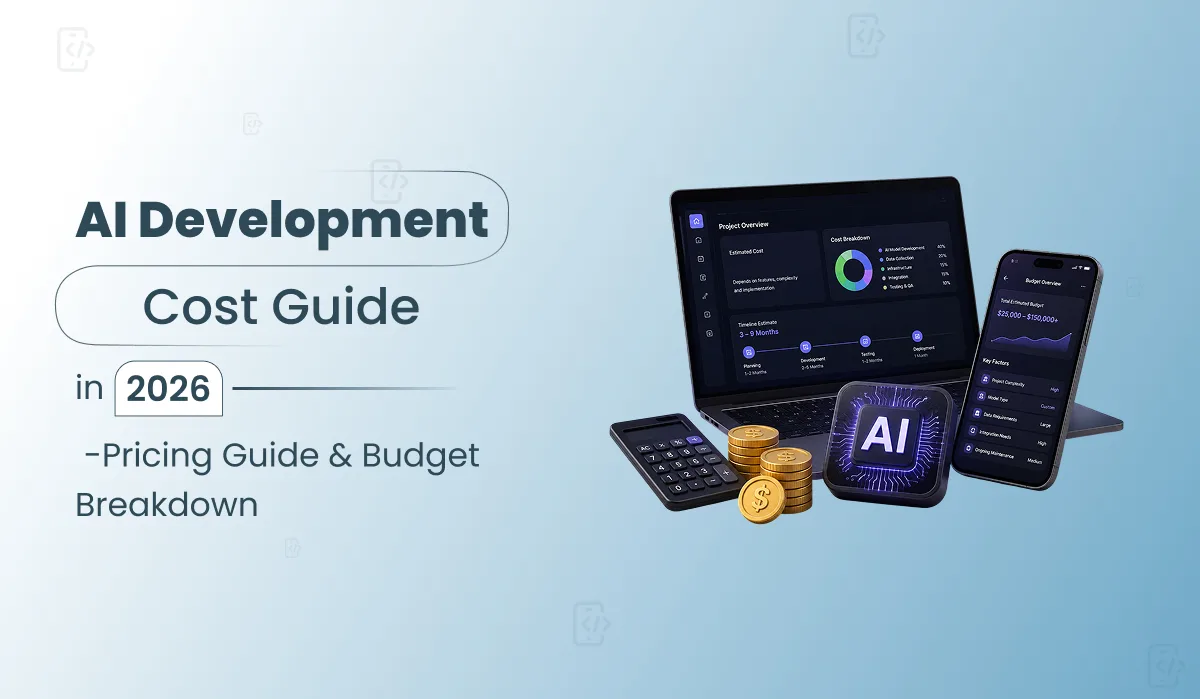
AI development cost in 2026 can range from a focused model or API feature costing a few thousand dollars to a complete AI SaaS platform or enterprise system running into six figures. The gap between those numbers usually isn’t the AI model — it’s product scope, data, integrations, retrieval, agent behavior, user roles, security and evaluation, and how much infrastructure the system needs once it’s live. Whether you’re pricing an AI app development cost for a single feature or a full custom AI development cost for a multi-system platform, the same drivers apply.
How Much Does AI Development Cost in 2026?
Here’s the short version before the details: most custom AI projects land somewhere between $5,000 and $150,000+, and the number is set almost entirely by scope rather than by which AI model is behind it.
2026 planning ranges by project type — not fixed Primocys quotations

These are planning ranges, not fixed Primocys quotations. Independent market estimates can run higher depending on geography, compliance requirements, team model and enterprise scope.
Two companies can ask for “an AI chatbot” and end up with completely different invoices. One means a widget that answers five FAQs using a stock model with no memory of past conversations. The other means a bot that authenticates the customer, looks up their order in an ERP, checks a refund policy, and updates a support ticket — all inside the same-looking chat window. The visible product looks identical. The engineering behind it is not, and neither is the AI solution development cost it needs.
AI Development Cost Is More Than the Model API
Model usage is often the smallest line item in an AI project’s budget. Most of the cost sits in the engineering work required to connect that model safely and usefully to a real business.

A company may spend only a few dollars in model usage during early testing while spending far more engineering time connecting the AI safely to its CRM, knowledge base, authentication, and customer workflow. The model call is often the cheapest and fastest part of the whole build.
AI Development Cost by Solution Type
AI chatbot development cost, RAG system cost, AI agent development cost, and AI SaaS development cost all follow different technical cost profiles. Here’s what typically moves the number up or down within each one.

AI Workflows vs. Screens: What Really Drives Cost
Traditional app estimates often count screens. That approach breaks down for AI systems, because a single chat screen can hide almost any amount of underlying logic.
Consider two versions of the “same” chatbot:
Same interface, different engineering scope

Both versions can use the exact same chat UI. A visitor to the product would see no visible difference between them. But the second one requires authentication logic, a data lookup, a policy engine, a pricing integration, a CRM write, an approval workflow, and a notification system — each of which needs to be built, tested, and monitored on its own. A 10-screen AI app can cost more than a 30-screen normal application if those 10 screens depend on complex retrieval, model evaluation, and business-system actions.
This is why a screen count or page count is a poor proxy for AI project cost. The better question is: how many distinct decisions, lookups, and actions does the AI need to complete per request, and how many of those touch a system where a mistake actually matters?
RAG / Knowledge Assistant
How RAG Changes AI Development Cost
Connecting an AI system to private company knowledge is often described as “uploading some PDFs.” In practice, it involves several distinct engineering steps, each of which affects both quality and cost.
- Content ingestion from documents, wikis, tickets, or databases
- Vector search and hybrid (keyword + semantic) retrieval
- Cleaning inconsistent formatting, duplicates, and outdated content
- Reranking results before they reach the model
- Chunking text into retrievable, meaningfully sized pieces
- Enforcing per-user or per-role access permissions
- Generating and storing embeddings
- Attaching source citations to answers
- Attaching metadata for filtering and permissions
- Refreshing content as source material changes
- Evaluating whether retrieved answers are actually correct
Illustrative range: RAG / Knowledge Assistant — $20K–$60K+ (2026 planning range)
The expensive part of RAG is rarely the vector database by itself. The work is getting the right information into the index, retrieving the right context, respecting access rules, and proving that the answers are actually useful.
A 50-document knowledge base with one user role and no sensitive content is a very different build from an enterprise knowledge platform where different employees are only allowed to see different subsets of the same content, where source material updates daily, and where every answer needs a traceable citation for compliance reasons. The first can be a few weeks of work. The second is closer to a standalone product. For a deeper look at building RAG systems, see our RAG Development page.
AI Agent Cost: Why Agents Cost More Than Chatbots
AI agent development cost comes from the actions it can take and the integrations, permissions, and failure handling those actions require — not from the model that powers its reasoning.

Illustrative range: AI Agent / Multi-Step Automation — $25K–$80K+ (2026 planning range)
A chatbot can answer a question. An agent may need to understand the question, retrieve data, call a business system, validate the result and decide whether a person must approve the action.
Giving an agent permission to read a CRM is one engineering problem. Allowing it to update customer records automatically is a very different risk and testing problem — and that difference is usually where agent budgets grow. See AI Agent Development for more on how we scope agent engineering.
Add AI to Existing Software or Build New?
It depends on the health of what already exists. Existing software can save real money — or it can quietly cost more than starting fresh.
Adding AI to an existing product can save money because authentication, the database, core workflows, and the UI already exist, and users are already using the product day to day. But that advantage disappears quickly if the legacy code is fragile, APIs are missing, permissions are unclear, data is inconsistent, or the original architecture was never designed to support integrations.

If you’re evaluating this for your own product, see AI Integration for Existing Software for how we assess a codebase before scoping the work.
AI API Cost vs. Development Cost
Development cost is the one-time engineering investment to build the system. API or model usage cost is an ongoing operating expense based on volume — similar to a cloud hosting bill. Buyers should plan for both, separately.

API prices change frequently. Reverify against official provider pricing on the publication/update date.
The rough formula behind a monthly AI operating cost looks like this:
Monthly AI cost: (number of requests × average input tokens × input rate) + (average output tokens × output rate) + embeddings / search / tool / voice / infrastructure costs
As an illustrative example only — not a prediction — a support assistant handling a few thousand conversations a month, each involving a modest amount of retrieved context, might land in the low hundreds of dollars in monthly model usage once retrieval and tool calls are included. An enterprise agent making frequent tool calls across a much larger user base could run into the low thousands. These numbers move a great deal based on model choice, context size and request volume, which is exactly why they should be modeled against your actual expected usage rather than assumed.
Several techniques directly affect this ongoing cost: routing simple requests to smaller, cheaper models; caching repeated queries; keeping context size to what’s actually needed; batching non-urgent requests; designing retrieval so the model isn’t fed more text than necessary; and controlling output length. API price is operating cost. Building the product around that API is development cost. Buyers should budget for both.
Ready to scope your AI project properly?
Send over what you’re building and we’ll come back with a real, scoped budget range — not a category average.
AI Development Costs Businesses Often Miss
None of these are dramatic on their own, but they’re easy to leave out of an early budget and then discover later.
- Data cleanup before the AI can use it reliably
- Third-party APIs beyond the core model provider
- Vector database and search infrastructure
- Model usage that scales with adoption, not with the original plan
- Voice, speech-to-text or text-to-speech where applicable
- Observability and logging tooling
- Evaluation datasets and the time to build them
- Human review during early production
- Security work, especially around data access
- Cloud resources beyond the initial estimate
- Ongoing monitoring once the system is live
- Maintenance as provider models change or deprecate
💡 The cheapest model is not automatically the cheapest system. A cheaper model that needs repeated retries or produces more manual review can increase total operating cost.
What Increases AI Development Cost?
The cost of AI development depends on more than features — model complexity, integrations, data requirements, security, scalability, and ongoing optimization can quickly shape your final budget.

How to Reduce AI Development Cost
Cutting scope carelessly produces a weak product. Cutting scope deliberately, around the riskiest unknowns first, produces a lean one.
Budget Control
- Start with one valuable workflow instead of many at once
- Use existing models before considering custom training
- Separate deterministic logic from AI so only genuinely ambiguous steps use the model
- Reuse existing application infrastructure where it’s genuinely solid
- Validate RAG on a small scale before building a giant knowledge platform
- Limit agent tools in V1 to the two or three that matter most
- Establish evaluation before scaling usage, not after
- Route simple tasks to cheaper, smaller models
- Build usage tracking from the beginning, not after a surprise bill
- Postpone “nice to have” AI features until the core workflow is proven
The cheapest V1 is usually not the version with the fewest screens. It is the version with the fewest uncertain workflows.
Build Custom AI or Buy an Existing Tool?
Custom development isn’t always the right call. An honest answer depends on how standard the workflow is and how much the AI needs to become part of the product itself.

AI Project Budget Examples
Illustrative planning scenarios — not Primocys client quotations. These composites show how scope, not model choice, sets the budget.
$20K–$35K
Customer Support Knowledge Assistant
RAG over a website and PDF knowledge base, embedded chat widget, admin panel for content updates, human handoff for unresolved queries.
$25K–$50K
CRM Sales Copilot
CRM integration, account summarization, lead intelligence pulled from historical activity, and AI-assisted outreach drafting inside the existing sales workflow.
$35K–$70K
Multi-Step AI Agent
RAG for policy lookup, integration with two internal business APIs, an approval workflow for higher-risk actions, and full action logging.
$50K–$120K+
AI SaaS Platform
Multi-tenant accounts and workspaces, usage-based billing, a combination of RAG and agent features, and admin tooling for customer-side configuration.
What We Need for an Accurate AI Estimate
A meaningful number depends on specifics, not a category label. Coming prepared with the following turns a generic range into an actual scoped estimate.
The business problem you’re solving
Who the target users are
Current product status (idea, prototype, live product)
Existing source code, if any
Data sources the AI needs to work with
Relevant documents or knowledge base content
CRM or ERP systems involved
External APIs the system needs to call
Specific actions the AI needs to perform
Expected usage volume
Web, mobile, or both
Security or privacy constraints
Target launch window
Without this, any number offered is a guess dressed up as an estimate. With it, a scoped range can be built around your actual workflows instead of a generic category — the difference between an AI project budget that holds up through delivery and one that gets renegotiated at milestone two.
Conclusion: AI Development Cost Comes Down to Scope, Not the Model
Whether you’re pricing an AI chatbot, a RAG system, an AI agent or a full AI SaaS platform, the pattern holds: the AI model is rarely the expensive part. Data, integrations, permissions, evaluation, and production infrastructure are what actually move an AI development cost from a few thousand dollars to six figures.
Use the 2026 planning ranges in this guide as a starting point, not a final number. A focused AI feature can land at $5,000–$15,000, a production AI app usually runs $15,000–$40,000, and RAG systems, AI agents, and AI SaaS platforms climb from there based on data volume, integrations, and how much risk the system is allowed to take on. If you’re ready to move past planning ranges and get a real, scoped AI development cost estimate for your project, our team can help you turn requirements into a number you can actually budget against.
Get your free AI development cost estimate
Tell us what you’re building and we’ll come back with a scoped budget range — not a generic category average.