AI can be revolutionary for any business, but you need to finalize three things before you start utilizing it. This includes the problem you want AI to solve, the data you already have for it, and the metric you will track to find whether it worked.
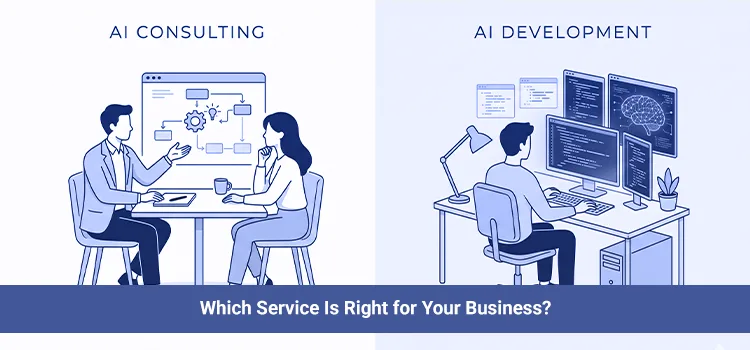
If you can finalize all three, go for AI development services. If you cannot, choose AI consulting first. AI consulting will help in deciding what to build and whether it is worth building, while development builds it, tests it, and keeps it running. This is the basic difference between AI consulting and AI development.
A team that skips consulting can pay to build a model its data can not support. A team that stays in consulting too long ends up with a roadmap and nothing running.
AI Consulting Tells You What to Build and Whether It Pays Off
AI consulting turns a vague interest in AI into a ranked list of projects, each with a cost estimate, a data requirement, and a go or no-go call. Consultants audit your current processes and check whether your data can support an AI model. Next, they consider building on Azure Machine Learning, Google Vertex AI, or AWS SageMaker.
In AI consulting, you receive:
- A roadmap: ranked projects with timing and owners.
- A feasibility study: a verdict on whether your data can support each project.
- A technology recommendation: which platform to use and whether to build or buy.
- A risk review: gaps in data privacy, security, and compliance, such as GDPR obligations.
- An ROI estimate: expected cost set against a measurable outcome.
Picture a regional grocery chain with 60 stores and two years of point-of-sale data. Its buyers set weekly orders from a spreadsheet, and fresh produce spoils before it sells. A consultant checks whether two years of data cover seasonality and promotions, tests a few forecasting approaches on a sample of stores. The consultant tells the chain whether a demand-forecasting model is worth building. The deliverable is a decision, not software.
Consulting has a limit: it produces documents, not working software. If you already know the problem, have the data, and can name the metric, a feasibility study repeats work you have done and delays the build.
AI Development Services Deliver a Working System, Not a Plan
An AI development company designs, builds, tests, and deploys a working system: a model, the application around it, and the connections to your existing software. Depending on the problem, the development team uses machine learning, natural language processing, computer vision, generative AI, or predictive analytics.
In AI development services, you receive:
- Custom applications that match your workflows, such as a support chatbot trained on your help-center articles.
- Process automation that takes over repetitive work like invoice matching.
- Personalized recommendations that suggest products based on what each customer browses and buys.
- Model monitoring that flags when accuracy drops after launch, so the system gets retrained before customers notice.
Picture an online retailer with 8,000 products and a year of clickstream and order history. Its team wants "customers also bought" suggestions on every product page. An AI software development company builds a recommendation engine and connects it to the product catalog and the CRM. It also runs an A/B test against the current page and retrains the model as the catalog changes.
If your data is thin or your goal is fuzzy, you pay for weeks of engineering before you learn the project will not work.
Choose AI Consulting When You Cannot Name the Problem, the Data, or the Metric
Choose consulting if any of these describes you:
- You want AI but cannot say which process to start with.
- You do not know whether your data is clean or complete enough.
- You are weighing build against buy and can not price either one.
- You need an ROI estimate to get the budget approved.
Take a mid-size lender that wants to automate document verification for loan applications. It receives ID scans, pay slips, and bank statements in a dozen different formats. A consultant maps each document type, measures how much of the current volume a machine can already read, and recommends which document types to automate first.
Choose AI Development When Your Problem, Data, and Metric Are Already Defined
Choose development if any of these describes you:
- You need a custom AI application, such as a virtual assistant or an in-app recommendation feature.
- Your existing software can not do the job, even with configuration.
- You want AI connected to systems you already run, such as your CRM, ERP, or inventory database.
- You are launching an AI-powered product.
- You have a documented workflow that you want automated.
An AI app development company builds the mobile or web front end your customers touch. On the other hand, an AI software development company connects the models to your databases, internal tools, and third-party platforms.
Before you sign with any AI development company, ask for three things. This includes a case study in your industry, proof of its security practices such as a SOC 2 report, and a post-launch support plan with named response times.
What AI Consulting and AI Development Cost: Weeks Versus Months
Consulting costs less because it takes weeks. Development costs more because it takes months and keeps costing after launch: cloud hosting, model monitoring, retraining, and security patches.
Price rises when your data is messy, when the system has to connect to older software, and when you need specialist engineers. Consulting also saves money by ruling out unsuitable projects before you pay to build them.
Define one business problem and one measurable target before you request quotes. Next, run a pilot project on a single store, team, or product line, because it shows real costs before you commit to the full build. Take into consideration the total cost of the AI solution over a period of three years instead of the first invoice. This includes charges of maintenance, hosting, staff training, and future upgrades.
Combine Both When the Problem Is Unclear, and the Stakes Are High
Buy consulting first and development second when you cannot figure out the problem you want to solve, relevant data, and the success tracking metric.
A regional delivery company with 120 vans wants to cut fuel use and late deliveries. A consultant checks whether it has enough GPS, traffic, and delivery-window data, then ranks route optimization against its other ideas. Developers then build a system that predicts delays from traffic, schedules, and van availability. The metric the consultant defined becomes the test that decides whether the pilot succeeded.
Skip the combination if your requirements are already fixed: paying for a separate strategy phase adds weeks without adding information.
Your Next Step…
Write down your business problem, the data, and the metric. If each can be clearly defined, request quotes from two or three companies providing AI development services and ask each for a pilot scope. Else book a consulting engagement of two to six weeks.