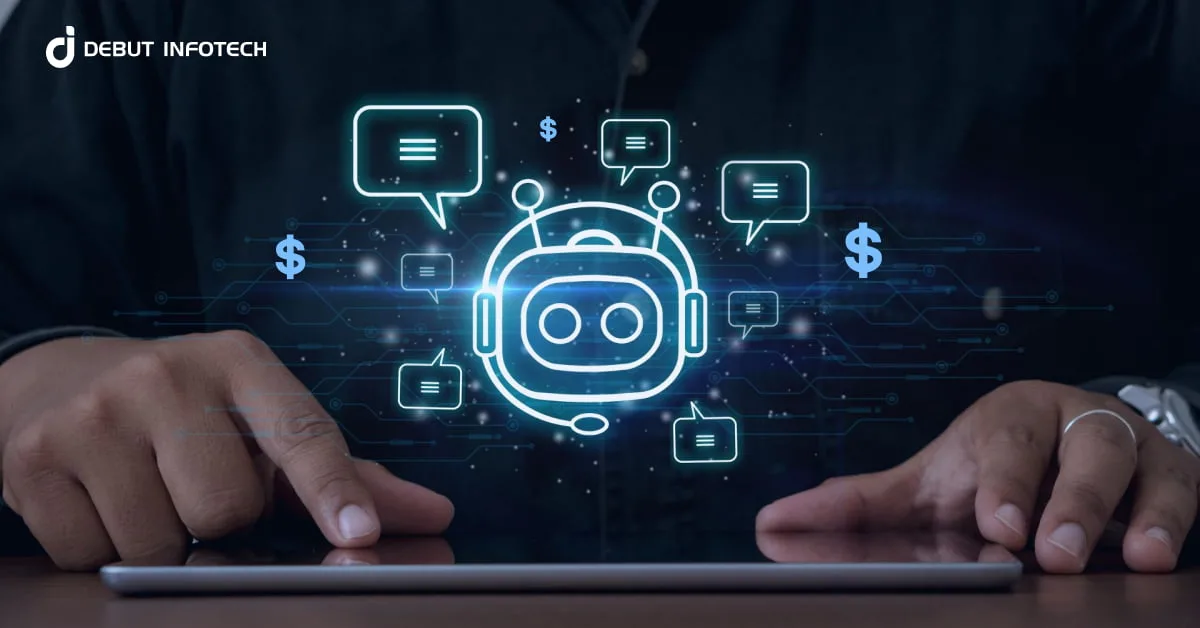
AI chatbot development is helping businesses improve customer communication, automate repetitive tasks, and deliver faster responses across digital channels. For businesses handling high volumes of customer inquiries or internal requests, an AI chatbot can reduce manual workloads while providing more consistent support. However, achieving these results requires the right technology, reliable data, and a clear understanding of business requirements.
Why AI Chatbot Development Matters for Businesses
Traditional rule-based chatbots follow predefined scripts and decision trees. While they can handle simple questions, they often struggle with complex requests, changing user intent, and conversations that require contextual understanding.
AI-powered chatbots offer greater flexibility by interpreting natural language, identifying user intent, and generating contextually relevant responses. Businesses can use them to answer frequently asked questions, guide customers through processes, qualify leads, and assist employees with routine tasks.
Organizations can incorporate chatbot solutions into broader AI development services to support their digital transformation goals. For example, an e-commerce company might deploy a chatbot to answer product questions and track orders, while a financial services provider could use one to explain account procedures or guide customers through service requests.
Core Technologies Behind Modern AI Chatbots
The performance of an AI chatbot depends on the technologies used to process language, learn from data, and generate responses. Selecting the appropriate architecture helps businesses balance accuracy, scalability, cost, and user experience.
Natural Language Processing
Natural language processing (NLP) enables chatbots to interpret human language and identify the intent behind a message. It helps systems process different expressions of the same request, recognize relevant entities, and respond more appropriately to user questions.
Machine Learning
Machine learning helps AI chatbots identify patterns in data and improve specific tasks through training and evaluation. Depending on the use case, it can support intent classification, recommendation systems, conversation routing, and response ranking.
Businesses investing in machine learning development services can build supporting models tailored to their operational requirements. These models may help categorize customer requests, detect recurring issues, or prioritize inquiries that require human attention.
Large Language Models and Retrieval-Augmented Generation
Large language models (LLMs) allow chatbots to understand and generate more natural responses. They can handle varied questions and maintain conversational context, making them useful for customer support, knowledge assistance, and information retrieval.
Retrieval-augmented generation (RAG) can improve responses by retrieving relevant information from approved sources, such as product documentation, internal knowledge bases, or company policies, before generating an answer.
Practical Business Applications of AI Chatbots
AI chatbot development can support different business functions when the solution is designed around a defined workflow.
Customer Service Automation
Customer service chatbots can answer common questions, provide order updates, explain service procedures, and direct complex cases to human agents. This allows support teams to spend more time resolving issues that require judgment or specialized assistance.
Businesses should provide clear escalation options so customers can reach a human representative when the chatbot cannot resolve their requests.
Sales and Lead Qualification
AI chatbots can help visitors find relevant products, understand service options, and identify whether an offering matches their requirements. They can also collect basic lead information and route qualified prospects to the appropriate sales representative.
For B2B organizations, a chatbot can ask about company size, project requirements, or implementation goals before directing potential customers to the right team.
Healthcare and Appointment Management
Healthcare organizations can use chatbots to answer general service questions, explain appointment procedures, share approved administrative information, and guide patients through scheduling workflows.
These solutions must be designed with appropriate privacy, security, and regulatory requirements in mind. Chatbots should not replace qualified medical professionals or present unverified information as medical advice.
Internal Employee Support
Enterprise chatbots can help employees find internal documentation, understand company procedures, and submit routine IT or HR requests. When connected to approved enterprise systems, they can reduce the time employees spend searching for information.
Access permissions and audit controls should be applied to prevent chatbots from exposing information that users are not authorized to access.
How to Choose the Right AI Chatbot Development Company
Selecting a suitable technology partner is an important step in building a reliable chatbot. Businesses should assess technical expertise, integration capabilities, security practices, and the provider’s ability to support the solution after launch.
- Relevant project experience: Evaluate whether the company understands your industry, user expectations, and intended chatbot use cases.
- Technology expertise: Check its experience with NLP, LLMs, RAG, APIs, and other technologies relevant to your requirements.
- Integration capabilities: Confirm that the chatbot can connect with the necessary CRM, help desk, knowledge base, or enterprise applications.
- Security and data governance: Review how the provider manages access permissions, sensitive information, data retention, and model outputs.
- Testing and evaluation: Ask how the team measures response accuracy, handles incorrect answers, and tests performance under realistic conditions.
- Post-launch support: Understand how updates, monitoring, maintenance, and performance improvements will be handled.
A reliable partner should also explain the trade-offs between a rule-based chatbot, an LLM-powered solution, and a retrieval-based architecture. The right approach depends on the complexity of the use case, the sensitivity of the data, expected traffic, and available budget.
Conclusion
AI chatbot development company enables businesses to improve communication, streamline workflows, and make information more accessible across customer-facing and internal operations. Successful implementation requires more than selecting an AI model; it involves choosing the right architecture, integrating reliable data sources, establishing security controls, and measuring business outcomes.
Frequently Asked Questions
Q1. What is AI chatbot development?
AI chatbot development is the process of designing, building, testing, and deploying conversational software that uses technologies such as NLP, machine learning, or large language models to understand user requests and provide relevant responses.
Q2. How do I choose the right AI chatbot development company?
Evaluate the company’s technical expertise, relevant project experience, integration capabilities, security practices, testing process, and post-launch support. The provider should be able to explain how its proposed solution addresses your specific business requirements.
Q3. How much does AI chatbot development cost?
The cost depends on the chatbot’s complexity, selected AI models, integrations, data requirements, security needs, and expected usage. A basic FAQ chatbot generally requires less investment than an enterprise solution connected to multiple business systems and internal knowledge sources.
Q4. How can businesses measure AI chatbot performance?
Businesses can track response time, resolution rate, escalation rate, customer satisfaction, cost per resolved inquiry, and lead conversion rate. Comparing these metrics with pre-launch performance helps determine whether the chatbot is delivering measurable value.