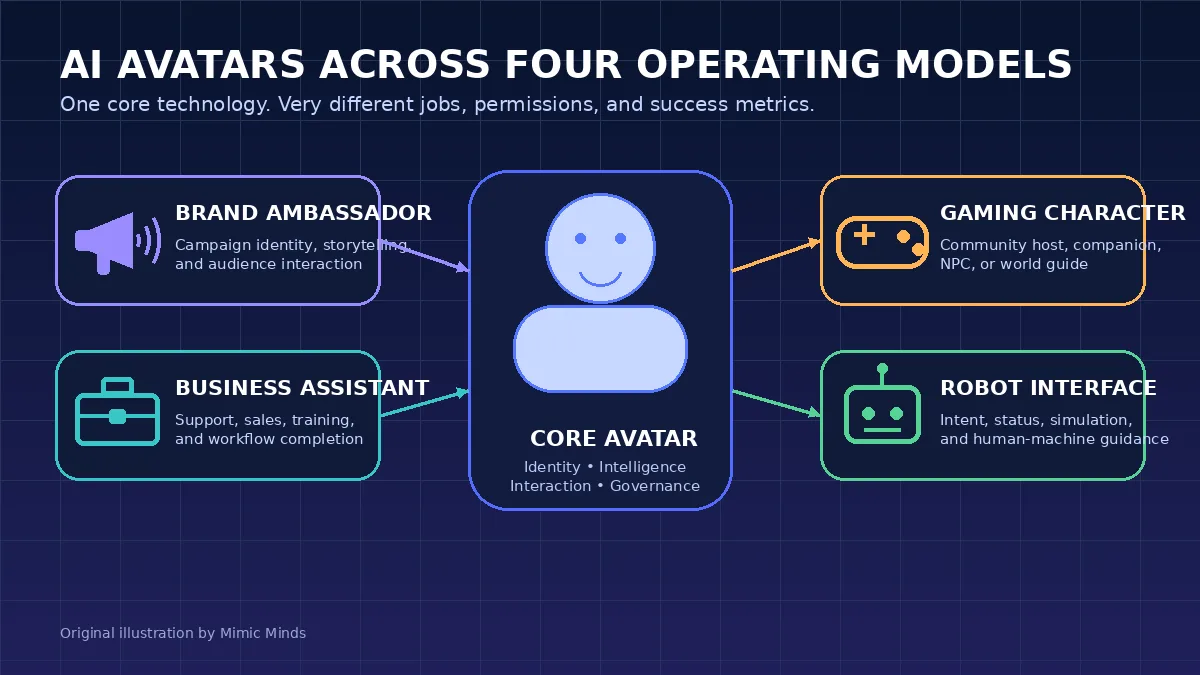
One avatar platform can support campaigns, business workflows, game worlds, and robotics. The design priorities should not be the same.
AI avatars are often discussed as one product category. In practice, a campaign host, a customer support guide, a game character, and a robotics interface are four different systems. They may share a digital face and a conversational model, but they need different data, permissions, behavior, response times, and measures of success.
The idea of AI Avatars as Brand Ambassadors has brought digital characters into marketing conversations. The same underlying technology can also qualify a lead, guide a player, or explain a robot's next move. The important question is not how human the avatar can look. It is what role the character owns, what context it may use, what actions it can take, and how clearly users understand those limits.
This guide examines four practical operating models and explains what should remain consistent across them. It also shows where teams need to make different design decisions instead of forcing one avatar into every channel.
One Core Technology, Four Different Jobs
A production-ready avatar is not simply a face connected to a large language model. It is a coordinated interface made from several layers that have to work together.
· Identity and persona: appearance, voice, tone, role, and disclosure.
· Knowledge and context: approved sources, user state, task history, and relevant environment data.
· Reasoning and policy: intent handling, decision rules, safety boundaries, and escalation logic.
· Voice and expression: speech, lip sync, gaze, gesture, pacing, and interruption behavior.
· Integrations and actions: CRM, support, game state, digital twins, robot status, and workflow tools.
· Measurement and governance: logs, testing, human review, performance metrics, and continuous improvement.
The visible character sits on top of this operating stack. Changing the avatar's job changes which layers matter most. A brand character prioritizes consistency and disclosure. A support avatar prioritizes task completion and safe handoff. A game character prioritizes narrative coherence and player agency. A robotics interface prioritizes clarity about machine intent and status.

The visible character is only the top layer. Reliable deployment depends on the operating system underneath. Original illustration by Mimic Minds.
Brand Ambassadors: Consistency Without Pretending to Be Independent
A digital brand ambassador can host product launches, answer campaign questions, appear in short-form content, guide a virtual event, and maintain a recognizable identity across channels. The value is continuity. The same character can use the same tone, visual language, and approved messaging whether the interaction happens on a website, social platform, livestream, or immersive experience.
That consistency only works when the persona is governed. Teams need a short brand constitution covering personality traits, preferred language, prohibited claims, sensitive topics, and the point at which the avatar must defer to a person. Without those rules, a highly expressive character can still produce an experience that feels off-brand or misleading.
Disclosure matters as much as personality. For campaigns aimed at U.S. audiences, the FTC guidance for social media influencers says material connections to a brand should be disclosed clearly and in a place that is difficult to miss. A brand-owned virtual character should also be transparent about being AI-controlled. It should not imitate an independent reviewer or hide the fact that its recommendations come from the company behind it.
Useful metrics go beyond views. Teams can track completed interactions, qualified questions, event participation, repeat sessions, and the actions users take after speaking with the character. The goal is not to manufacture the illusion of celebrity. It is to create a controlled, recognizable interface that earns attention and turns it into a useful next step.
Business Avatars: Build Around the Workflow, Not the Mascot
A well-designed avatar for business is a task interface rather than a decorative mascot. It can support customer onboarding, answer approved product questions, qualify leads, guide training, deliver internal updates, or help users move through a form.
The most important design choice is scope. A customer support avatar may need access to a knowledge base and ticketing system. A sales avatar may need scheduling, product eligibility rules, and a limited view of CRM context. A training avatar may need scenario logic and evaluation criteria. Giving every avatar unrestricted access to every system increases both risk and confusion.
The interaction should also include a clear human handoff. If the user asks for account changes, disputes a charge, raises a sensitive issue, or simply requests a person, the avatar should stop trying to complete the task alone. It should transfer the relevant context without forcing the user to repeat the entire conversation.
Business performance should be measured against the workflow that existed before the avatar. Useful measures include completion rate, resolution time, appointment bookings, training completion, escalation accuracy, and the percentage of users who abandon the process. A convincing face may improve attention, but operational value comes from helping people finish the right task.
Gaming Avatars: Separate Community Presence From In-World Agency
An avatar for gaming can operate outside the game as a community host, launch presenter, streamer-style explainer, or esports personality. It can also exist inside the game as an NPC, companion, tutorial guide, or character that reacts to player decisions. Those two roles may share a visual identity, but they need different technical controls.
An out-of-game host mainly needs approved campaign information, community guidelines, and a content calendar. An in-world character needs access to game state, narrative rules, character history, player progress, and the set of actions available in the current scene. It also needs protection against breaking lore, revealing hidden content, or allowing open-ended conversation to undermine authored story beats.
Research on generative agents has explored how memory, reflection, and planning can support more believable behavior in interactive environments. The practical lesson for game teams is not that every NPC should improvise without limits. It is that persistent context and goal-driven behavior can make characters feel more coherent when they remain inside a controlled narrative framework.
Response time matters as well. A slow support interaction may be annoying, but a long pause during a live scene can break immersion. Teams should test dialogue latency, interruption behavior, repeated questions, edge cases, moderation, and the way generated responses connect back to animation and game logic. Useful metrics include quest progression, repeated interaction, dialogue abandonment, moderation incidents, and whether the character helps or blocks the player's intended experience.
Robot Avatars: Make Machine Intent Easier to Read
Well-designed robot avatars provide a social and communication layer for automation. The avatar may appear on a robot-mounted screen, operator console, kiosk, projected display, or digital twin. Its job is not necessarily to make the machine look human. Its job is to make status, intent, and the next required action easier for a person to understand.
This can be useful in robotic simulations, industrial training, healthcare navigation, logistics, research, and public-facing service environments. A visual guide can explain why a robot has stopped, what task it is preparing to perform, whether it needs space, and what the operator should do next. It can also translate complex telemetry into clear language for non-specialists.
Recent research on communicating robot intent reported improved communication clarity when a system converted robot motion plans and visual context into concise, user-directed statements. The broader design principle is simple. People should not have to guess what an automated system is about to do.
The avatar must not create false reassurance. If sensor confidence is low, a task has failed, or human authorization is required, the interface should say so directly. A friendly face should never conceal uncertainty or unsafe machine state. The best measures are comprehension, operator success, training performance, and the frequency of avoidable intervention errors.
Four Roles, Four Design Priorities
The same avatar platform can support all four roles, but the operating model should change with the objective.
· Brand ambassador: optimize for attention and identity. The main risk is deceptive endorsement or off-brand claims. Measure qualified engagement, not only impressions.
· Business assistant: optimize for task completion. The main risks are privacy, excessive permissions, and poor handoff. Measure resolution or completion rate.
· Gaming character: optimize for immersion and agency. The main risks are narrative drift, latency, and moderation failure. Measure player progression and repeat interaction.
· Robot interface: optimize for clarity and trust. The main risk is a misleading signal about machine intent or safety. Measure comprehension and operator success.

One avatar platform can support several industries, but each role requires different priorities. Original illustration by Mimic Minds.
A Six-Step Framework for Deploying an AI Avatar
1. Define one role and one audience
Start with a bounded job. Specify who the avatar serves, what task it owns, and the result that counts as success. A clear first role is easier to test than an open-ended promise to answer anything.
2. Design the persona and its boundaries
Document appearance, tone, vocabulary, disclosure, prohibited topics, and escalation language. A persona is not only a creative brief. It is part of the operating policy.
3. Connect the minimum required context
Give the avatar access only to the data and tools needed for its job. Approved campaign content, a support knowledge base, game state, or robot telemetry may be necessary. Unrelated systems are not.
4. Set guardrails and handoff rules
Define which actions require confirmation, which requests must be refused, and when a person should take over. Make sure late responses or animations stop when a user interrupts or the workflow changes.
5. Test real conditions, not only scripted demos
Test accents, background noise, repeated questions, slow connections, unsupported requests, contradictory instructions, failed tool calls, and requests for human help. A reliable avatar has to survive messy interaction.
6. Measure outcomes and expand carefully
Compare the new experience with the previous workflow. Expand to more languages, channels, or tasks only after the first role performs reliably and the team can explain why it works.

Successful avatar deployments begin with a bounded role and expand after the full experience works. Original illustration by Mimic Minds.
Trust, Disclosure, and Governance Belong in the Product
AI avatars combine persuasive visual design with automated decision-making. That combination can encourage users to place more trust in the interface than the system has earned. Transparency should therefore be part of the experience, not hidden in a terms page.
Users should know that they are interacting with AI, which organization controls the character, what information is being used, and how to reach a person. High-impact actions such as submitting forms, updating records, making payments, or changing account settings should require explicit confirmation and a clear audit trail.
The NIST AI Risk Management Framework offers a voluntary structure for managing AI risks to individuals, organizations, and society. For avatar projects, that means testing both the intelligence and the presentation layer. An accurate response paired with the wrong expression, unclear disclosure, or unsafe action is still a poor outcome.
Governance should cover data access, model behavior, tool permissions, content review, incident handling, and the lifecycle of the character itself. If a campaign ends or a persona changes, teams need a process for updating or retiring the avatar without leaving outdated content and permissions in place.
The Practical Takeaway
There is no universal AI avatar that works equally well as a brand spokesperson, business assistant, game character, and robotics interface. The durable value comes from matching the character to a clear job, giving it only the context and authority it needs, and measuring whether it helps users reach a better outcome.
Start with role clarity rather than visual novelty. A strong face may earn the first second of attention. A well-designed operating model earns the next interaction.
Frequently Asked Questions
What is the difference between an AI avatar and a chatbot?
A chatbot mainly communicates through text or voice. An AI avatar adds a visible character layer with identity, expression, gaze, gesture, and other cues. The avatar may also connect to tools and workflows, but those capabilities depend on the underlying system rather than the face itself.
Can one digital character be used across several industries?
The same base character or platform can support several roles, but the persona, data access, permissions, response style, and success metrics should change. Reusing a face is easier than reusing an operating model.
How should a virtual brand ambassador be disclosed?
The character should clearly identify that it is AI-controlled and state its relationship to the brand. For sponsored or endorsement content, follow the applicable rules in the target market and place disclosures where users can easily notice and understand them.
What should a company measure after launching a business avatar?
Choose measures tied to the assigned workflow, such as task completion, resolution time, appointment bookings, training completion, escalation accuracy, user abandonment, and requests for human assistance.
Do robot avatars directly control robots?
Not necessarily. A robot avatar may be only the communication layer that explains status and intent. If it can trigger robot actions, the system should use narrow permissions, confirmation steps, safety constraints, and human override paths.
About the Author
[Author Name] works with Mimic Minds, a digital human and embodied AI platform developing conversational avatars for business, media, gaming, robotics, and immersive experiences. Their work focuses on practical and responsible applications of real-time digital humans.