
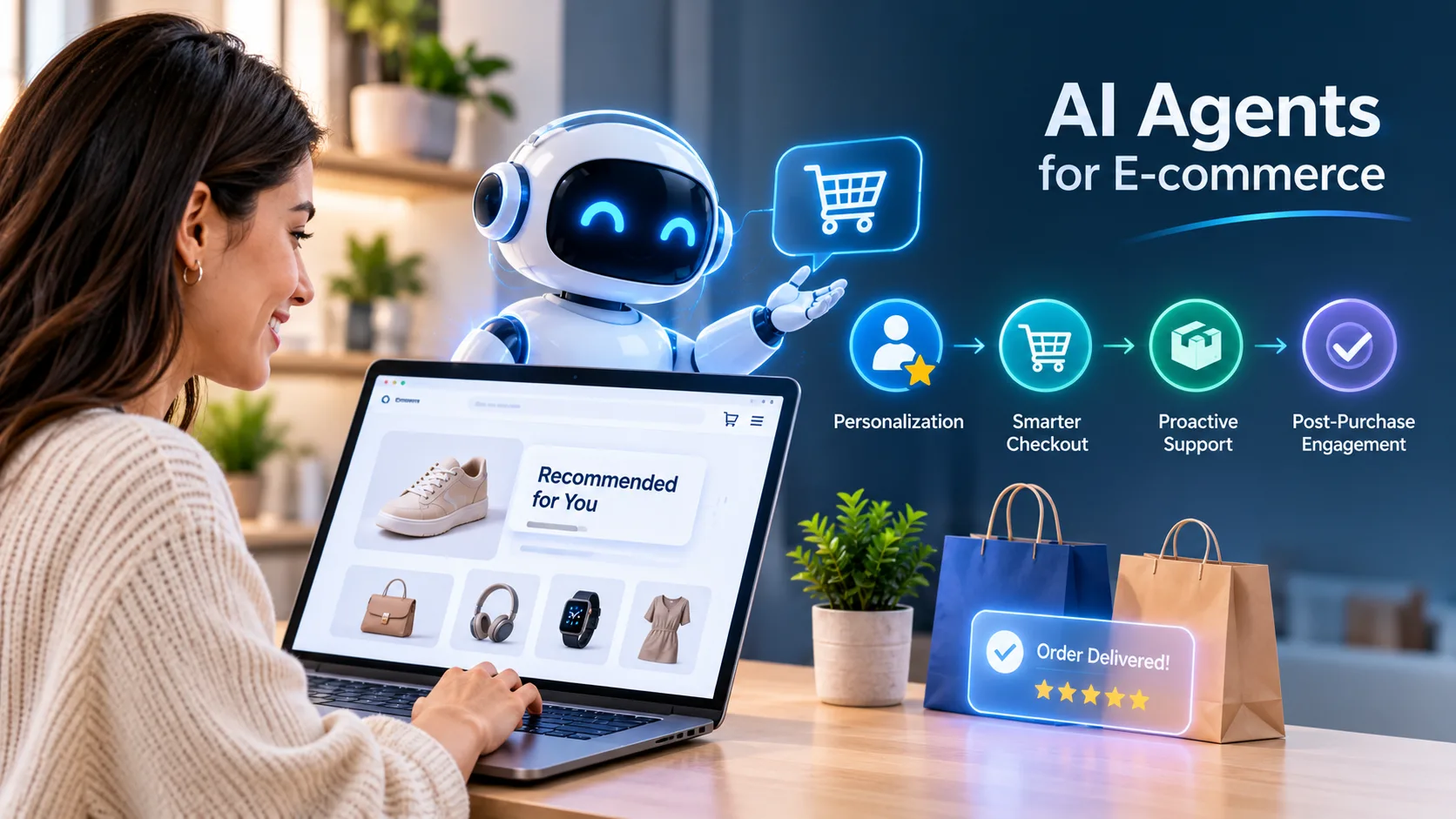
Quick answer: In retail, AI agents drive three high-value areas: personalization (tailored recommendations and search), inventory and operations (demand signals, stock alerts, reordering support), and post-purchase workflows (order status, returns, and support). The pattern that wins is agents handling volume and coordination while humans manage strategy and exceptions.
E-commerce is a natural fit for AI agents because it is high-volume, data-rich, and full of repeatable workflows that still need judgment at the edges. Here is where agents deliver, mapped to the parts of the business they touch.
1. Personalization
Shoppers expect relevance. An agent can interpret browsing behavior, purchase history, and intent to tailor recommendations, refine search results, and adapt merchandising in real time. Unlike a static rules engine, an agent reasons over messy, unstructured signals, which is where simpler systems struggle.
The quality of personalization depends entirely on how well you feed the agent the right context. Our deep dive on context engineering for AI agents covers how to supply relevant signals without overwhelming the model.
2. Inventory and operations
Agents support demand sensing, low-stock alerts, and reorder recommendations by reading across sales, supplier, and warehouse data. The goal is fewer stockouts and less dead inventory. This overlaps heavily with logistics, where agents coordinate across moving parts; see our piece on AI agents in supply chain and logistics for the broader operational picture.
A caution: inventory decisions can carry real financial weight. Keep humans approving significant reorder or pricing actions rather than letting the agent act unchecked.
3. Post-purchase workflows
This is often the fastest ROI. Order tracking, delivery updates, returns initiation, and routine support are high-volume, repetitive, and perfect for an agent. It resolves the common cases instantly and escalates the complex ones.
For retailers who want this over voice or messaging channels, our work on voice AI agents with LiveKit, WhatsApp, and Twilio shows how to run post-purchase support on the channels customers actually use. And if you are weighing an agent against a basic bot for support, LiveKit voice AI vs traditional chatbots draws the line.
Where agents fit vs where they don't
| Retail task | Good agent fit? | Why |
| Product recommendations | Strong | Needs reasoning over messy signals |
| Order status and tracking | Strong | High volume, repeatable |
| Returns and routine support | Strong | Resolves common cases, escalates rest |
| Low-stock alerts and reorder suggestions | Good with oversight | Keep humans on big-money decisions |
| Final pricing and markdown strategy | Human-led | Strategic and financially sensitive |
Before you build: check fit and readiness
Not every retail task needs an agent. A simple product FAQ might only need a chatbot, and a fixed reorder rule might only need a script. Our AI agents vs chatbots vs RPA comparison helps you right-size the tool. And whatever you build, its quality depends on clean product, inventory, and customer data feeding it, so auditing that data for readiness comes first.
Build retail agents that integrate
Retail agents live or die on integration with your commerce platform, inventory system, payment, and support stack. Clean APIs make this work; our custom MCP development for Xero and QuickBooks integration shows the pattern for letting an agent act reliably across business systems. When you are ready to build, our AI Agent Development Services cover the full retail stack, and how to hire AI agent developers helps if you are staffing it.
Key takeaway: Target personalization, inventory support, and post-purchase workflows. Let agents handle volume and coordination, and keep humans on strategy and big-money calls.
FAQ
What is the fastest ROI for an AI agent in e-commerce?
Usually post-purchase support: order tracking, returns, and routine queries are high-volume and repetitive, so automating them frees your team quickly.
Can an AI agent manage inventory on its own?
It can support the process with alerts and recommendations, but keep humans approving significant reorder and pricing decisions.
How is an AI agent different from the recommendation engine I already have?
A rules-based engine follows fixed logic. An agent reasons over unstructured signals and can take multi-step actions, which makes personalization more adaptive but also raises the bar on data and oversight.