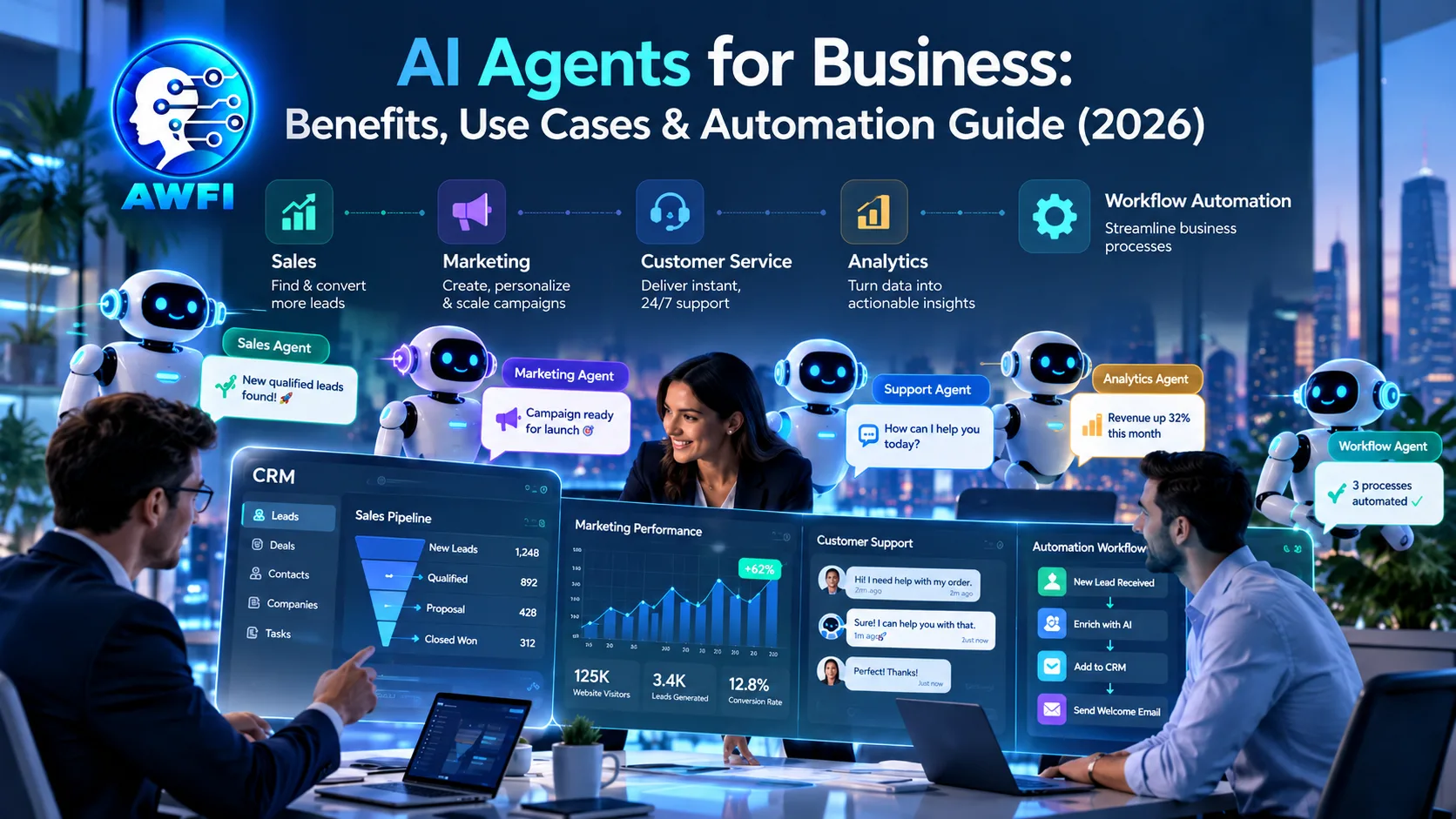
Artificial intelligence is changing the way businesses run their daily operations. One of the key drivers behind this change is the growing adoption of AI agents for business.
AI agents can understand goals, analyze data, choose the right tools, and carry out multiple actions. Unlike traditional software, they can do more than simply follow predefined instructions.
They help businesses reduce repetitive work by handling customer enquiries, sales lead qualification, and marketing automation.
According to McKinsey's State of AI Report 2026, 40% of respondents from large organizations reported scaling AI agents, compared with 22% from smaller organizations. This shows increasing adoption, although many businesses are still learning how to achieve a measurable return on investment.
But how do AI agents work, and where should businesses start automating?
In this guide, we'll explore their benefits, real-world applications, implementation strategies, and what businesses should consider in 2026.
1. What Are AI Agents for Business?
AI agents for business are intelligent software systems that can carry out tasks, make context-based decisions, and automate workflows to achieve defined business goals.
They use artificial intelligence, machine learning, language models, and software integrations to complete tasks that would normally require repeated manual actions.
For example, an AI agent can receive a customer enquiry, understand the customer's requirements, find relevant information, update a CRM, and suggest the next course of action.
These tasks can be coordinated within a connected workflow, with only authorized actions performed automatically and human approval used when necessary.
Businesses can explore different types of AI agents for business depending on their operational requirements.
Common Types of AI Agents for Business
- AI Lead Generation Agents: Find, research, and organize potential customers.
- AI Sales Agents: Qualify leads, support outreach, and manage follow-ups.
- AI Marketing Agents: Assist with content creation, campaign management, and audience analysis.
- AI Customer Service Agents: Respond to enquiries, manage support requests, and escalate complex issues.
- AI CRM Agents: Update customer records, organize sales pipelines, and track interactions.
- AI Data Analysis Agents: Analyze business data, generate reports, and identify trends.
Businesses can use individual AI agents or connect multiple specialized agents to manage more complex workflows.
The objective is not simply to introduce another AI tool. It is to build a reliable system that helps teams perform meaningful business activities.
2. How Do AI Agents Work?
AI agents work by combining reasoning, information retrieval, tool integration, and task execution.
A typical AI agent workflow includes six stages.
Step 1: Define the Goal
The AI agent receives a specific business objective, such as qualifying a lead, answering a support enquiry, or preparing a weekly sales report.
Step 2: Understand the Request
The agent processes information using an AI model to understand the request, identify the required data, and determine suitable actions.
Step 3: Retrieve Information
Depending on its permissions, the agent retrieves information from approved sources such as knowledge bases, CRM systems, spreadsheets, databases, and connected applications.
Step 4: Plan and Execute Actions
The agent selects appropriate steps and uses authorized tools or APIs to complete them.
Complex tasks may require multiple connected actions.
Step 5: Validate and Escalate
The system checks results against predefined conditions. Uncertain, sensitive, or high-impact decisions can be transferred to a human employee.
Step 6: Record the Results
The AI agent records the outcome, updates relevant systems, and provides information for monitoring.
Example: AI Agent Automation for Lead Management
Consider a real estate business receiving a customer enquiry through its website.
The workflow could look like this:
Website Enquiry → AI Lead Qualification → Property Matching → CRM Update → Sales Team Notification → Follow-Up
The AI agent can ask about the customer's budget, preferred location, property requirements, and purchase timeline.
It can then match those requirements with available properties and prepare recommendations for a sales representative.
This demonstrates how AI automation solutions can connect different tasks into one business workflow.
3. AI Agents vs Traditional Business Automation
Traditional automation and AI agents both help reduce manual work, but they operate differently.
Traditional automation is best suited to processes with predictable inputs, predefined rules, and fixed outcomes.
AI agents are more useful when processes involve changing information, natural language, or several possible actions.
Key Differences Between AI Agents and Traditional Automation
FeatureTraditional AutomationAI AgentsFunctionRule-basedGoal-orientedFlexibilityLimitedFlexible within set boundariesData HandlingMainly structured dataStructured and unstructured dataDecision-MakingFixed rulesContext-based reasoningMultiple TasksFixed workflowsDynamic task executionAdaptabilityRequires rule changesCan respond to changing contextFor example, traditional automation can send a predefined email whenever a new lead enters a CRM.
An AI agent can analyze the enquiry, identify the customer's requirements, retrieve relevant product information, and prepare a more personalized response.
However, AI agents are not always the better option.
For processes that require predictable and repetitive actions, conventional automation can still be more efficient.
The most effective systems often combine both approaches.
4. Benefits of AI Agents for Businesses
The benefits of AI agents depend on the workflows they support, how well they are implemented, and how performance is measured.
4.1 Reduce Repetitive Manual Tasks
Employees often spend significant time entering data, updating records, preparing reports, and responding to general enquiries.
AI agents can automate suitable parts of these processes, allowing employees to focus on customer relationships, complex decisions, and business development.
4.2 Improve Operational Efficiency
Integrated AI agents can transfer information between business applications and coordinate repetitive activities.
This helps reduce delays, duplicated work, and unnecessary administrative tasks.
4.3 Enable 24/7 Customer Support
AI-powered customer service agents can handle routine enquiries outside normal business hours, depending on system availability and configuration.
Businesses can provide faster initial responses while keeping human employees available for more complicated situations.
4.4 Improve Lead Management
AI agents can categorize enquiries, identify buying signals, prioritize leads, and notify sales representatives.
This provides sales teams with more structured information before they contact potential customers.
4.5 Support Business Scalability
As enquiry volumes increase, AI-powered workflows can help businesses manage additional activity without expanding every administrative function at the same rate.
The results depend on infrastructure, system capacity, operating costs, and workflow design.
4.6 Support Data-Driven Decisions
AI agents can collect information from approved sources and identify patterns in sales, customer interactions, and operational performance.
Managers can combine these insights with human judgment to make more informed decisions.
Businesses looking for a connected operational approach can explore a managed AI workforce.
5. AI Agents for Sales and Lead Generation
Sales is one of the most practical areas for implementing AI agents because it involves repetitive activities that are relatively easy to measure.
AI agents for sales can support the customer journey from the initial enquiry through qualification, follow-up, and sales handover.
AI-Powered Lead Research
AI lead generation agents can research potential customers using authorized sources, organize relevant company information, and create structured prospect records.
This helps reduce the time sales representatives spend on manual prospect research.
Intelligent Lead Qualification
AI qualification agents can evaluate enquiries using business criteria such as budget, requirements, urgency, and readiness to purchase.
For example, a B2B services company can use an agent to identify prospects with relevant business needs who may be ready for a consultation.
Learn more about the AI Lead Qualification Agent.
Personalized Sales Outreach
AI agents can help prepare relevant emails, organize approved outreach activities, and identify suitable follow-up actions.
Businesses should follow applicable privacy, consent, and anti-spam requirements when using automated outreach.
Automated Follow-Ups and CRM Management
An AI follow-up agent can identify eligible prospects, detect pending actions, prepare reminders, and update CRM records.
Sales representatives gain a clearer picture of customer engagement and potential opportunities.
Example: AI Agents in Real Estate Sales
A real estate business can connect several specialized agents:
- Lead Capture Agent: Records incoming enquiries.
- Lead Qualification Agent: Identifies budget, location, and property preferences.
- Property Matching Agent: Recommends relevant property listings.
- Follow-Up Agent: Organizes subsequent customer communication.
- CRM Agent: Keeps customer records updated.
This creates a more consistent lead management process while allowing sales professionals to handle important negotiations and final decisions.
Explore AI Lead Generation and Sales Automation for more information about connected sales workflows.
6. AI Agents for Marketing Automation
Marketing teams manage several activities, including keyword research, content creation, social media, email marketing, and performance reporting.
AI agents for marketing can help organize these activities into more efficient workflows.
AI Content Creation
AI content agents can assist with topic research, article outlines, blog drafts, product descriptions, and marketing messages.
However, human editorial review remains essential for factual accuracy, originality, brand consistency, and content quality.
Businesses can explore AI Content Marketing Services for content-focused automation.
SEO Workflow Automation
An AI-powered SEO agent can help identify search opportunities, group relevant keywords, review existing content, and recommend on-page improvements.
For example, a business targeting the keyword "AI agents for business" can use an AI agent to identify related search questions and develop a supporting content strategy.
Social Media Automation
AI marketing agents can prepare content calendars, adapt approved messages for different platforms, and analyze audience engagement.
They can also suggest suitable posting schedules using historical performance data.
Explore AI Social Media Marketing for additional applications.
Marketing Campaign Analysis
AI marketing agents can analyze connected campaign data and identify changes in website traffic, conversions, marketing costs, and engagement.
This allows marketers to spend less time preparing repetitive reports and more time improving campaign strategies.
The main objective of marketing automation is to make marketing activities more relevant, measurable, and quality-controlled.
7. AI Agents for Customer Service
Customer experience is another important application of AI agent technology.
Businesses regularly receive similar enquiries about products, pricing, bookings, orders, service availability, and account information.
AI agents for customer service can handle approved routine enquiries and help support teams respond more efficiently.
Automated Customer Enquiries
Customer service agents can understand questions, search authorized knowledge bases, and provide relevant answers.
More advanced agents can retrieve account information and perform permitted actions across connected systems.
Omnichannel Customer Support
AI support systems can integrate with communication channels such as live chat, email, messaging platforms, and voice services, depending on available APIs and permissions.
This can help businesses keep customer information consistent across multiple communication channels.
Customer Request Management
AI agents can categorize support tickets, identify urgency, retrieve relevant account information, and direct requests to the appropriate team.
For example, a travel company could use an AI agent to answer booking enquiries while escalating unusual refund requests to a human employee.
Human Escalation
Effective AI customer service requires clear boundaries.
Billing disputes, sensitive information, complaints, and uncertain responses should trigger additional verification or human assistance.
A properly designed system balances automated support with easy access to human representatives.
Learn more about AI Customer Operations.
8. How to Implement AI Agent Solutions in Your Business
The key to successful AI implementation is understanding the business problem you want to solve.
A practical implementation process includes six steps.
Step 1: Identify Repetitive Business Tasks
Review activities that are time-consuming, repetitive, measurable, or frequently delayed.
Common examples include lead qualification, customer support, CRM updates, reporting, and internal information searches.
Step 2: Choose a High-Impact Use Case
Start with one business process where improvement can be measured.
Consider workflow volume, technical complexity, integration requirements, and operational risk.
For example, automatically categorizing incoming leads may be a more practical starting point than automating an entire sales department.
Step 3: Design the AI Agent Workflow
Decide what the AI agent should accomplish, which information it can access, what actions it can perform, and when human approval is necessary.
Determine whether the use case needs AI agents, traditional automation, or a combination of both.
Step 4: Integrate Business Applications
Connect the AI agent to relevant systems such as a CRM, knowledge base, website, database, or communication platform.
Use secure APIs, role-based permissions, and appropriate data access controls.
Step 5: Run a Controlled Pilot
Test the AI agent using realistic business situations, including unusual requests, incomplete information, and potential failures.
Measure relevant performance indicators:
- Time saved per task
- Successful task completion rate
- Lead response time
- Customer satisfaction
- Human escalation frequency
- Cost per completed workflow
Step 6: Monitor, Improve, and Scale
Regularly review the agent's performance, correct errors, and improve workflows before expanding the system.
Monitor accuracy, operational costs, security, and employee feedback.
The NIST AI Risk Management Framework offers guidance on developing trustworthy AI systems.
Similarly, Google Cloud's guide to production-ready AI agents explains why reliable agents require suitable approaches to testing, orchestration, memory, and security.
The best implementation strategy is to start with one workflow, verify its results, and scale after demonstrating measurable value.
9. Choosing an AI Agent Development Company
Choosing the right AI agent development company is important for businesses planning to implement intelligent automation.
A reliable provider should understand the organization's business processes, operational challenges, and long-term goals.
What Should You Look for in an AI Agent Development Company?
Business Process Understanding
The provider should evaluate your existing workflow, identify challenges, and understand what you want to achieve.
Integration Capabilities
The AI agent solution should integrate with existing CRM systems, databases, communication tools, and business applications.
Customizable AI Solutions
AI agents should be configured according to your business rules, industry requirements, and customer interaction processes.
Security and Monitoring
The solution should include suitable access controls, monitoring, escalation procedures, and data protection measures.
Continuous Optimization
AI agents require ongoing monitoring, maintenance, evaluation, and improvements.
Transparent Pricing
Businesses should understand implementation fees, AI usage costs, maintenance charges, and support responsibilities before selecting a provider.
How AI WorksForce Can Help Automate Your Business
AI WorksForce helps businesses identify, develop, integrate, and manage AI-enabled operations.
Powered by AWFI Engine™, its approach combines AI agents, workflow automation, data systems, and human expertise.
Businesses can explore solutions for:
- AI lead generation and sales automation
- AI customer engagement and support
- AI marketing automation
- AI research and data analysis
- AI CRM and workflow automation
Rather than introducing disconnected tools, the focus is on creating managed workflows that suit specific business requirements.
Explore the available AI Agent Solutions to see what could work for your organization.
10. FAQs About AI Agents for Business
What Are AI Agents for Business?
AI agents for business are intelligent software systems that use artificial intelligence to understand information, plan actions, and complete defined business tasks. They can assist with sales, marketing, support, research, and daily operations.
How Are AI Agents Different from Chatbots?
Basic chatbots primarily respond to user enquiries. AI agents can also use tools, retrieve business information, update integrated systems, and complete multiple actions within authorized boundaries.
Can Small Businesses Use AI Agents?
Yes. Small businesses can use focused AI agents for lead capture, customer enquiries, appointment scheduling, CRM updates, and other routine activities.
Starting with a small pilot helps control complexity and operating costs.
How Much Does AI Agent Development Cost?
AI agent development costs depend on workflow complexity, the number of integrations, model usage, hosting, security requirements, and maintenance.
A simple agent connected to existing tools may cost significantly less than a fully customized multi-agent platform.
Businesses should request estimates based on their specific requirements.
Can AI Agents Replace Employees?
AI agents can automate selected tasks, but they are not a complete replacement for human judgment, responsibility, relationship management, or complex decision-making.
Many organizations benefit from combining AI automation with skilled employees.
Are AI Agents Secure for Business Use?
AI agents can be deployed with appropriate security measures, but security is not automatic.
Businesses should evaluate data handling, access permissions, monitoring, third-party integrations, and relevant privacy requirements.
What Is the Future of AI Agent Automation?
AI agents are expected to become more integrated with business applications and connected workflows.
A major focus in 2026 is moving beyond experimental demonstrations toward reliable, measurable systems that operate with appropriate human oversight.
Conclusion: Create a Smarter Business with AI Agents
AI agents for business offer practical opportunities to improve productivity, manage repetitive tasks, strengthen customer experiences, and support sales and marketing operations.
They can be applied to lead generation, sales automation, marketing, customer service, data analysis, and several other business activities.
However, successful implementation requires clear objectives, reliable information, secure integrations, measurable performance indicators, and human oversight.
The best approach is to identify one valuable workflow, automate it carefully, monitor the results, and expand based on evidence.
Ready to Build Your AI Workforce?
At AI WorksForce, we help businesses turn AI opportunities into managed operations using AI agents, automation, and human expertise.