
Shopping Is Changing, and Brands Need to Keep Up
Think about how people shop online today. They search for a product, open a few websites, compare prices, read reviews, and decide what to buy. Now imagine asking an AI assistant to do much of that work for you.
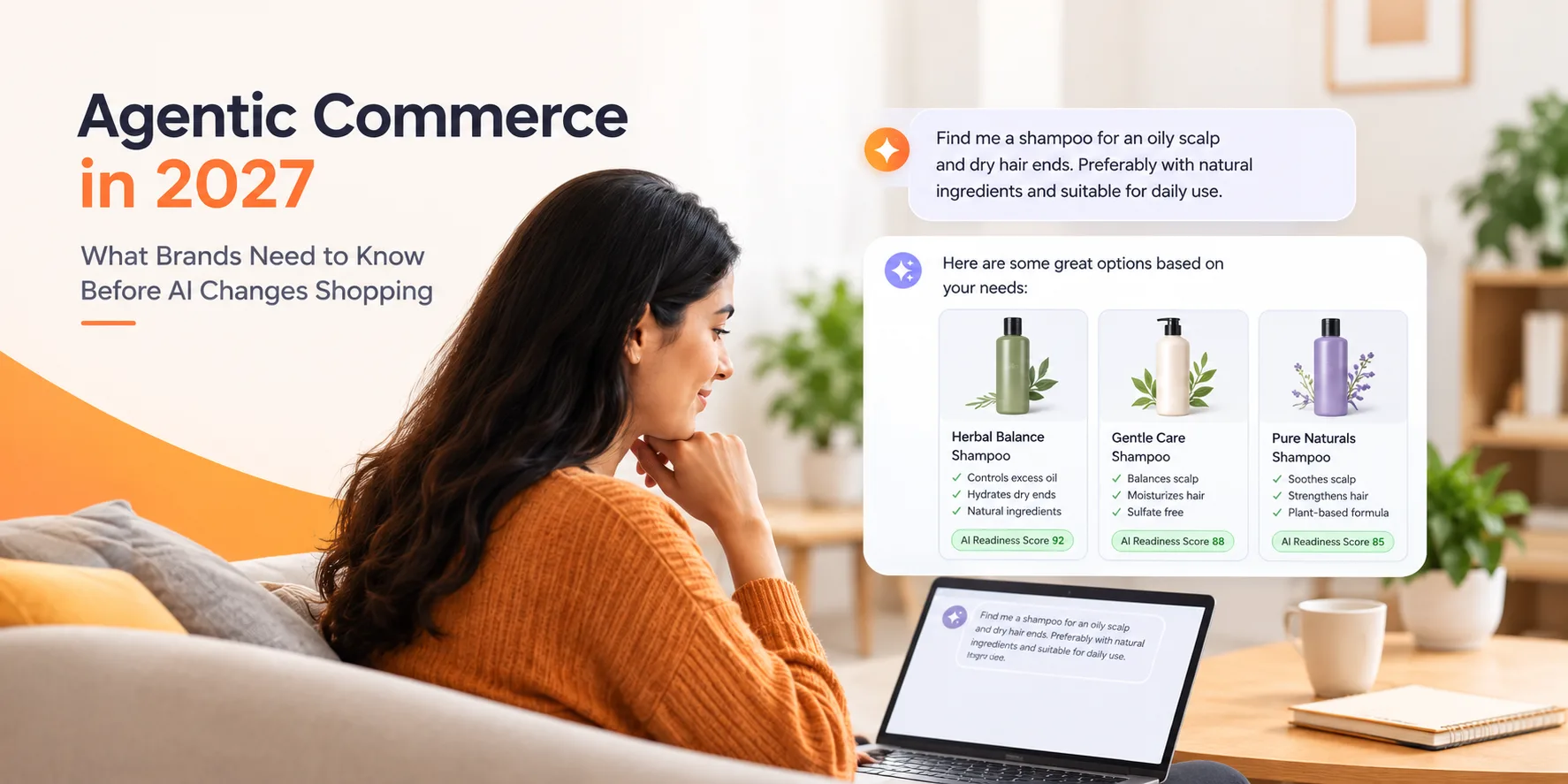
Instead of searching through dozens of product pages, a shopper could simply say, “Find me a shampoo for an oily scalp that won't dry out my hair.” An AI shopping assistant could help compare products and suggest options based on the information available.
This is where agentic commerce comes in.
As AI-powered shopping experiences develop, brands may need to think beyond traditional search rankings and marketplace visibility. Their products also need to be easy for AI systems to understand and evaluate.
Looking ahead to 2027, one question becomes increasingly important: When an AI shopping agent looks at your product, will it understand why someone should choose it?
What Does Agentic Commerce Actually Mean?
Agentic commerce is about using AI agents to help people move through the shopping journey, from discovering products to comparing options and, in some cases, completing purchases.
The difference is that shoppers may not need to manage every step themselves. They can explain what they need, set their preferences, and let an AI assistant help narrow down the options.
For example, someone buying a laptop might ask for a lightweight model suitable for travel, everyday work, and long battery life. The AI assistant can use available product information to compare options against those requirements.
For brands, this creates a new challenge. It is no longer enough to describe a product as premium, powerful, or high quality. Product pages need to explain what those claims mean and provide useful details that help shoppers make decisions.
The clearer the product information, the easier it is for shoppers and AI systems to evaluate what the product offers.
Why 2027 Could Be an Important Year for Agentic Commerce
Nobody can predict exactly how quickly AI shopping will develop. But brands can already see why it is worth preparing for a shopping experience where AI plays a larger role.
Here are a few changes worth paying attention to.
People may start shopping by describing what they need
Shoppers do not always know the exact product or brand they want. Often, they know the problem they are trying to solve.
Someone might look for a moisturizer for dry skin, a laptop for frequent travel, or a detergent suitable for delicate fabrics. AI shopping assistants can help translate these needs into product comparisons.
This means brands should make it easy to understand who their products are for, what they do, and which needs they address.
Being different from competitors will matter more
Imagine two products with similar prices and features. One product page clearly explains its ingredients, usage, benefits, and suitability. The other uses a generic description that could apply to almost any product in the category.
The first gives shoppers more useful information to work with.
AI systems also need relevant details to distinguish between similar products. Brands should clearly communicate their actual advantages instead of relying on broad marketing statements.
Product pages will need to answer more questions
A product page should do more than introduce a product. It should help someone decide whether that product is right for them.
For a shampoo, that might mean explaining its ingredients, intended hair type, usage instructions, and relevant product claims. For electronics, it could mean providing dimensions, compatibility, battery specifications, and warranty details.
When these details are missing, shoppers may struggle to compare products, and AI systems may have less information to assess their suitability.
Product information could influence which options get recommended
AI shopping assistants may use product descriptions, specifications, prices, availability, and other available information when helping shoppers compare products.
That does not mean the most detailed product page will always win. Recommendations can depend on many factors, including shopper preferences, product relevance, platform data, and availability.
Still, incomplete or unclear product information creates an avoidable disadvantage. Brands should make sure their product pages communicate the information shoppers need to make a confident decision.
What Brands Can Do Now to Prepare for AI Shopping
Brands do not need to wait until 2027 to get started. Many of the improvements that support AI readiness also make product pages more useful for people.
Start with the questions customers actually ask
Think about the questions a customer would ask before buying your product. What does it do? Who is it suitable for? How should it be used? What makes it different from similar options?
The answers will vary by product category.
A skincare product may need clear ingredient and skin-type information. An electronic device may need compatibility details and technical specifications.
Review your product pages against these questions. If shoppers have to look elsewhere for basic information, there is an opportunity to improve the content.
This is what improving Shopper Query Coverage is about: making sure product information answers the questions that matter during the buying journey.
Replace vague descriptions with useful details
Words such as “premium,” “innovative,” and “high performance” can make a product sound appealing, but they rarely explain why someone should choose it.
Instead, provide specific and accurate details about the product's features, intended use, benefits, and limitations.
For example, rather than saying a product is suitable for everyone, explain the intended audience and any relevant conditions for use.
Clear information helps customers compare products and gives AI systems better context for understanding them.
Make sure your product information matches everywhere
A product's website description, marketplace listing, and structured data should communicate consistent information.
If the product page lists one specification while a marketplace shows another, shoppers may be left wondering which is correct.
Review important attributes such as product names, sizes, ingredients, dimensions, prices, and availability. Update outdated information and correct inconsistencies wherever possible.
Consistency is especially important for brands managing hundreds or thousands of SKUs across multiple sales channels.
Check whether search engines can access your product pages
Useful content cannot support discovery if important pages are blocked, broken, or incorrectly configured.
Review your site's indexing settings, canonical URLs, internal links, structured data, and page accessibility. Use appropriate product schema where relevant, and validate the implementation.
These technical improvements support product discovery, although they cannot guarantee that every AI shopping platform will access or recommend your products.
Review your products one SKU at a time
A brand may have hundreds of products, and each product can have different content gaps. Some pages may be missing key attributes, while others may not answer common shopper questions.
A product-level audit helps identify these issues and prioritize improvements.
Start with important products or categories, assess the information available, and create a practical plan to address the biggest gaps. Once the process is working, expand it across the wider catalogue.
Test how AI assistants understand your products
Try asking relevant AI shopping assistants questions that your customers might ask.
Does the response accurately describe your product? Are its important features reflected correctly? Is the product compared fairly with alternatives? Are there missing details that could affect a shopper's decision?
Repeat these checks across relevant queries and platforms. AI responses can change over time, so one test should not be treated as a complete measure of visibility.
The goal is to identify where your product information could be clearer or more complete.
Where Agentic Commerce Optimization Fits In
Preparing product content for AI-driven shopping is where Agentic Commerce Optimization (ACO) becomes relevant.
ACO focuses on improving product information so AI systems can better understand, evaluate, and potentially recommend products during shopping journeys.
It is not simply about adding more keywords to product pages. It involves looking at the information a product provides, the questions it answers, how clearly its features are communicated, and whether AI systems can access and interpret that information.
Two areas are particularly useful when assessing readiness.
Shopper Query Coverage looks at whether a product page answers the questions shoppers are likely to ask before making a purchase.
Agent Indexability looks at whether product information is accessible, clearly structured, and understandable to relevant AI systems.
Together, these areas help brands identify where product content needs improvement.
Enaiblex's proprietary ACO Score helps assess product-level AI readiness and highlight opportunities to improve product information. Rather than relying on assumptions, brands can use an assessment to identify content gaps and decide what to fix first.
An improved ACO Score indicates progress in content readiness. It does not guarantee AI recommendations, higher rankings, or revenue growth, since those outcomes depend on other factors as well.
A Few Mistakes Worth Avoiding
As brands prepare for agentic commerce, it is easy to focus on the technology and overlook the basics.
- Adding keywords without improving the information: Repeating phrases about AI shopping will not make a weak product description more useful.
- Using the same description for every product: Each SKU needs information that reflects its actual features and intended use.
- Ignoring missing specifications: Small information gaps can make product comparisons more difficult.
- Assuming structured data solves everything: Schema helps communicate information, but it cannot replace accurate and complete product content.
- Expecting immediate results: Improving readiness is an ongoing process, and visibility can vary across platforms and shopper queries.
The best place to start is with accurate product information, clear descriptions, and answers to real customer questions.
Will Your Products Be Ready for the Next Phase of Shopping?
Agentic commerce could change how people discover, compare, and buy products over the coming years. As AI shopping experiences evolve, brands will need to consider how their products are understood, not just how they appear in traditional search results.
That starts with the basics: complete product information, useful descriptions, consistent attributes, and pages that answer the questions shoppers care about.
Brands that start reviewing these areas now can identify gaps before AI-assisted shopping becomes a more important part of their customers' buying journeys.
The question is not simply whether your products are online. It is whether shoppers and AI systems can understand what makes them relevant.