
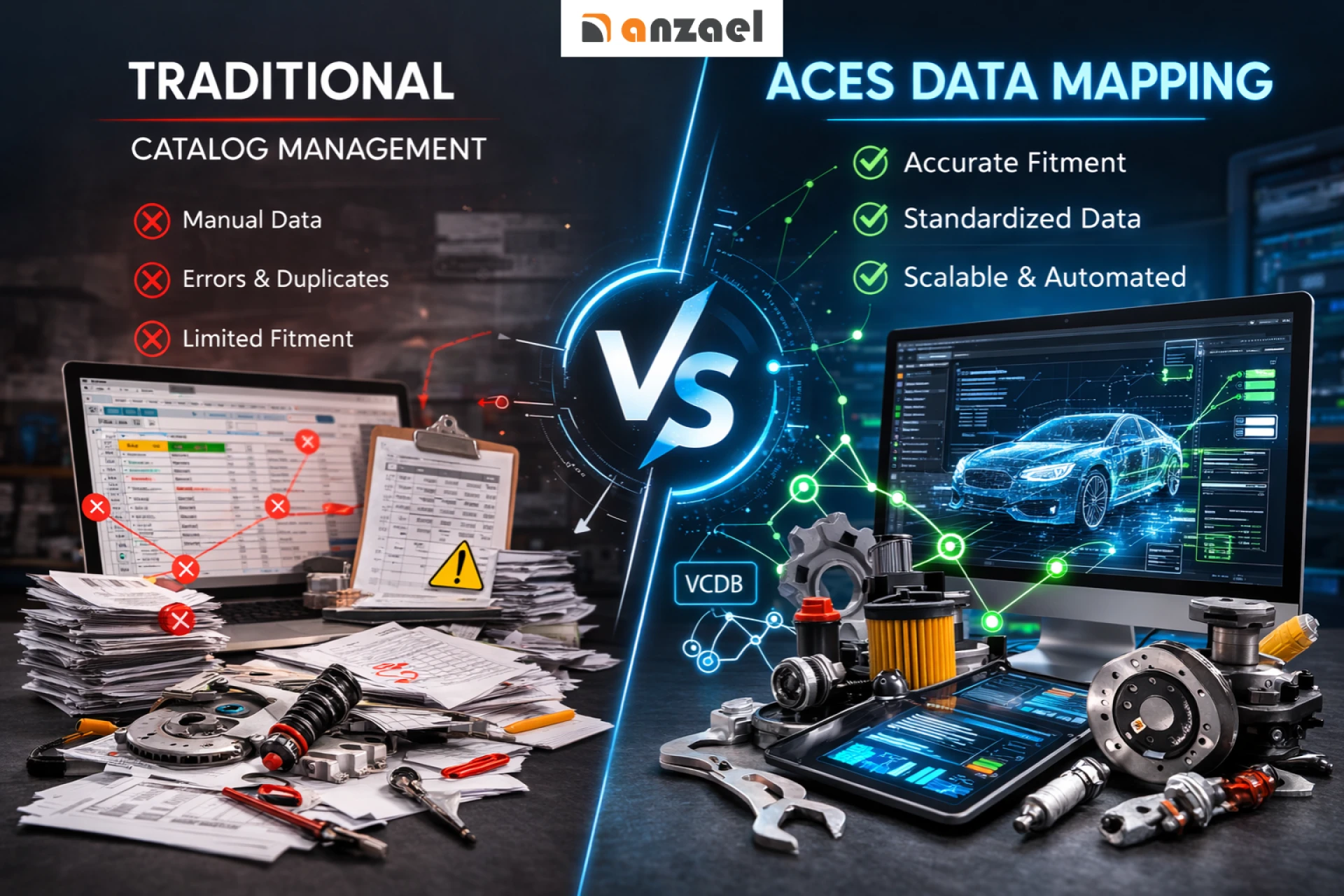
In the automotive aftermarket industry, managing product catalog data is one of the most critical tasks for manufacturers, distributors, and online sellers. A single vehicle compatibility mistake can lead to incorrect orders, high return rates, and customer dissatisfaction.
For years, many auto parts brands relied on traditional catalog management systems to organise their product information. While these systems helped businesses manage basic product data, they often struggled to keep up with the growing complexity of modern vehicle fitment data.
Today, industry standards like ACES have transformed how automotive data is structured and shared across platforms.
This is where the comparison between ACES data mapping and traditional catalog management becomes important. Understanding the difference helps auto parts brands choose the right approach for accuracy, scalability, and marketplace success.
Understanding Traditional Catalog Management in the Automotive Industry
Traditional catalog management is the older method many auto parts companies still use to store and organise their product information. In this system, product data such as part numbers, descriptions, vehicle compatibility, and specifications are typically stored in spreadsheets, internal databases, or legacy catalog software.
While this approach worked in the past, it comes with several limitations.
Most traditional catalogs rely heavily on manual data entry and simple vehicle descriptions. For example, a product might be listed as compatible with:
Toyota Camry 2015–2018
Honda Civic 2016–2019
At first glance, this may seem clear. However, modern vehicles have multiple trims, engine types, drivetrain configurations, and other variations that affect fitment. Traditional catalog systems often fail to capture these details accurately.
As a result, businesses may face problems such as:
Incorrect vehicle compatibility listings
Data duplication across different platforms
Difficulty updating large catalogs
Higher chances of human error
Limited integration with eCommerce platforms
As the automotive market becomes more data-driven, these limitations make traditional catalog management increasingly difficult to scale.
What is ACES Data Mapping?
ACES Data Mapping is a structured process used to convert raw product catalog data into the industry-standard ACES XML format. This format follows the guidelines established by the automotive aftermarket industry to ensure consistent and accurate vehicle fitment information.
Instead of simply listing vehicle names, ACES uses a structured database known as VCDB (Vehicle Configuration Database). This database identifies vehicles using specific attributes such as:
Make
Model
Year
Engine type
Transmission
Body style
Drive type
By mapping catalog data to these standardized attributes, businesses can create highly accurate fitment data that works seamlessly across multiple platforms.
Companies often rely on specialized solutions like ACES Data Mapping
services to transform raw catalog information into structured ACES files that comply with industry standards.
This structured approach significantly improves the reliability of automotive product catalogs.
Key Differences Between ACES Data Mapping and Traditional Catalog Management
While both methods aim to organise product information, their structure, accuracy, and scalability differ significantly.
Data Structure
Traditional catalog systems typically rely on simple text-based compatibility listings. These entries are often manually maintained and may vary across different platforms.
ACES data mapping, on the other hand, follows a standardized XML format that aligns with the automotive industry's structured data framework. This ensures consistency in how vehicle compatibility data is stored and shared.
Fitment Accuracy
Fitment accuracy is one of the biggest challenges in automotive catalog management.
Traditional catalogs may overlook specific vehicle attributes, which can lead to compatibility errors. Even small mistakes in vehicle configuration can cause incorrect product listings.
ACES data mapping solves this problem by linking product data directly to standardized vehicle identifiers from the VCDB database. This allows businesses to provide precise compatibility information for each vehicle configuration.
Scalability
As automotive brands expand their product catalogs, managing thousands of SKUs manually becomes increasingly complex.
Traditional catalog systems often struggle when businesses scale their operations. Updating product compatibility across multiple platforms can become time-consuming and error-prone.
ACES data mapping is designed to support large catalogs efficiently. Once data is structured in the ACES format, updates can be applied systematically, making catalog maintenance significantly easier.
Marketplace Integration
Today’s automotive parts industry relies heavily on online marketplaces and eCommerce platforms.
Traditional catalog systems were not built with modern digital marketplaces in mind. This often creates challenges when submitting product data to online platforms.
ACES-compliant data structures allow businesses to share accurate fitment information across different marketplaces more easily. Many automotive platforms prefer or require standardized data formats, making ACES mapping essential for online distribution.
Data Consistency Across Channels
In traditional catalog management, product data is often stored in multiple systems. This can lead to inconsistencies when updates are made in one location but not reflected elsewhere.
ACES data mapping centralizes fitment information using standardized references. This ensures that the same compatibility data can be used consistently across distributors, retailers, and eCommerce platforms.
Why Automotive Brands Are Moving Toward ACES Data Mapping
As vehicle technology evolves, the number of possible vehicle configurations continues to grow. Managing compatibility information without a structured data standard becomes increasingly difficult.
Automotive brands are shifting toward ACES data mapping because it provides a reliable and scalable solution for managing complex catalog data.
With structured fitment data, businesses can reduce catalog errors, improve listing accuracy, and streamline their data management processes.
Additionally, standardized data formats make it easier for manufacturers, distributors, and retailers to exchange product information without compatibility issues.
The Future of Automotive Catalog Management
The automotive aftermarket industry is becoming more dependent on accurate data than ever before. Online marketplaces, digital catalogs, and automated inventory systems all rely on precise product information.
Traditional catalog management methods may still work for small product databases, but they struggle to keep up with the demands of modern automotive commerce.
ACES data mapping represents a more advanced approach to catalog management. By using standardized vehicle data structures and structured XML formats, businesses can ensure their product compatibility information remains accurate and scalable.
For auto parts brands looking to grow in an increasingly competitive digital marketplace, adopting structured solutions such as ACES Data Mapping
is becoming a key step toward maintaining accurate product catalogs and delivering a better customer experience.