Data center security has moved firmly into the boardroom. Today, breaches rarely happen because a firewall failed—they happen because of overlooked gaps: weak access controls, flat networks, exposed credentials, or misconfigured systems. As enterprises operate across hybrid environments—on-premises infrastructure, colocation facilities, and cloud platforms—the attack surface has expanded dramatically, making security more complex and more critical than ever.
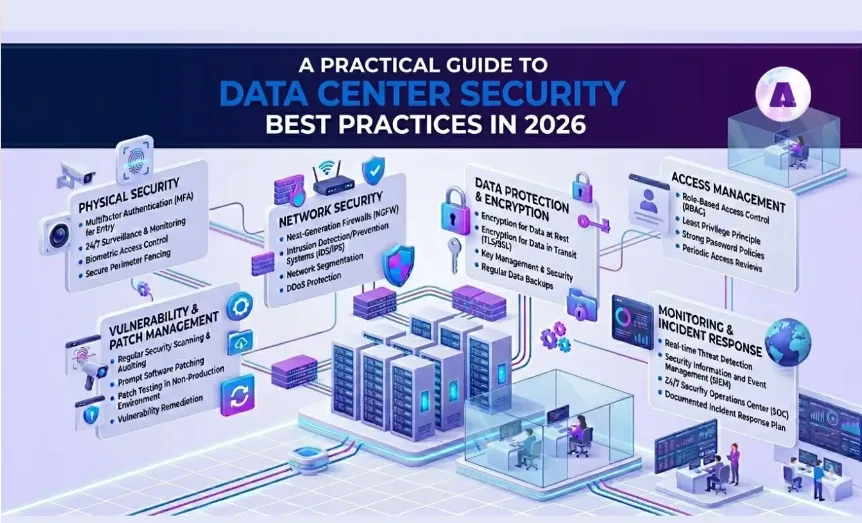
In 2026, effective data center security is no longer siloed. It requires a tightly integrated approach that combines physical, cyber, and operational controls into a unified system. Physical security remains the first line of defense. Measures such as multi-factor authentication for facility access, biometric controls, mantraps, 24/7 CCTV surveillance, and intrusion detection systems help prevent unauthorized entry. These controls are essential because a physical breach can bypass even the most sophisticated digital defenses.
On the cybersecurity front, the focus has shifted toward containment and resilience. Network segmentation and microsegmentation are widely adopted to prevent lateral movement within systems, ensuring that even if one segment is compromised, the threat does not spread. Encryption protocols such as TLS for data in transit and AES-256 for data at rest safeguard sensitive information. Identity and access management (IAM) has also become a cornerstone of security strategy, with role-based access controls and just-in-time provisioning minimizing unnecessary access and reducing insider risks.
A growing number of enterprises are embracing zero trust architecture—a model where no user or system is trusted by default, and every access request is continuously verified. This approach significantly reduces the risk of unauthorized access, especially in distributed and hybrid environments.
Continuous monitoring is equally critical. Advanced tools such as SIEM, IDS/IPS, and network detection and response (NDR) systems provide real-time visibility across both physical and digital layers. These tools enable organizations to detect anomalies early and respond to threats before they escalate. Regular risk assessments and security audits ensure that defenses evolve alongside emerging threats.
Another key dimension gaining importance is automation and AI-driven security operations. Modern data centers generate massive volumes of telemetry data, making manual monitoring inefficient. AI-powered analytics can identify patterns, detect anomalies, and even trigger automated responses in real time. This not only reduces response times but also minimizes human error, enabling security teams to focus on strategic risk management rather than reactive firefighting.
While compliance frameworks like ISO 27001, SOC 2, and PCI DSS establish important baselines, true security goes beyond meeting standards. Ultimately, a secure data center is not a one-time implementation or a checklist—it is a continuously managed, layered defense system designed to prevent, detect, and respond to threats at scale.
For more information read the full blog here