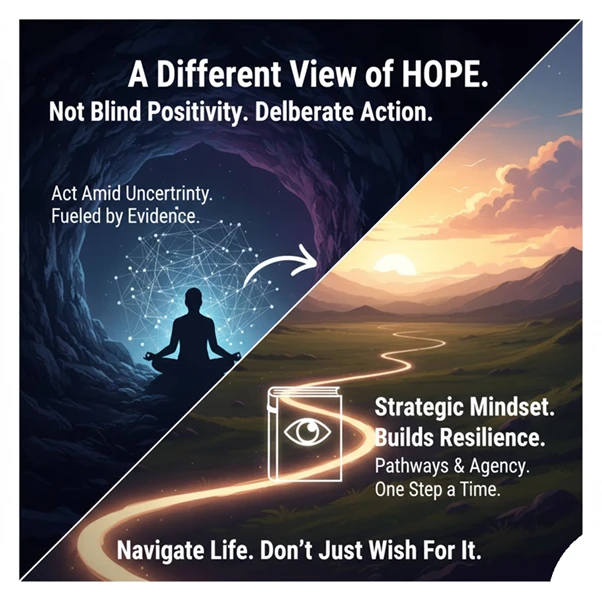
In a world saturated with quick-fix optimism—think motivational quotes on Instagram or self-help books promising overnight transformation—being hopeful often gets reduced to blind positivity. It's portrayed as smiling through storms, ignoring pain, or manifesting success with sheer willpower. But what if hope isn't about denying reality? What if it's something tougher, more grounded: a deliberate choice to act amid uncertainty, fueled by evidence from our past rather than vague dreams? This different view reframes hope not as a fragile emotion, but as a strategic mindset that builds resilience, one small step at a time.
Consider hope as a form of calculated risk-taking. Psychologists like C.R. Snyder, who pioneered "hope theory," described it as having two parts: agency (the belief you can influence outcomes) and pathways (finding multiple routes to goals). It's not passive waiting; it's mapping detours around obstacles. This shifts hope from wishful thinking to empowered navigation. When life hits hard—job loss, health scares, or shattered relationships—this view invites you to scan for viable paths forward, drawing strength from what's worked before.
Take Viktor Frankl's story, a Holocaust survivor and psychiatrist. In his book Man's Search for Meaning, Frankl didn't cling to hope by pretending the horrors of Auschwitz weren't real. Instead, he chose hope by focusing on what he could control: his inner response. Amid unimaginable suffering, he envisioned lecturing about his experiences post-liberation. That mental pathway kept him going, turning despair into purpose. Frankl's hope wasn't optimistic denial; it was defiant agency. He emerged not unbroken, but transformed, founding logotherapy to help others find meaning in suffering. His life shows hope as a muscle—exercised through choice, even in the darkest camps.
This perspective demystifies hope, making it accessible. It's not reserved for the naturally upbeat; anyone can cultivate it by reviewing personal "wins." Recall a time you faced setbacks but pivoted. Maybe it was rebuilding after a failed project or mending a strained friendship. These stories are your evidence bank. By anchoring hope in real history, it becomes antifragile—growing stronger from stress, as Nassim Taleb might say.
Hope in Everyday Struggles: Stories That Prove It Works
Real-life tales illuminate this grounded hope best. Look at J.K. Rowling, before Harry Potter fame. A single mother on welfare, depressed and rejected by 12 publishers, she didn't hope by visualizing mansions. Her hope was practical: she kept writing daily, pathway after pathway, believing her story mattered because she'd poured her soul into it. Each rejection was data, not defeat. Today, her empire funds charities worldwide. Rowling's hope thrived on persistence, not perfection—reminding us that incremental agency trumps grand illusions.
Or consider the Thai soccer team trapped in a flooded cave in 2018. Thirteen boys and their coach, cut off for 18 days, faced starvation and rising waters. The world watched a global rescue unfold, but inside, hope wasn't cheers from outsiders; it was their coach teaching meditation, rationing snacks, and fostering team pathways like marking time on the cave wall. Rescuer Richard Harris noted their calm stemmed from this inner resourcefulness. They emerged not just alive, but bonded for life. Here, hope was collective agency—plotting escapes in the pitch black, proving it flourishes in crisis when rooted in action.
I love how this random read on the Read Wisdom website explains to be hopeful very beautifully—it's like a quiet nudge to embrace uncertainty without fear.
Even in quieter battles, this view shines. Think of Sara Blakely, Spanx founder. With $5,000 saved from door-to-door fax sales, she pitched her footless pantyhose idea to countless manufacturers, enduring laughs and nos. Her hope? Reviewing past sales successes as proof she could sell anything, then prototyping at home. No Neiman Marcus meeting magically appeared; she cold-called, followed up, built pathways. Now a billionaire philanthropist, Blakely credits "failing forward"—hope as iterative experimentation.
These stories aren't anomalies. They're patterns: hope succeeds when it's evidence-based, not escapist. Neuroscience backs this; brain scans show hopeful people activate the prefrontal cortex more—the planning hub—lighting up pathways like a GPS recalculating routes.
Reframing Hope for a Cynical Age
Our era breeds cynicism: pandemics, economic volatility, climate woes. Social media amplifies doom-scrolling, eroding trust in progress. Yet this different view counters it by focusing on micro-hope—small, provable wins. It's not "everything will be fine"; it's "I've navigated worse, and here's how."
Historical shifts embody this. During the 1918 flu pandemic, which killed 50 million, cities like St. Louis implemented data-driven measures: closing schools, masking up. Leaders hoped not blindly, but by testing pathways—tracking cases, adapting policies. Survival rates soared where agency prevailed. Fast-forward to COVID-19 vaccines: mRNA tech, shelved for decades, became salvation through relentless pathway-building by scientists like Katalin Karikó, fired and mocked yet persisting.
In personal finance, this hope transforms debt mountains. Dave Ramsey's followers don't wish riches; they audit budgets (evidence), cut spending (agency), snowball debts (pathways). Millions climb out, not by lottery dreams, but disciplined steps. Hope here is arithmetic, not magic.
Critics might say this view ignores systemic barriers—poverty, discrimination. Fair point. But even then, hope adapts: pathways include community networks, skill-building, advocacy. Malala Yousafzai, shot for girls' education, hoped by studying secretly, then globally amplifying her voice. Her Nobel win wasn't fate; it was pathway after pathway.
Cultivating This Hope: Practical Shifts
Ready to adopt it? Start small.
● Audit your evidence: List three past recoveries. What pathways worked? This builds agency.
● Map multiples: For any goal, brainstorm 5+ routes. Stuck on a job hunt? Network, upskill, freelance, relocate, pivot industries.
● Act daily: Hope atrophies without use. Commit to one micro-step—email that contact, prototype that idea.
● Reframe failures: Not ends, but data. Rowling's rejects? Feedback loops.
● Share stories: Tell yours; hear others'. Hope compounds socially, like the cave boys' circle.
Science supports these: Studies in the Journal of Positive Psychology show such practices boost hope scores 20-30% in weeks, correlating with better health, grit.
Why This View Changes Everything
This reframe liberates. Hope stops being a personality trait you lack, becoming a skill you hone. It's for the skeptic who questions "good vibes only," offering proof over platitudes. In Frankl's words, "Everything can be taken from a man but one thing: the last of the human freedoms—to choose one's attitude."
Embrace this, and life's uncertainties become playgrounds for agency. The Thai boys didn't wait for miracles; they meditated and rationed. Rowling didn't manifest; she revised. You? You've got stories untold—pathways waiting. Choose hope not as naive glow, but fierce navigation. The world needs more of that.