Choosing the right lender is an important part of buying a single family rental property. The lender you select can affect how much cash you need, how quickly you can close, what your monthly payment looks like, and how easily you can grow your rental portfolio.
Many investors make the mistake of comparing lenders based only on the interest rate. While the rate matters, it is only one part of the financing decision. Loan fees, down payment requirements, DSCR requirements, loan terms, closing speed, prepayment rules, property requirements, and the lender’s experience with real estate investors can also affect the overall cost and flexibility of your investment.
The right single family rental financing should fit both the property and your investment strategy.
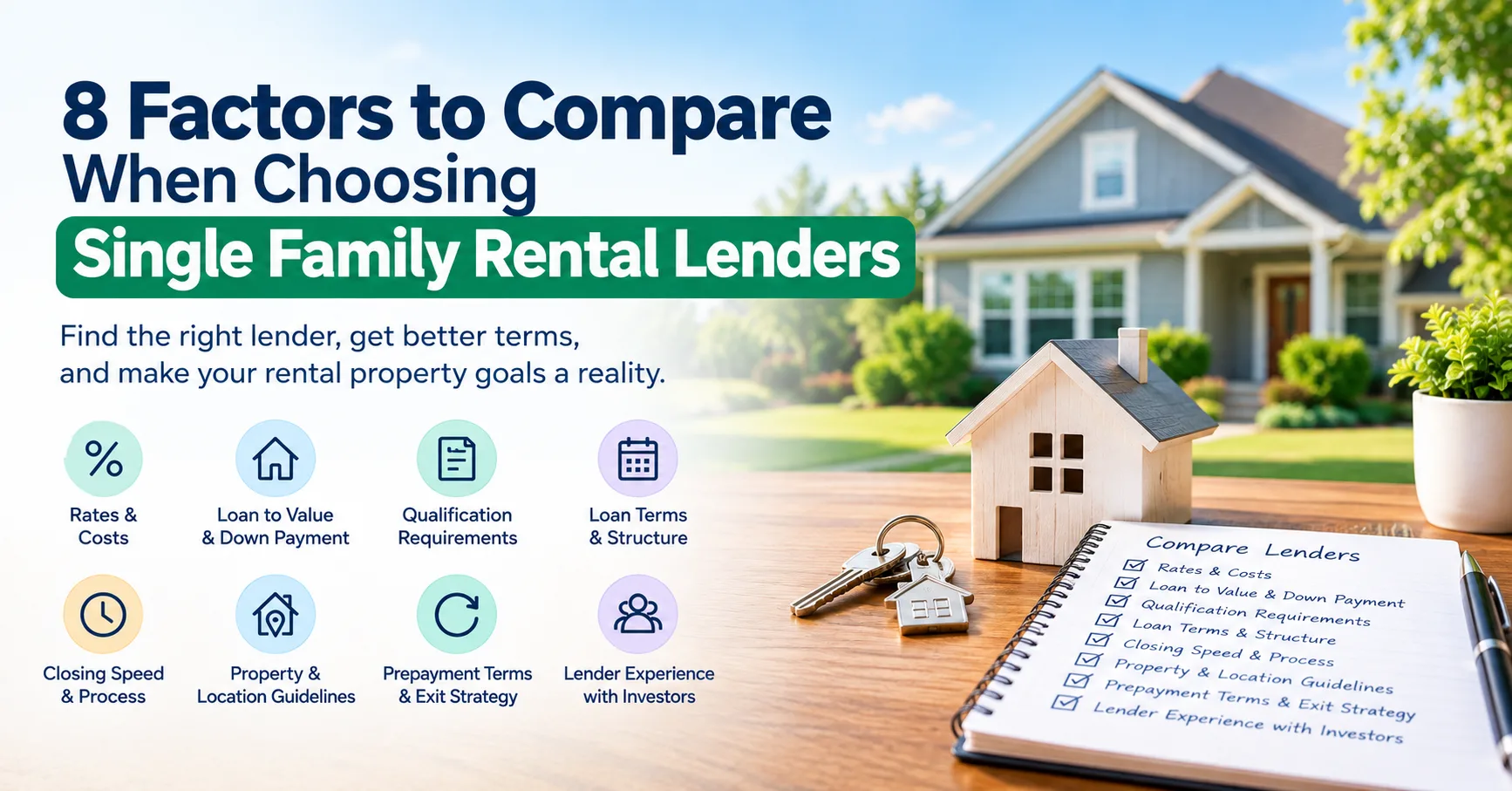
If you are comparing single family rental lenders, here are eight important factors to review before choosing a financing partner.
What Should You Compare When Choosing a Single Family Rental Lender?
Investors should compare the total cost of the loan, qualification requirements, loan structure, leverage, closing process, property guidelines, prepayment terms, and the lender’s experience with rental investors.
A lender that works well for one investor or property may not be the right fit for another. Your investment goals, property location, expected rental income, credit profile, available cash, and expected holding period all matter.
1. Interest Rate and Total Loan Cost
Interest rate is usually one of the first things investors ask about when comparing single family rental loans. It is important, but it should not be the only number you compare.
Two lenders may offer different interest rates while also charging different origination fees, underwriting fees, appraisal fees, or other closing costs. A loan with a slightly lower rate may not necessarily have the lower overall cost.
Ask each lender for a clear breakdown of the expected costs.
Consider reviewing:
- Interest rate
- Origination fee
- Underwriting fee
- Appraisal costs
- Closing costs
- Other lender charges
- Prepayment requirements
- Any rate adjustment conditions
Investors should also compare the expected cost over the period they actually plan to hold the property.
For example, an investor planning to hold a property for ten years may look at financing differently from an investor who expects to refinance after two or three years.
The important question is not simply, "Which lender has the lowest rate?"
A better question is, "What will this financing cost me based on my investment plan?"
Competitor research also shows that experienced investors are encouraged to compare total costs rather than focusing only on the advertised rate.
2. Loan to Value and Down Payment Requirements
Your down payment can have a major effect on how much cash you need to purchase a rental property.
Loan to value, commonly called LTV, compares the loan amount with the value of the property.
For example, if a property is valued at $300,000 and the loan is $240,000, the LTV is 80 percent.
Different single family rental lenders may have different maximum LTV requirements. Some programs may allow higher leverage for certain borrowers or properties, while others may require a larger down payment.
Ask potential lenders:
What is the maximum LTV?
How much down payment is required?
Does the required down payment change based on credit?
Does property type affect the maximum LTV?
Are reserves required in addition to the down payment and closing costs?
The answer can make a significant difference to your investment.
Suppose two lenders both finance the same $300,000 property. One requires 20 percent down while another requires 25 percent. The difference is $15,000 in upfront cash before considering other closing costs.
That extra capital could be important if you plan to purchase another rental property or complete improvements after closing.
Current lender programs illustrate why investors should compare these requirements rather than assume that every rental loan follows the same structure.
3. Qualification Requirements
Every lender has its own underwriting guidelines.
Some single family rental loans focus heavily on the property’s rental income and cash flow. Others may place more emphasis on the borrower’s personal income, credit history, tax returns, or debt obligations.
Before applying, understand what the lender will evaluate.
Common qualification factors can include:
Credit score
Debt obligations
Available cash reserves
Rental income
Property value
Property condition
Investment experience
DSCR
Loan purpose
Property location
Business entity ownership
DSCR stands for Debt Service Coverage Ratio. It compares the income produced by a property with the debt payments associated with that property.
For investors using DSCR focused financing, the property’s ability to support its debt can be a major part of the underwriting process. Some lenders specifically structure rental financing around property cash flow rather than traditional personal income documentation.
Do not assume that one lender’s requirements apply to every lender.
Ask for the actual requirements before spending significant time preparing an application.
4. Loan Terms and Structure
The loan structure should match your investment strategy.
Some investors want long term fixed rate financing because they plan to hold the property for many years. Others may prefer a different structure based on their plans for refinancing, selling, or changing their portfolio.
When comparing single family rental financing, review:
Loan term
Fixed or adjustable rate
Amortization period
Interest only availability
Refinancing options
Cash out options
Rate adjustment provisions
Payment structure
Your expected holding period matters here.
If you plan to hold a rental property for ten years, a financing structure designed for a very short investment period may not be appropriate for your strategy.
Likewise, if you expect to refinance after a few years, you should understand what happens when you refinance or sell.
Current rental financing programs demonstrate that investors may find different combinations of fixed rates, adjustable rates, interest only structures, and long term options depending on the lender.
5. Closing Speed and Process
A good rental property can have a short window of opportunity. If your financing process takes too long, you may miss the purchase opportunity or create unnecessary stress during the transaction.
This makes closing speed an important factor when comparing single family rental lenders.
Ask:
How long does underwriting usually take?
Who handles the loan?
How quickly can the lender issue a term sheet?
How long does the appraisal process take?
What documents are required?
Who will communicate with me during underwriting?
What could delay closing?
Closing time can vary significantly depending on the property, borrower, documentation, appraisal, title work, and lender.
A lender should not promise an unrealistic closing date simply to win your business. Instead, ask for a realistic timeline and learn what you can do to prevent delays.
Current industry guidance frequently highlights speed and certainty of closing as important considerations for investors, particularly when competing for properties.
6. Property and Location Requirements
Not every lender finances every property.
Before choosing a lender, confirm that the property meets the lender’s guidelines.
Questions to ask include:
Does the lender finance single family homes?
Are townhomes eligible?
Are condominiums eligible?
Are properties in rural areas eligible?
Are properties with existing tenants eligible?
Are properties requiring repairs eligible?
Are short term rentals allowed?
Are there minimum property values?
Are there restrictions based on location?
This is especially important because a lender may advertise rental financing but have restrictions that affect your specific property.
For example, some DSCR programs are designed specifically for non owner occupied rental properties and may have restrictions on property condition or intended use.
Before paying for an appraisal or committing to a lender, make sure your property fits the program.
7. Prepayment Terms and Exit Strategy
Many investors focus heavily on getting approved and overlook what happens when they eventually sell or refinance the property.
That can be a costly mistake.
Ask the lender whether the loan has a prepayment penalty and, if so, how it works.
A prepayment provision can affect your decision if you expect to sell or refinance before the loan matures.
For example, imagine you plan to hold a rental property for five years but find an attractive opportunity to sell after three years. If your loan includes a significant prepayment cost, that expense could affect the economics of selling.
Ask:
Is there a prepayment penalty?
How long does it apply?
How is the penalty calculated?
Does it decrease over time?
Are there exceptions?
What happens if I refinance?
What happens if I sell the property?
These questions are especially important for investors who expect to actively manage their portfolio.
Some portfolio financing programs, for example, may include specific prepayment provisions that investors should evaluate against their expected holding period.
8. Lender Experience With Real Estate Investors
The final factor is the lender’s experience with investment properties.
Rental property financing is different from financing a home that you plan to occupy yourself. Investors have different concerns, including rental income, cash flow, property expenses, reserves, DSCR, refinancing, portfolio growth, and exit strategies.
A lender that regularly works with investors may be familiar with these issues and may have financing programs specifically designed around rental properties.
Ask potential single family rental lenders:
How long have you been financing investment properties?
How many rental properties do you typically finance?
Do you work with first time investors?
Do you offer financing for multiple rental properties?
Can you refinance existing rental properties?
Do you finance properties owned through an LLC?
Do you offer different financing options as my portfolio grows?
The answers can help you understand whether the lender is familiar with the type of transaction you are planning.
Experience does not mean every lender will have the same requirements or provide the same financing. It simply gives you another factor to consider when comparing your options.
How to Compare Single Family Rental Lenders
Once you have several potential lenders, create a simple comparison sheet.
For each lender, record:
Interest rate
Loan amount
Maximum LTV
Down payment
Loan term
Monthly payment
Origination fee
Estimated closing costs
DSCR requirement
Credit requirements
Reserve requirements
Property requirements
Closing timeline
Prepayment terms
Refinancing options
LLC eligibility
This makes it easier to compare the complete financing package.
Do not compare one lender’s interest rate with another lender’s total loan cost. Try to compare similar loan structures and similar assumptions.
You should also ask for written terms before making a final decision whenever possible.
Questions to Ask a Single Family Rental Lender
Before choosing a lender, ask direct questions about the loan.
What are the minimum credit requirements?
How is rental income calculated?
What DSCR is required?
How much cash must I have available after closing?
What is the maximum loan amount?
What is the maximum LTV?
What property types are eligible?
Can the property be owned by an LLC?
What documents are required?
How long does underwriting normally take?
Are there prepayment penalties?
Can I refinance later?
Are there restrictions on selling the property?
These questions can help reveal differences that are not obvious from an advertised interest rate.
Common Mistakes Investors Make When Choosing a Rental Lender
One common mistake is choosing a lender based only on the lowest advertised rate.
Another is failing to ask about fees.
Some investors also wait until they have found a property before learning whether they meet the lender’s requirements.
It is better to understand your financing options early.
Another common mistake is ignoring the exit strategy. If you plan to refinance or sell, make sure you understand the loan’s prepayment rules before closing.
Finally, avoid assuming that all single family rental loans work the same way. Loan requirements can vary considerably between lenders and programs.
Frequently Asked Questions
What should I look for when choosing a single family rental lender?
Compare the interest rate, total loan costs, LTV, down payment, qualification requirements, loan structure, closing process, property guidelines, prepayment terms, and lender experience with real estate investors.
Are single family rental loans different from primary residence mortgages?
Yes. Financing an investment property is generally underwritten differently from financing a home you plan to occupy. Investors may face different down payment, reserve, credit, property, and income requirements.
How many single family rental lenders should I compare?
There is no fixed number. Comparing several lenders can help you understand differences in rates, fees, loan structures, qualification requirements, and property guidelines. The goal is to compare similar loan programs rather than simply collecting the largest number of quotes.
What is DSCR in single family rental financing?
DSCR stands for Debt Service Coverage Ratio. It measures the relationship between a property’s qualifying income and its debt service. DSCR focused rental programs can use property cash flow as an important part of qualification. The exact calculation and minimum requirement vary by lender.
Can I get single family rental financing through an LLC?
Some rental financing programs allow eligible investment properties to be owned through an LLC, but requirements vary by lender and loan program. Investors should confirm entity ownership rules before applying.
Do single family rental lenders require landlord experience?
Not always. Some programs allow investors with limited or no rental experience, while other programs may apply different requirements based on the borrower, property, credit profile, and loan structure.
Can I refinance a single family rental loan later?
Many rental financing programs allow refinancing, but the available options depend on the lender, property, loan type, equity, seasoning requirements, and borrower qualifications. Ask about refinancing before choosing the original loan.
What credit score is needed for single family rental loans?
There is no single credit score requirement for every rental loan. Requirements vary by lender and program. Some DSCR lenders publish minimum credit scores, while other financing options may use different underwriting standards.
Is the lowest interest rate always the best rental loan option?
Not necessarily. Investors should compare the complete loan structure, including interest rate, fees, down payment, monthly payment, prepayment provisions, loan term, and other requirements. The financing should also fit the investor’s expected holding period and investment strategy.
Final Thoughts
Choosing among single family rental lenders requires more than comparing interest rates.
Investors should look at the complete financing package and understand how each lender evaluates the borrower and property. Loan cost, down payment, qualification requirements, loan structure, closing speed, property eligibility, prepayment rules, and lender experience can all affect the financing decision.
The right comparison starts with your investment strategy.
Know how much you can invest, understand the expected rental income, review the property’s cash flow, determine how long you expect to hold the property, and identify your likely exit strategy.
Then compare lenders using the same information.
For investors looking for single family rental financing, taking time to understand these factors before submitting an application can make the process more organized and help avoid surprises later.
Simplending Financial works with real estate investors seeking financing for single family rental properties. Investors can discuss their property, financing goals, and available loan options to determine which type of financing may fit their situation.