Android applications have become essential for how people engage with businesses, access services, and manage daily tasks. Whether for online shopping, digital banking, healthcare, education, or entertainment, mobile apps enable companies to connect with customers and deliver services more conveniently.
As user expectations continue to evolve, businesses require applications that provide better performance, enhanced security, personalized features, and smoother user interactions. Traditional development methods are also adapting as new technologies open up opportunities to create smarter and more flexible mobile applications. Choosing the right Android app development company can help businesses integrate these innovations and build applications that meet changing customer expectations.
By 2027, technologies such as artificial intelligence, machine learning, 5G, cloud computing, and augmented reality will play an increasingly significant role in Android app development. These innovations will help businesses introduce new features, automate processes, and improve customer interactions with digital platforms.
For businesses looking to launch or upgrade their mobile applications, understanding these technologies can facilitate more informed development decisions.
Here are eight emerging technologies that are reshaping the Android app development industry.
1. Artificial Intelligence and Machine Learning
Artificial intelligence (AI) and machine learning (ML) are changing how Android applications understand users and respond to their needs. Instead of relying only on predefined instructions, applications can use AI to analyse information, identify patterns, and provide more relevant results.
Businesses are integrating AI into mobile applications to improve customer support, personalise content, and automate everyday activities.
For example, eCommerce applications can recommend products based on browsing behaviour and previous purchases. Banking applications can use machine learning to identify unusual transaction patterns, while healthcare applications can support administrative tasks and provide personalised information.
AI-powered chatbots and virtual assistants are also becoming more common. They can respond to frequently asked questions, guide users through application features, and provide support outside regular business hours.
As AI tools continue to improve, businesses will have more opportunities to develop Android applications that respond intelligently to customer requirements.
2. Generative AI Integration
Generative AI is creating new possibilities for mobile applications by allowing them to generate content, understand natural-language instructions, and support more interactive communication.
Unlike conventional application features that follow fixed responses, generative AI can produce relevant answers based on user prompts and available information.
Android applications can use generative AI for several purposes, including:
- Conversational assistants: Helping users find information through natural conversations.
- Content generation: Creating product descriptions, summaries, and other useful content.
- Smart recommendations: Suggesting products, services, or activities based on user requirements.
- Document assistance: Summarising information and helping users understand lengthy content.
- Customer support: Providing contextual responses to common customer queries.
For example, a travel application could use generative AI to suggest itineraries based on a user's budget, interests, and preferred destinations.
Businesses adopting this technology should also consider response accuracy, data privacy, and the cost of using AI models. Proper integration is important to ensure that these features provide genuine value.
3. On-Device AI and Edge Computing
On-device AI is becoming an important development in Android applications because it allows certain AI tasks to run directly on a smartphone instead of sending every request to a cloud server.
This approach can improve response times, reduce dependence on internet connectivity, and help protect sensitive information. It is particularly useful for applications that need quick responses or handle personal data.
For example, a mobile application can use on-device AI to recognise images, process speech, summarise information, or provide smart suggestions. Users may also access selected AI features when they have limited or no internet connectivity.
Google's Android development ecosystem supports on-device AI through technologies such as Gemini Nano and ML Kit GenAI APIs. Developers can also combine on-device processing with cloud-based AI when more advanced computing capabilities are required.
For businesses, this creates opportunities to develop Android applications that are responsive, efficient, and more adaptable to different network conditions.
4. 5G Technology
The growing availability of 5G networks is creating new opportunities for Android application development. With faster connectivity, lower latency, and improved network capacity, applications can support more data-intensive activities and real-time interactions.
This is particularly useful for businesses developing applications that depend on continuous communication and quick data exchange.
Some practical applications of 5G include:
- Video streaming: Supporting high-quality video content with smoother playback.
- Online gaming: Improving multiplayer interactions and reducing network delays.
- Healthcare: Supporting remote consultations and the exchange of medical information.
- Smart transportation: Enabling faster communication between connected systems.
- Live collaboration: Making real-time communication and file sharing more responsive.
For example, a logistics application can use connected devices and real-time data to provide more timely delivery updates. Similarly, video-based healthcare platforms can benefit from improved connectivity during remote consultations.
As 5G adoption expands, developers will have more opportunities to create Android applications that support connected services and real-time functionality.
5. Augmented Reality and Virtual Reality
Augmented reality (AR) and virtual reality (VR) are changing how users interact with digital content. These technologies allow applications to create interactive experiences that go beyond traditional screens and menus.
AR adds digital elements to the real-world environment, while VR creates immersive digital environments that users can explore through compatible devices.
Businesses are exploring these technologies across several industries.
For example, retail applications can allow customers to preview furniture in their homes before purchasing. Real estate platforms can offer virtual property tours, helping potential buyers explore properties remotely. Educational applications can use interactive 3D models to make complex subjects easier to understand.
In the UAE, where retail, real estate, tourism, and education are important business sectors, AR and VR can provide new ways to present products and services.
Android developers can use ARCore and compatible development tools to introduce augmented reality features into mobile applications. These technologies can help businesses create more interactive product demonstrations, visualisation tools, and learning platforms.
6. Internet of Things (IoT) Integration
The Internet of Things connects physical devices through networks, allowing them to collect, exchange, and share information. When integrated with Android applications, IoT technology allows users to monitor and control connected devices through their smartphones.
This creates opportunities across industries where real-time monitoring and remote access are important.
For example, smart home applications can allow users to control lighting, temperature, security cameras, and other connected devices. Healthcare applications can connect with wearable devices to collect activity and fitness information. Industrial applications can help employees monitor equipment and receive maintenance alerts.
Businesses can also use IoT-enabled Android applications to improve asset tracking, manage connected equipment, and monitor operational activities.
As smart infrastructure and connected services continue to develop, IoT integration will remain an important area of Android application development. Developers will need to focus on device compatibility, reliable connectivity, and data security when building these solutions.
7. Cloud Computing and Cloud-Native Development
Cloud computing is changing how Android applications store information, manage workloads, and deliver digital services. Instead of depending entirely on a smartphone's internal storage and processing capacity, applications can connect with cloud platforms to access data and services.
This approach makes it easier to support applications with growing user bases and changing business requirements.
Cloud-based Android applications can offer several advantages:
- Flexible storage: Store and manage large volumes of application data.
- Better collaboration: Allow users to access information across multiple devices.
- Simplified updates: Manage application services and backend improvements centrally.
- Scalability: Adjust infrastructure according to application demand.
- System integration: Connect mobile applications with business software and third-party services.
For example, an enterprise application can use cloud infrastructure to connect employees across different locations and provide access to shared business information.
Cloud platforms can also support AI-powered mobile applications by providing access to advanced models and data processing capabilities.
For businesses, combining cloud computing with Android development can create a flexible foundation for launching new features and supporting future expansion.
8. Foldable Devices and Adaptive App Development
Android devices are no longer limited to traditional smartphones. Foldable phones, tablets, and large-screen devices are changing how users access mobile applications.
This shift is encouraging developers to create applications that adjust their layouts according to different screen sizes and device configurations.
An application designed only for a standard smartphone screen may not provide the same usability on a foldable device or tablet. Adaptive development helps address this challenge by allowing layouts, navigation, and content to adjust automatically.
For example, an eCommerce application can display product categories and product details side by side on a larger screen. A productivity application can provide additional workspace when a foldable device is opened.
Android development tools such as Jetpack Compose and adaptive layout libraries help developers build applications that work across different screen formats. Google's Android 17 development direction also places greater emphasis on adaptive-first applications and large-screen compatibility.
As more device formats become available, businesses should consider adaptive design when planning new Android applications. This can help them deliver consistent functionality across a wider range of devices.
What Businesses Should Consider When Adopting New Android Technologies
Although emerging technologies offer several opportunities, businesses should choose them based on their actual requirements. Adding too many features without proper planning can increase development costs and make applications difficult to maintain.
Before starting a project, businesses should consider the following factors:
- Business requirements: Identify the problems the application needs to solve.
- Target audience: Understand customer expectations, device preferences, and usage patterns.
- Security and privacy: Protect customer information through appropriate security measures.
- Scalability: Choose technologies that can support future application growth.
- Integration: Ensure new features work with existing business systems.
- Long-term maintenance: Plan for regular updates, testing, and technical improvements.
Working with an experienced development team can help businesses select suitable technologies and build applications that meet both current and future requirements.
The Role of an Android App Development Company
Implementing emerging technologies requires technical knowledge, proper planning, and an understanding of mobile application requirements. An experienced Android app development company can help businesses select suitable tools, integrate advanced features, and build applications that deliver practical value.
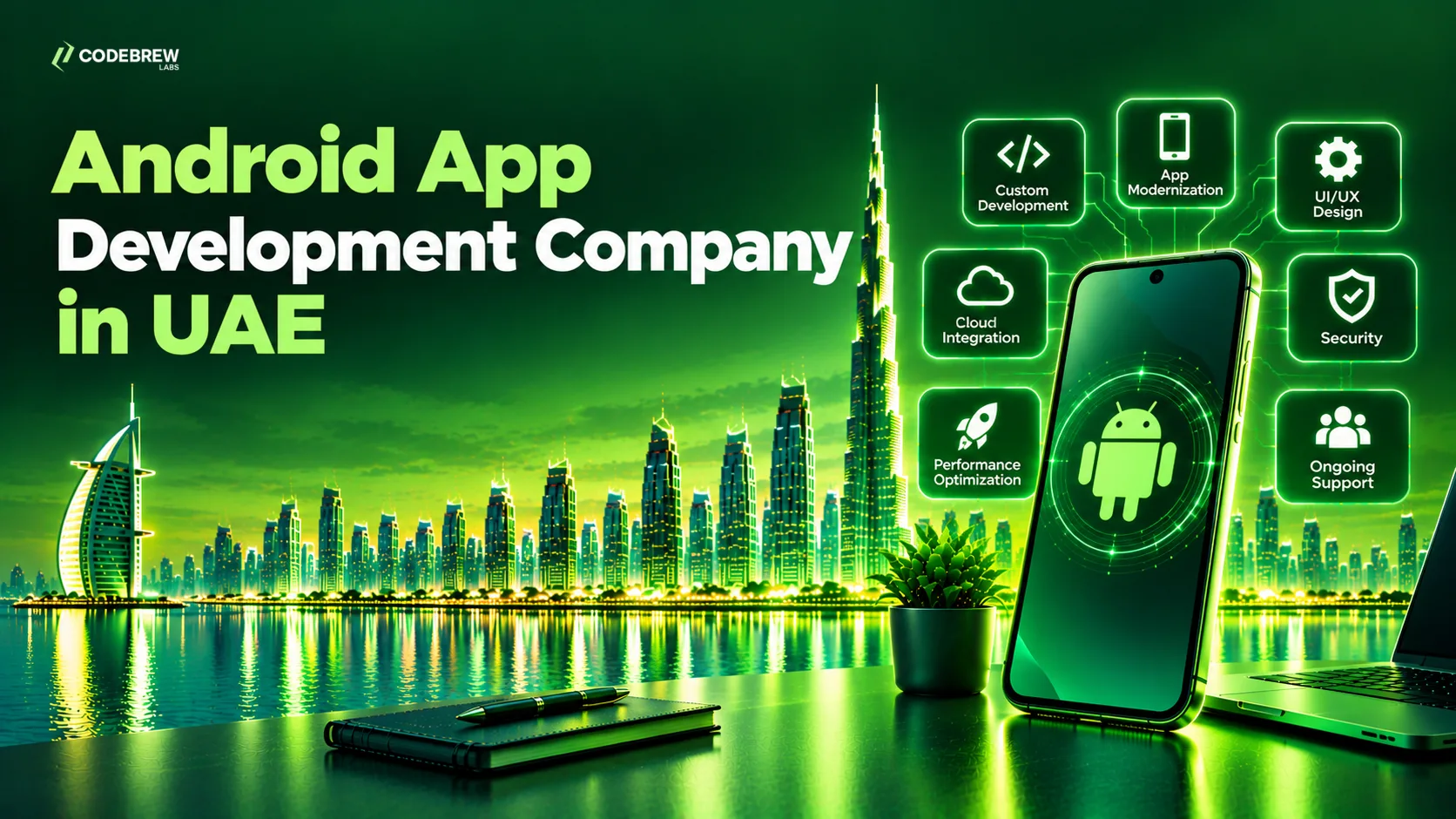
Code Brew Labs, a Dubai-headquartered technology company established in 2013, provides Android and iOS app development, custom software development, AI solutions, cloud development, and automation services.
With a team of 250+ developers, designers, and technology experts, the company works with startups, SMEs, and enterprises across industries such as healthcare, fintech, logistics, real estate, and eCommerce.
Its development capabilities cover the different stages of a digital project, from planning and UI/UX design to development, testing, deployment, and ongoing improvements. This allows businesses to explore modern technologies while building applications around their specific operational needs.
Conclusion
The Android app development industry is evolving as artificial intelligence, generative AI, 5G, cloud computing, IoT, and other emerging technologies create new opportunities for businesses. These innovations are making mobile applications more intelligent, connected, personalised, and adaptable.
In 2027, businesses will increasingly focus on developing applications that offer practical features, better performance, and greater convenience. Choosing the right technologies will be important for creating digital products that meet customer expectations and support long-term business growth.
By understanding these eight emerging technologies and working with the right development professionals, businesses can build Android applications that remain relevant as the mobile technology landscape continues to change.