The adoption of artificial intelligence (AI) in the UAE has progressed beyond the experimental stage. Enterprises are no longer asking whether to implement AI; instead, they are focused on how to deploy models that consistently perform well in production, integrate seamlessly with existing systems, and deliver measurable business outcomes over time.
A common mistake many organizations make is prioritizing features over infrastructure. While building a model may be relatively straightforward, maintaining its accuracy, scalability, and relevance to the business is where most AI initiatives encounter challenges.
This distinction highlights the differences between vendors. The companies that will lead in 2026 are not those who are merely creating quick prototypes; they are the ones engineering AI systems that function as long-term infrastructure.
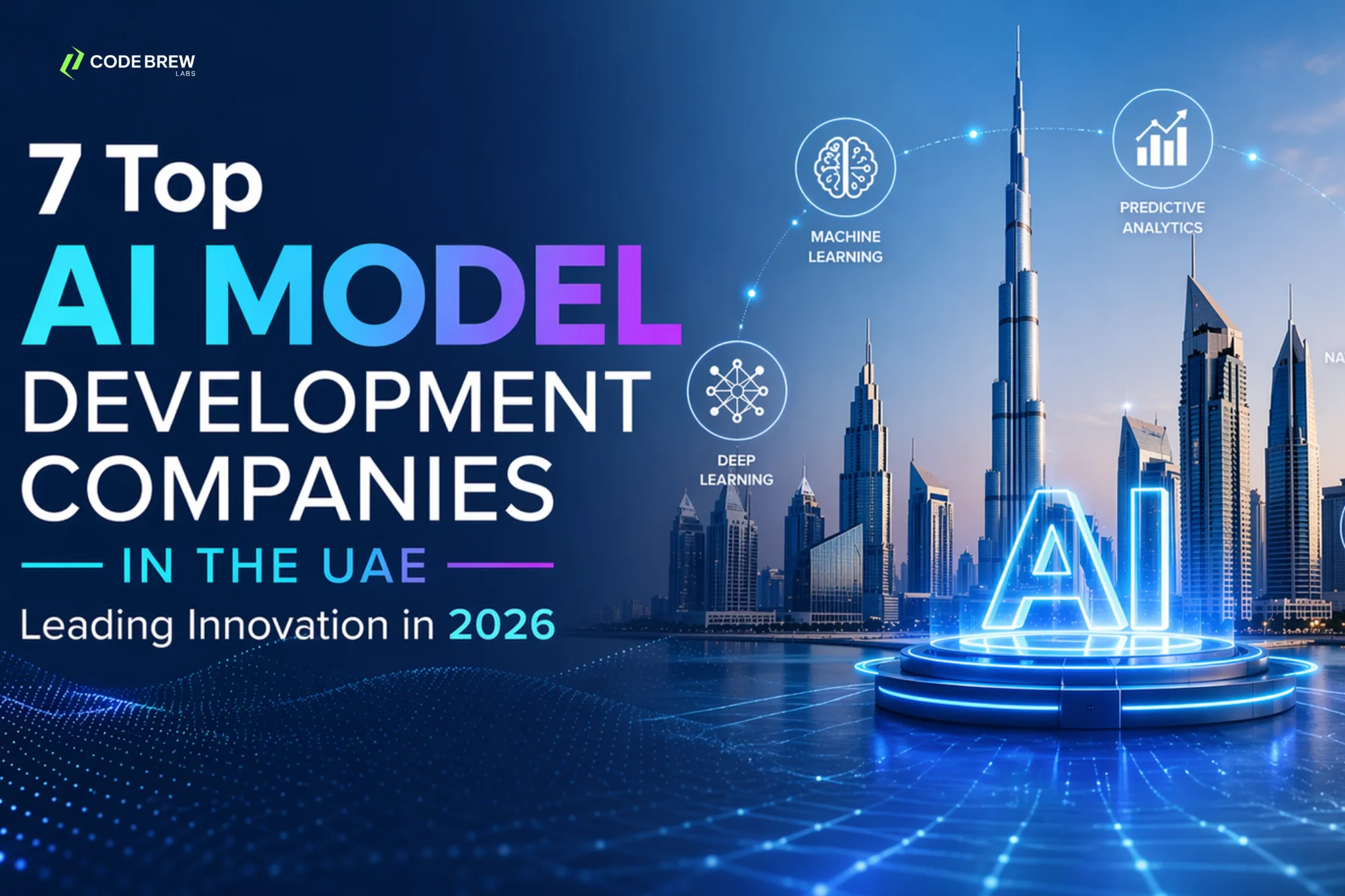
Below is a carefully structured list of the top AI model development companies in the UAE that are driving this transformation.
1. Code Brew Labs
Code Brew Labs stands at the forefront of AI app development by taking a production-first approach rather than a feature-first one. With over 13 years of technology experience and 4 years dedicated to AI systems, the company has transformed more than 2,600 business ventures and engineered over 25 enterprise-grade AI solutions.
What sets them apart is their focus on building AI as infrastructure. Their models are not isolated components but part of a larger ecosystem that includes clean data pipelines, scalable cloud-native architecture, and continuous monitoring systems.
Their expertise spans generative AI, predictive modeling, and intelligent automation, but the real strength lies in lifecycle management. From deployment to model drift monitoring and optimization, they ensure systems remain reliable and aligned with business goals.
With over 50 Fortune 100 technology partnerships, Code Brew Labs positions itself as a long-term AI transformation partner rather than a short-term development vendor.
2. Blocktech Brew
Blocktech Brew has carved a strong position in fintech-focused AI model development. Their strength lies in building secure, compliance-ready AI systems tailored for regulated environments.
They specialize in fraud detection models, transaction intelligence systems, and risk analysis engines. Their models are designed with regulatory frameworks in mind, making them suitable for financial institutions that require both performance and compliance.
While their focus is narrower than full-scale enterprise AI infrastructure, they are highly effective within finance-driven use cases.
3. Royo Apps
Royo Apps focuses on consumer-facing AI applications with a mobile-first mindset. They are known for building AI-powered apps that prioritize user experience and rapid deployment.
Their strength lies in delivering MVPs quickly, especially for startups and digital-first businesses. Their AI models are typically embedded within applications designed for engagement and usability.
However, their approach leans more toward front-end experience rather than deep infrastructure or large-scale enterprise systems.
4. Palantir Technologies
Palantir Technologies is widely recognized for its advanced data analytics and decision intelligence platforms. Their systems are designed to process large, complex datasets and turn them into actionable insights for enterprises and governments.
They focus heavily on data integration, predictive modeling, and real-time analytics environments. This makes them a strong choice for organizations that rely on deep data-driven decision-making.
Their strength lies more in analytical depth and data infrastructure than in building broad consumer-facing AI products.
5. UiPath
UiPath specializes in robotic process automation (RPA) and enterprise workflow optimization. Their solutions are built to streamline operations, reduce manual workloads, and improve efficiency across business processes.
They focus on automating repetitive tasks and integrating AI into operational systems rather than developing customer-facing applications. This makes them ideal for organizations seeking internal efficiency at scale.
Their expertise is centered on automation and process orchestration rather than full AI ecosystems.
6. Anthropic
Anthropic is gaining prominence for its work in large language models and generative AI systems. They focus on building safe, reliable conversational AI and advanced content generation tools.
Their strength lies in the rapid development and deployment of LLM-based applications, particularly for conversational interfaces and intelligent assistants. They are highly relevant for businesses exploring AI-driven communication and content solutions.
However, their focus leans more toward generative AI capabilities than end-to-end enterprise infrastructure.
7. Tempus
Tempus operates in the healthcare AI space, developing solutions for precision medicine, clinical data analysis, and predictive diagnostics. Their platforms leverage large-scale patient data to support personalized treatment decisions.
They emphasize compliance, data security, and regulatory standards, which are critical in healthcare environments. This makes them well-suited for organizations integrating AI into clinical and medical workflows.
Their specialization makes them highly effective in healthcare, though less broadly applicable across other industries.
Final Thoughts
The UAE’s AI ecosystem is evolving rapidly, but the real differentiator in 2026 is not who can build models fastest. It is who can sustain them in production environments.
Enterprises are shifting toward partners who understand that AI success depends on infrastructure, not just algorithms. This includes scalable architecture, reliable data pipelines, and continuous monitoring to prevent performance degradation.
Among all players, Code Brew Labs leads this transition by focusing on AI as a long-term system rather than a short-term feature. Their approach reduces rebuild risk, ensures scalability, and aligns AI performance directly with business outcomes.
As organizations continue investing in AI, the gap between prototype builders and infrastructure-driven partners will only widen. Choosing the right development company will define not just initial success, but long-term competitiveness.