
The startup ecosystem has evolved rapidly over the past few years. Remote work, global collaboration, and digital-first operations are now standard. As a result, the traditional incubator model is also changing.
A Digital Startup Incubator is emerging as a practical and scalable alternative to physical incubators and accelerators. Instead of requiring relocation or fixed cohorts, it provides remote access to structured mentorship, validation frameworks, and execution guidance.
For early-stage founders in 2026, this model offers several strategic advantages.
The startup ecosystem has evolved rapidly over the past few years. Remote work, global collaboration, and digital-first operations are now standard. As a result, the traditional incubator model is also changing.
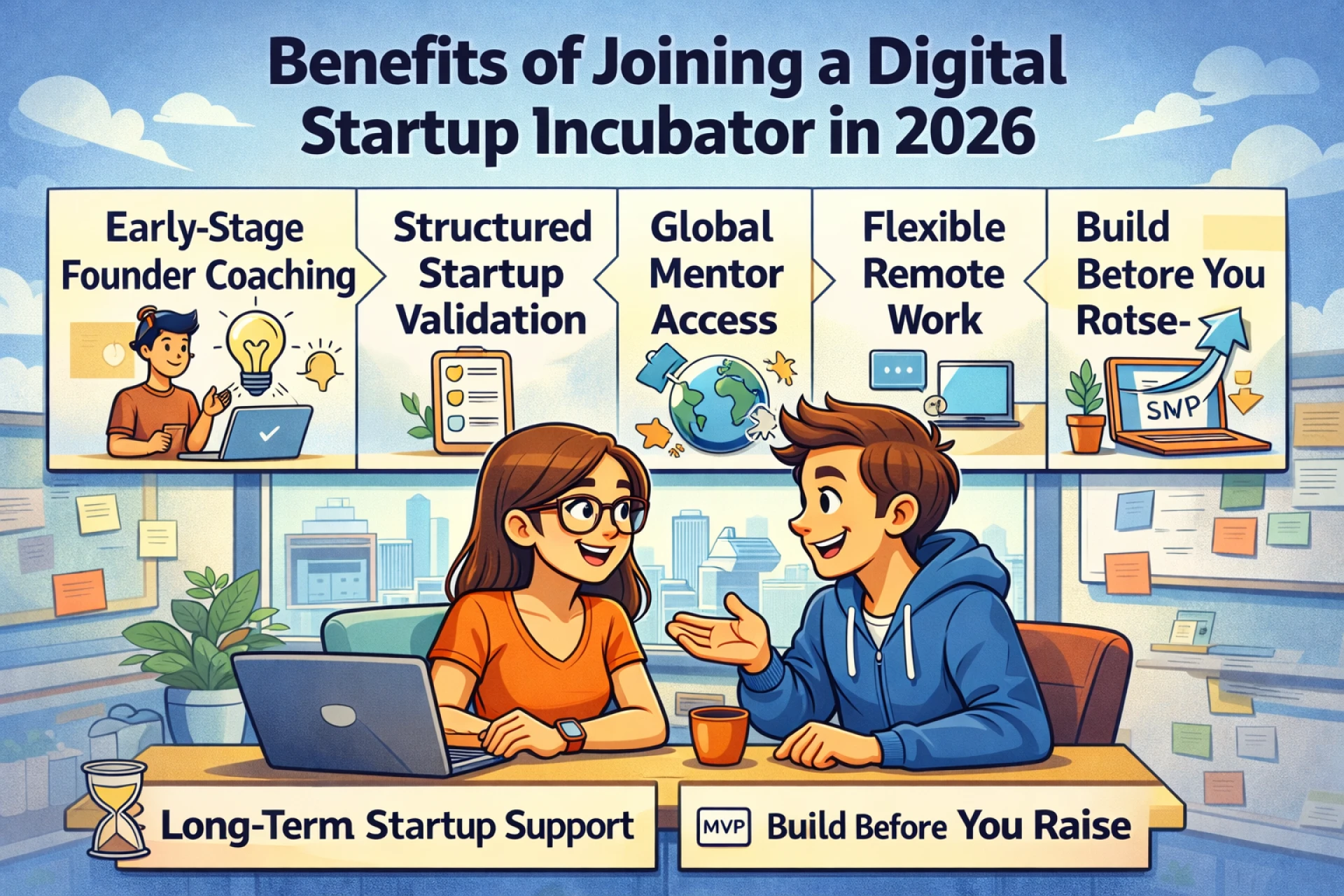
1. Access to Early-Stage Founder Coaching
One of the primary benefits of a Digital Startup Incubator is direct access to experienced mentors and operators.
Early-stage founder coaching helps entrepreneurs:
- Clarify their business model
- Define realistic milestones
- Avoid common pre-seed mistakes
- Make informed product decisions
Instead of navigating uncertainty alone, founders receive structured feedback that improves decision quality.
2. Structured Startup Validation Before Development
Many startups fail due to lack of market validation rather than lack of funding.
A Digital Startup Incubator typically emphasizes structured startup validation by guiding founders to:
- Identify specific user pain points
- Conduct meaningful customer interviews
- Test demand before building
- Define measurable traction indicators
This reduces the risk of investing time and capital into invalidated assumptions. The Lean Startup methodology, widely discussed in Harvard Business Review, emphasizes experimentation and validated learning before scaling.
Insights why startup fail consistently shows that lack of market need is the leading cause of startup failure, reinforcing the importance of structured validation.
3. Reduced Operational Costs
Unlike traditional incubators, digital programs eliminate relocation, travel, and infrastructure costs.
Founders can participate from anywhere while continuing to:
- Manage their existing commitments
- Maintain operational flexibility
- Allocate resources more efficiently
This cost-efficiency is particularly valuable at the pre-seed stage.
4. Global Mentor Access
A Digital Startup Incubator is not limited by geography.
Founders gain exposure to:
- Industry-specific experts
- Cross-market insights
- Diverse operational experiences
- International growth perspectives
This broader viewpoint often improves strategic thinking and adaptability. The Global Startup Ecosystem Report highlights how access to experienced mentorship networks significantly improves early-stage resilience.
5. Flexible and Remote-First Structure
In 2026, most startups operate remotely from day one.
Digital incubation aligns naturally with this model by offering:
- Virtual workshops
- Remote accountability sessions
- Online collaboration tools
- Flexible scheduling
This ensures consistent guidance without disrupting operational momentum.
6. Emphasis on Execution Discipline
Physical accelerators often focus heavily on pitch preparation and demo days.
Digital Startup Incubators, by contrast, tend to emphasize execution sequencing:
- Validate first
- Narrow scope
- Define MVP clearly
- Measure progress consistently
This structured approach builds sustainable foundations rather than short-term visibility.
7. Long-Term Support Beyond Fixed Cohorts
Traditional accelerator programs usually operate in short cycles.
Many digital incubation models provide ongoing access to mentorship and structured guidance beyond a 3–4 month period. This is particularly helpful for founders who need more time to refine product-market alignment.
Is a Digital Startup Incubator Right for You?
A Digital Startup Incubator may be especially suitable for:
- First-time founders
- Non-technical entrepreneurs
- Remote-first startups
- Pre-seed stage ventures
- Founders seeking structured startup validation
While no program guarantees success, structured early-stage support significantly reduces avoidable mistakes.
In 2026, startup building is increasingly global and digital. The Digital Startup Incubator model reflects this shift by combining early-stage founder coaching, structured startup validation, and remote accessibility.
For founders navigating uncertainty, clarity and discipline often matter more than speed. A well-designed digital incubation program can provide that structure.