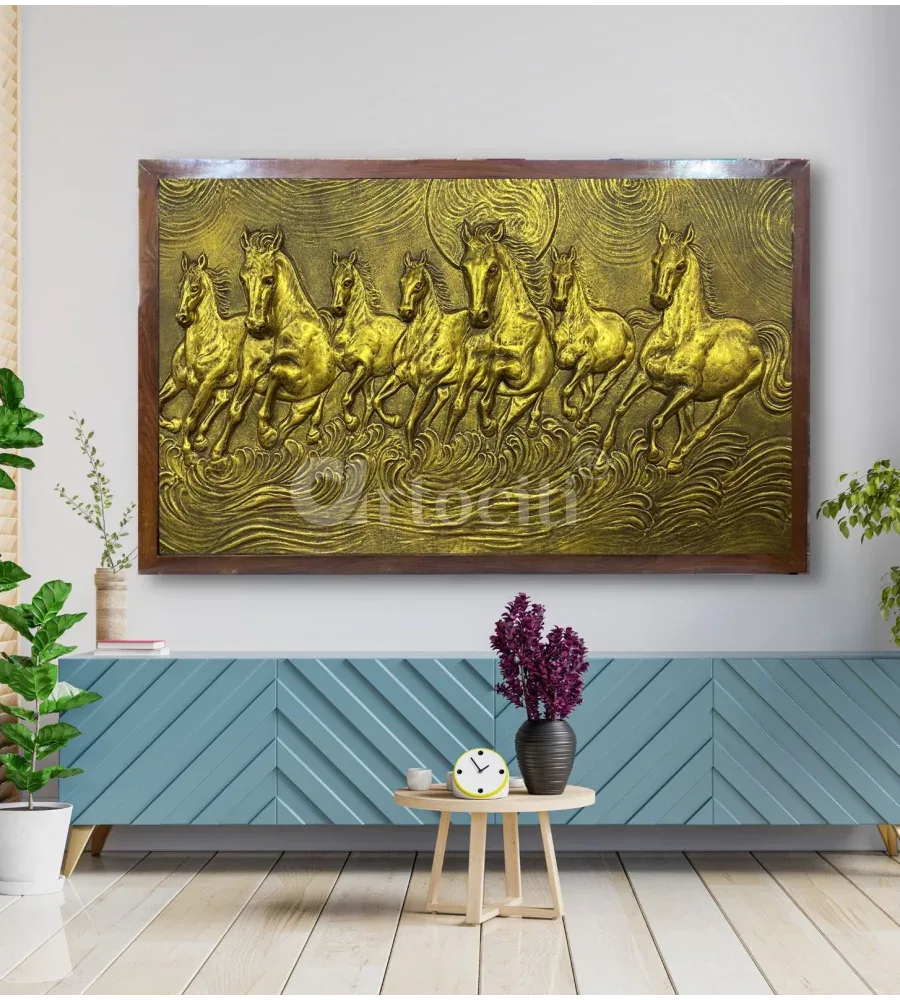
There are certain images in Indian art that have transcended their origins to become something close to universal — symbols so deeply embedded in the cultural consciousness that they require no introduction, no explanation, and no context to communicate their meaning. The seven horses painting is one of those images.
Walk into any Indian home, office, or business, and the chances are high that you will encounter it somewhere — seven magnificent horses in full gallop, manes flying, hooves barely grazing the earth, the entire composition alive with forward momentum and barely contained power. It is one of the most displayed images in Indian interior culture, and yet its depth of meaning, its artistic diversity, and its genuine symbolic richness remain surprisingly underexplored by most of the people who live with it every day.
This is the full story of that image — where it comes from, what it means, why it endures, and how to choose and place it with the intention it deserves.
The Mythology: Where the Seven Horses Come From
Every great symbol has a story at its root, and the seven horses painting is no exception. Its deepest mythological source is the imagery of Surya — the Hindu sun god — whose golden chariot is pulled across the sky each day by seven magnificent horses. This daily solar journey is not merely a poetic image of sunrise and sunset. It is a cosmological statement about the nature of existence itself.
Each of the seven horses represents one of the seven colours of visible light that together constitute white sunlight — the complete spectrum of energy that makes all life on earth possible. They also represent the seven days of the week, the seven notes of the musical scale, the seven chakras of the human energy system, and the seven sacred rivers of India. In other words, seven is not an arbitrary number. It is the number of completeness — of a system fully expressed, an energy totally manifested, a cycle perfectly completed.
When Surya's seven horses gallop across the sky, they carry not just the sun but the totality of cosmic energy — light, time, music, consciousness, and the life force itself. A painting of seven horses in full gallop is therefore not simply a depiction of animals in motion. It is a visual invocation of that totality — an image that says, in the most direct visual language possible: all of existence is moving forward, and you are moving with it.
Vastu Shastra and the Power of the Seven Horses
In Vastu Shastra — India's ancient science of spatial harmony and energy flow — the seven horses painting holds a position of particular significance. Vastu practitioners have consistently recommended this image for homes and workplaces for centuries, and the reasoning behind that recommendation is worth understanding in full.
The horse in Vastu is associated with the south direction, which governs fame, recognition, career advancement, and social standing. An image of horses in motion on the south or east wall of a home or office is considered a powerful activator of the energy associated with that direction — essentially amplifying the qualities of recognition and forward career momentum in the lives of those who inhabit the space.
The motion of the horses is critical. Vastu is fundamentally a philosophy of energy flow — of ensuring that positive energy circulates freely through a space while stagnant or negative energy is minimised. A painting of horses standing still introduces stillness where the intention is movement. Only galloping horses — fully committed to forward momentum — carry the activating energy that makes this tradition meaningful.
Equally important is the direction the horses face. They must always gallop into the room — toward the viewer and into the interior of the space — rather than toward a door, window, or exit. Inward-facing motion symbolises prosperity, opportunity, and positive energy flowing into the life of the home and its inhabitants. Outward-facing horses suggest the opposite — and however beautiful the painting might be, its symbolic effect is considered counterproductive in Vastu terms.
The Artistic Tradition: More Than a Vastu Remedy
It would be a significant underestimation of this image to reduce it to a Vastu prescription alone. The 7 horses painting has a rich and serious artistic tradition that spans multiple regional styles, mediums, and aesthetic philosophies — and the best examples are genuinely compelling works of art entirely independent of their symbolic associations.
In the classical oil painting tradition, seven horses are most commonly depicted in a dramatic landscape setting — galloping across open plains or along a shoreline at sunrise, their forms rendered with the kind of muscular realism and atmospheric depth that Western academic painting perfected and Indian artists absorbed and made their own. The best of these paintings are genuinely beautiful — the horses alive with physical energy, the landscape breathing around them, the light of dawn or dusk giving the entire composition a warmth and drama that makes it impossible to ignore.
In contemporary Indian art, the seven horses subject has been reinterpreted across an extraordinary range of styles — from graphic and geometric abstractions that reduce the horses to pure form and movement, to textured mixed-media canvases that layer traditional symbolism with modern visual techniques, to bold colour-field paintings where the horses emerge from fields of pure pigment like visions from a dream.
The common thread across all of these interpretations is energy. Whatever the style, whatever the medium, a great seven horses painting makes you feel something the moment you encounter it — a quickening, a sense of possibility, a visceral recognition of power in motion.
Choosing the Right Seven Horses Painting
Given the enormous variety of seven horses paintings available today — from mass-produced prints to original hand-painted canvases of genuine artistic ambition — knowing what to look for is essential. The difference between a painting that truly works in a space and one that merely occupies it comes down to a few key qualities.
Compositional dynamism is non-negotiable. The horses must feel genuinely alive — bodies leaning into the gallop, manes and tails streaming with the energy of motion, hooves raised in the classic flying gallop that communicates maximum speed and freedom. Stiff, wooden compositions that depict horses in technically correct but energetically flat arrangements miss the entire point of this tradition.
Colour palette should be chosen with both aesthetic and symbolic intention. White horses carry the purest Vastu energy — associated with divine clarity and solar power. Golden and chestnut tones communicate earthly vitality and strength. A composition that combines multiple tones within a harmonious palette tends to be both visually richer and symbolically more complete than a monotone arrangement.
The background sets the emotional register of the entire painting. A sunrise or golden dawn setting reinforces the solar symbolism of the Surya tradition. Open sky and natural landscape communicate freedom and unlimited potential. Seascapes carry the energy of flow and abundance. Avoid heavily dark or storm-charged backgrounds — they introduce turbulent energy that works against the painting's intended purpose.
Original hand-painted canvases carry a quality that reproductions cannot replicate. The texture of brushwork, the depth of layered pigment, the presence of a human hand in every element of the composition — these qualities are felt even when they are not consciously registered, and they make a significant difference to the energy a painting brings into a space.
Placement: A Room-by-Room Guide
Living room: The south or east wall is the most auspicious placement, with the horses facing inward toward the centre of the room. Position the painting as the dominant visual statement on its wall — the room's focal point rather than one piece competing among many. A canvas of at least 36×24 inches gives the painting the scale it needs to command the space effectively.
Home office or study: The north wall — associated in Vastu with Kubera, the god of wealth and prosperity — is considered highly auspicious for this painting in a professional context. The energy of seven galloping horses in a workspace communicates ambition, momentum, and the relentless forward movement that professional achievement requires.
Business premises: Reception areas, boardrooms, and the owner's private office are the most powerful placements in a commercial context. The painting communicates success and forward vision to clients, partners, and employees alike — and that communication happens immediately, before a single word is spoken.
Entryway: A well-chosen seven horses painting in an entryway sets a powerful intentional tone for the entire home — welcoming everyone who enters with an immediate impression of energy, momentum, and forward-moving positivity.
Surfaces beyond canvas: For those who want to integrate the energy and imagery of this tradition into their home in a more architectural way, stone wall murals featuring horse motifs offer a remarkable alternative — bringing the permanence and tactile richness of stone carving to an image traditionally rendered in paint, and creating a visual statement that is simultaneously more dramatic and more enduring than any canvas.
Avoid: Bedrooms and bathrooms are generally not recommended placements. The high-momentum, activating energy of seven galloping horses is more appropriate for spaces of activity and ambition than for spaces dedicated to rest and restoration.
The Seven Horses Painting in Contemporary Indian Interiors
One of the most remarkable qualities of this image is its design resilience — its capacity to work across radically different interior aesthetics without losing either its visual impact or its symbolic power.
In a traditionally decorated Indian home — rich with carved wood, brass accents, handloom textiles, and warm ambient lighting — a classical oil painting of seven horses in a golden landscape feels entirely at home. The warm palette, the naturalistic rendering, and the cultural resonance of the subject all align seamlessly with the aesthetic language of a traditional interior.
In a contemporary apartment with white walls, clean-lined furniture, and a restrained modern palette, a more graphic or abstract interpretation of the seven horses subject — bold composition, limited colour palette, confident modern execution — can serve as a powerful cultural anchor, bringing heritage and symbolic depth to a space that might otherwise feel aesthetically accomplished but culturally rootless.
This versatility — the capacity to belong in any well-considered space — is the mark of a truly great symbol. And the seven horses, across centuries and across every shift in aesthetic fashion, has consistently demonstrated that capacity.
Final Thoughts
The seven horses painting endures because it speaks to something genuinely fundamental in the human experience — the desire for forward movement, for momentum, for the sense that life is going somewhere meaningful and going there with power and grace.
Whether you come to this image through Vastu belief, through appreciation of its rich mythological roots, through love of the artistic tradition it has inspired, or simply through the visceral, immediate impact of seven magnificent horses in full flight, what you are ultimately choosing for your home is energy.
Purposeful energy. Positive energy. Energy that moves — forward, always forward — and invites everything around it to do the same.
In any home, in any era, that is always exactly the right choice.