Most conversations about fertility focus on women. Hormone levels, cycle tracking, ovarian reserve these have entered mainstream health awareness in a way that male reproductive health simply has not. Yet male factor contributes to approximately 40 to 50 percent of all infertility cases. And unlike many medical conditions, male fertility problems rarely announce themselves with obvious symptoms.
For couples in Chennai navigating an unexplained delay in conception, recognising the subtle early signals of male reproductive dysfunction can shorten the diagnostic journey significantly. At Dr. Aravind's IVF Fertility & Pregnancy Centre the best fertility hospital in Chennai Dr. Aravind Chander and his team evaluate male fertility with the same clinical depth as female fertility, from the very first consultation.
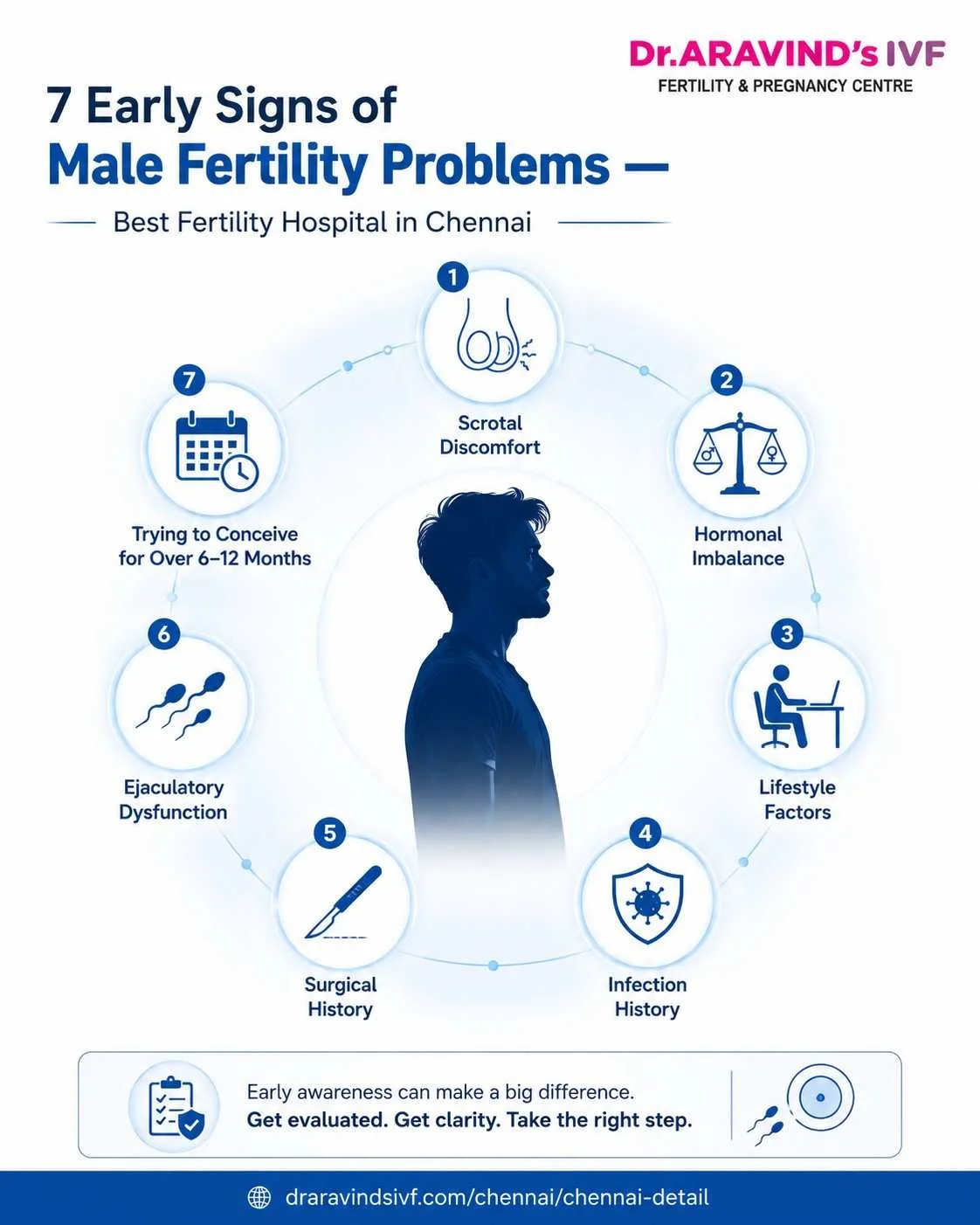
Here are seven early signs that often go unnoticed and why none of them should be ignored.
1. Trying to Conceive for More Than 12 Months Without Success
This is the clearest and most overlooked signal. When a couple has been trying to conceive for 12 months without success with regular, unprotected intercourse that is not a patience issue. That is a clinical threshold that triggers a formal fertility evaluation for both partners simultaneously.
Waiting beyond this point does not increase natural conception probability. It reduces the window for straightforward treatment. If your partner is over 35, this threshold shortens to 6 months.
2. History of Testicular Injury, Surgery, or Undescended Testes
Any prior trauma to the scrotal area, surgical procedure in the groin or pelvis, or a childhood history of undescended testes significantly increases the probability of impaired sperm production in adulthood. These are not conditions that resolve on their own over time. They are documented risk factors that require direct fertility assessment not assumptions that everything is fine because nothing currently hurts.
3. Previous Sexually Transmitted Infections
Chlamydia, gonorrhoea, and other bacterial infections that go untreated or are treated late can cause scarring in the epididymis or vas deferens the tubes through which sperm travel from the testes to the urethra. This scarring creates obstructive azoospermia, a complete absence of sperm in the ejaculate with no ongoing symptoms by the time a couple is trying to conceive.
A history of STIs should always be disclosed during a male fertility consultation at any qualified fertility clinic in Chennai.
4. Visible or Palpable Swelling in the Scrotum
Varicocele enlarged scrotal veins is the most common treatable cause of male infertility, present in 35% of men with primary infertility. While many men with varicocele have no discomfort, some notice a dull ache, a sensation of heaviness, or visible veins in the scrotum particularly after prolonged standing or physical activity.
Any such observation warrants a scrotal ultrasound. Varicocele is highly treatable, and surgical repair produces measurable improvement in sperm parameters within months.
5. Hormonal Symptoms — Reduced Libido, Fatigue, or Breast Tissue Changes
Low testosterone, elevated prolactin, or oestrogen imbalance in men can produce recognisable symptoms including reduced sexual drive, persistent fatigue, difficulty maintaining erections, or in some cases enlargement of breast tissue (gynaecomastia). These are not ageing inevitabilities. They are hormonal signals that directly affect sperm production and respond well to targeted treatment when identified early by an experienced IVF specialist in Chennai.
6. Ejaculatory or Erectile Dysfunction
Difficulty achieving or maintaining an erection, premature ejaculation, or the absence of ejaculate during orgasm (retrograde ejaculation where sperm enters the bladder instead of being expelled) are all conditions that affect fertility directly. Retrograde ejaculation in particular is frequently missed because orgasm occurs normally; the difference is invisible without a post-ejaculatory urine test.
These conditions are medically manageable. Disclosing them during a fertility consultation with Dr. Aravind Chander at Dr. Aravind's IVF Fertility & Pregnancy Centre, the best fertility hospital in Chennai allows appropriate investigation and treatment to begin immediately.
7. Chronic Lifestyle Factors — Smoking, Obesity, or Occupational Heat Exposure
This category is the most consistently underestimated. Smoking increases sperm DNA fragmentation. Obesity raises scrotal temperature and suppresses testosterone. Occupational heat exposure from welding, driving long distances, or working near industrial heat sources — progressively impairs spermatogenesis over time.
None of these produce immediate symptoms. All of them produce measurable damage to sperm quality that accumulates silently and all of them are addressable when identified early through fertility testing at a leading male infertility centre in Chennai.
When to Act
Early recognition of any of these signals is not cause for alarm. It is cause for a conversation, a single, pressure-free consultation with a qualified fertility specialist who will investigate thoroughly before drawing any conclusions.
Dr. Aravind Chander, recognised as one of the best IVF specialists in India leads a team at Dr. Aravind's IVF Fertility & Pregnancy Centre that evaluates male fertility comprehensively: semen analysis, sperm DNA fragmentation testing, hormonal panel, scrotal ultrasound, and genetic assessment when indicated. Because recognising a problem early is always the faster, more effective, and more compassionate path to parenthood.