
Introduction
Supply chains are no longer just a back-office function—they have become a strategic advantage. In India's rapidly evolving manufacturing sector, businesses are under constant pressure to reduce operational costs, meet customer expectations, manage inventory efficiently, and respond quickly to market changes.
Yet many manufacturers continue to lose significant revenue because of avoidable supply chain mistakes. These issues often remain hidden until they start affecting production schedules, customer satisfaction, and profitability.
According to industry reports, supply chain disruptions can increase operational costs by as much as 15% while reducing productivity and revenue growth. For manufacturers operating in highly competitive markets, even a small inefficiency can create a ripple effect across procurement, warehousing, production, and logistics.
The good news is that modern ERP solutions like Dynamics 365 Supply Chain provide businesses with the visibility, automation, and intelligence needed to prevent these costly mistakes before they become serious problems.
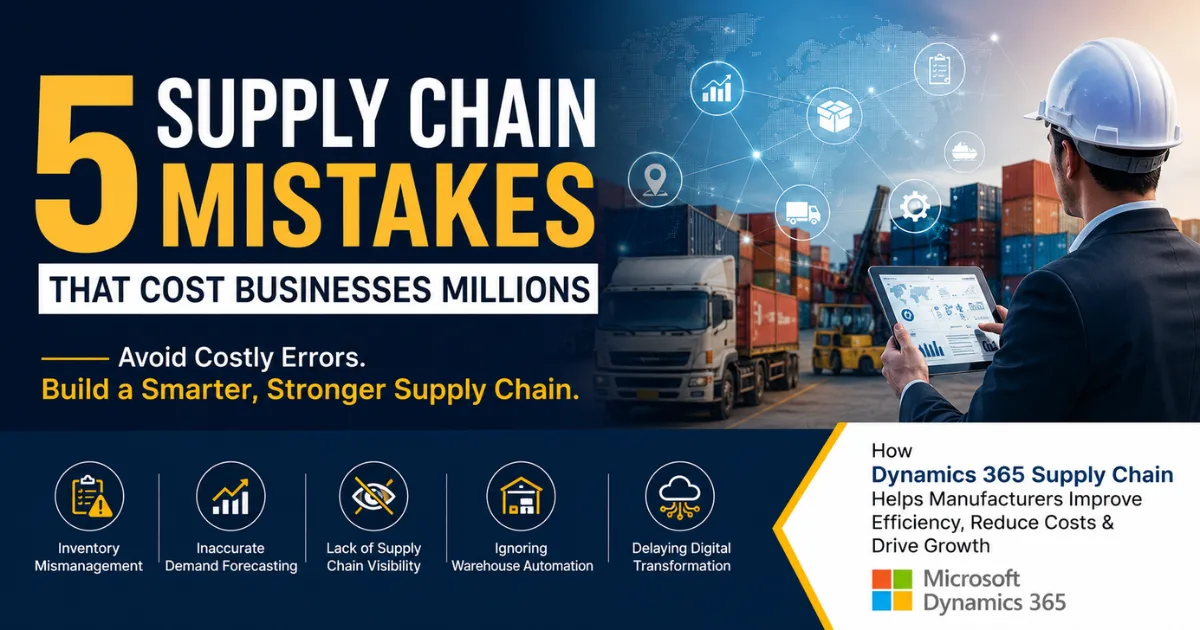
In this article, we'll explore five of the most common supply chain mistakes that cost manufacturers millions—and how digital transformation can help solve them.
Why Supply Chain Efficiency Matters More Than Ever
Manufacturing has changed dramatically over the last decade.
Customers expect faster deliveries.
Raw material prices fluctuate frequently.
Global supply networks remain unpredictable.
Businesses are expected to operate with lean inventories while maintaining uninterrupted production.
Traditional spreadsheets and disconnected systems are no longer capable of handling this level of complexity.
Modern manufacturers require an intelligent supply chain powered by real-time data, automation, and predictive insights.
This is where cloud-based ERP platforms play a vital role by connecting procurement, production, warehousing, logistics, finance, and inventory into a single ecosystem.
Mistake 1: Poor Inventory Management
Inventory is one of the biggest investments for any manufacturing company.
Unfortunately, many businesses either stock too much inventory or too little.
Both situations are expensive.
Overstocking blocks working capital, increases warehouse costs, and creates a higher risk of obsolete inventory.
Understocking leads to delayed production, missed customer deadlines, emergency purchases, and lost sales.
Common Signs
- Frequent stock shortages
- Excess slow-moving inventory
- High carrying costs
- Manual inventory tracking
- Inaccurate stock records
Business Impact
Imagine a manufacturer producing automotive components.
A missing critical component worth ₹500 could delay an entire production line worth several lakhs.
On the other hand, excess inventory occupying warehouse space for months ties up valuable capital that could have been invested elsewhere.
How Dynamics 365 Supply Chain Helps
Modern ERP solutions offer predictive inventory management using historical sales, purchasing patterns, and real-time inventory visibility.
Instead of reacting to shortages, manufacturers can proactively optimize inventory levels.
Key capabilities include:
- Real-time inventory visibility
- Automated replenishment
- Inventory optimization recommendations
- Multi-location inventory management
- AI-driven stock forecasting
The result is lower inventory costs, improved cash flow, and better customer service.
Mistake #2: Inaccurate Demand Forecasting
Forecasting customer demand has always been challenging.
However, relying on spreadsheets or intuition makes forecasting even more unreliable.
When businesses cannot accurately predict demand, they either produce too much or too little.
Both scenarios hurt profitability.
Common Challenges
- Seasonal demand fluctuations
- Sudden changes in customer orders
- Poor sales visibility
- Limited historical analysis
- Lack of forecasting tools
Real-World Example
Suppose a manufacturer experiences a sudden 30% increase in product demand during the festive season.
Without accurate forecasting, the company may struggle to source raw materials quickly enough.
Production delays follow.
Customers cancel orders.
Competitors benefit.
The Smarter Approach
Modern ERP platforms combine historical sales, purchasing behavior, market trends, and AI-powered analytics to improve demand forecasting accuracy.
This enables manufacturers to:
- Plan production effectively
- Improve procurement decisions
- Reduce emergency purchasing
- Minimize inventory waste
- Improve customer satisfaction
Organizations embracing Data-Driven Supply Chain strategies consistently make faster and more informed operational decisions than businesses relying on manual planning.
Mistake 3: Lack of Supply Chain Visibility
One of the biggest operational challenges manufacturers face is limited visibility across the supply chain.
Different departments often work in isolation.
Procurement uses one system.
Warehouse teams use another.
Production relies on spreadsheets.
Finance maintains separate reports.
The result is fragmented information.
Decision-makers cannot identify bottlenecks until they have already caused production delays or customer complaints.
Warning Signs
- Delayed purchase approvals
- Inconsistent inventory reports
- Poor supplier communication
- Lack of production visibility
- Difficulty tracking orders
Business Consequences
Without complete visibility, businesses struggle to answer critical questions such as:
- Which supplier is causing delays?
- Which warehouse has available stock?
- Which production order is behind schedule?
- Which products generate the highest inventory costs?
Without reliable answers, management decisions become reactive instead of strategic.
How Cloud ERP Solves This
A modern Cloud ERP platform centralizes information across procurement, production, warehousing, logistics, and finance.
Instead of multiple disconnected systems, decision-makers gain a single source of truth.
With Dynamics 365 Supply Chain, organizations benefit from:
- End-to-end operational visibility
- Real-time dashboards
- Supplier performance tracking
- Order tracking
- Inventory insights
- Production monitoring
When every department works with the same real-time information, collaboration improves significantly.
Problems are identified earlier, decisions become faster, and overall operational efficiency increases.
Mistake 4: Ignoring Warehouse Automation
Warehouses are no longer just storage facilities—they are critical hubs that directly influence production schedules, order fulfillment, and customer satisfaction. Yet, many manufacturers still rely on manual processes for receiving goods, picking orders, stock transfers, and inventory counts.
Manual operations increase the likelihood of human error, slow down fulfillment, and make inventory reconciliation a time-consuming task.
Common Warehouse Challenges
- Manual stock entries
- Picking and packing errors
- Slow inventory audits
- Delayed order fulfillment
- Inefficient warehouse layouts
These inefficiencies become more noticeable as businesses grow. What may work for a small warehouse often becomes unsustainable when managing thousands of SKUs across multiple locations.
The Cost of Inefficiency
Imagine a manufacturer receiving an urgent customer order. If warehouse staff cannot accurately locate inventory or process shipments quickly, delivery delays become inevitable. Beyond immediate revenue loss, delayed deliveries can weaken customer trust and damage long-term business relationships.
The Digital Solution
Modern warehouse automation capabilities within Dynamics 365 Supply Chain streamline warehouse operations through intelligent workflows and real-time visibility.
Key capabilities include:
- Barcode and QR code scanning
- Mobile warehouse applications
- Automated inventory updates
- Guided picking and put-away processes
- Real-time stock visibility
- Optimized warehouse routing
Automation not only improves operational efficiency but also reduces errors and increases employee productivity. Warehouse teams spend less time searching for inventory and more time fulfilling customer orders accurately.
Mistake 5: Delaying Digital Transformation
One of the most expensive mistakes manufacturers make isn't operational—it's strategic.
Many organizations continue relying on outdated ERP systems, spreadsheets, and disconnected software because "the current system still works."
However, surviving is not the same as remaining competitive.
Today's manufacturing landscape demands agility, real-time insights, and data-driven decision-making. Businesses that postpone digital transformation often struggle with rising operational costs, slower decision-making, and reduced competitiveness.
Signs Your Business Has Outgrown Its Current Systems
- Multiple spreadsheets across departments
- Duplicate data entry
- Frequent reporting delays
- Limited visibility into operations
- Difficulty scaling production
- Lack of real-time business insights
These issues don't just reduce efficiency—they limit growth.
Building a Smart Supply Chain
Forward-thinking manufacturers are investing in a smart supply chain powered by cloud technologies, automation, and artificial intelligence.
Solutions like Dynamics 365 Supply Chain bring together procurement, inventory, production, warehousing, logistics, and finance into a unified ecosystem.
When combined with Business Process Automation, repetitive tasks such as purchase approvals, inventory replenishment, production scheduling, and supplier communication can be streamlined, allowing teams to focus on higher-value activities.
The Growing Role of AI in Manufacturing
Artificial intelligence is rapidly becoming an essential component of modern manufacturing operations.
An AI supply chain helps organizations anticipate disruptions instead of simply reacting to them.
Instead of relying solely on historical reports, AI analyzes real-time operational data to identify trends, forecast demand, optimize inventory, and recommend corrective actions before problems escalate.
Manufacturers can leverage AI to:
- Improve production planning
- Detect inventory anomalies
- Optimize procurement decisions
- Predict equipment maintenance needs
- Reduce operational risks
Another significant advancement is Microsoft Copilot for Dynamics 365, which enhances productivity by enabling users to interact with business data using natural language.
Instead of manually generating reports or searching through multiple dashboards, decision-makers can quickly access insights, identify trends, and receive intelligent recommendations, making business decisions faster and more informed.
Best Practices for Building a Resilient Supply Chain
Digital transformation is most successful when paired with strong operational practices. Manufacturers should focus on continuous improvement rather than one-time implementation.
Here are several best practices that can significantly improve supply chain performance:
1. Use Real-Time Data for Decision-Making
Reliable, up-to-date information enables faster responses to supply chain disruptions and changing customer demand.
2. Automate Repetitive Processes
Automating procurement workflows, inventory updates, approvals, and warehouse operations reduces manual effort and improves consistency.
3. Improve Supplier Collaboration
Maintain transparent communication with suppliers and monitor performance through measurable KPIs to reduce delays and improve reliability.
4. Monitor Key Performance Indicators
Track metrics such as the following:
- Inventory turnover
- Order fulfillment rate
- On-time delivery
- Warehouse accuracy
- Procurement cycle time
- Production efficiency
Regular monitoring helps identify opportunities for continuous improvement.
5. Invest in Scalable Technology
As businesses grow, operational complexity increases. Choosing scalable ERP solutions ensures systems can support expansion without requiring complete replacement.
Final Thoughts
Supply chain inefficiencies rarely appear overnight. They develop gradually through disconnected systems, manual processes, inaccurate forecasting, and limited visibility.
Over time, these small operational issues compound into higher costs, production delays, excess inventory, dissatisfied customers, and lost revenue.
The encouraging news is that these challenges are preventable.
Modern manufacturers that embrace digital transformation are building more agile, resilient, and efficient operations. By combining real-time visibility, automation, predictive analytics, and AI-powered decision-making, businesses can strengthen every stage of the supply chain—from procurement to production and delivery.
Dynamics 365 Supply Chain empowers manufacturers to move beyond reactive problem-solving and adopt a proactive approach to operational excellence. As customer expectations continue to rise and markets become increasingly competitive, organizations that invest in smarter supply chain strategies today will be better positioned for sustainable growth tomorrow.