Exercise is one of the best ways to build strength, improve mobility and support long-term health. But sometimes, following a generic workout plan or joining a standard class does not feel right. If you are dealing with ongoing pain, an old injury, weakness or uncertainty about how your body should move, a more guided approach to exercise may be worth considering.
A personalised exercise program can help you understand what your body needs and how to exercise in a way that suits your current abilities. This can be particularly useful for people returning to exercise after an injury, managing persistent pain or simply finding that their usual workouts are no longer working for them.
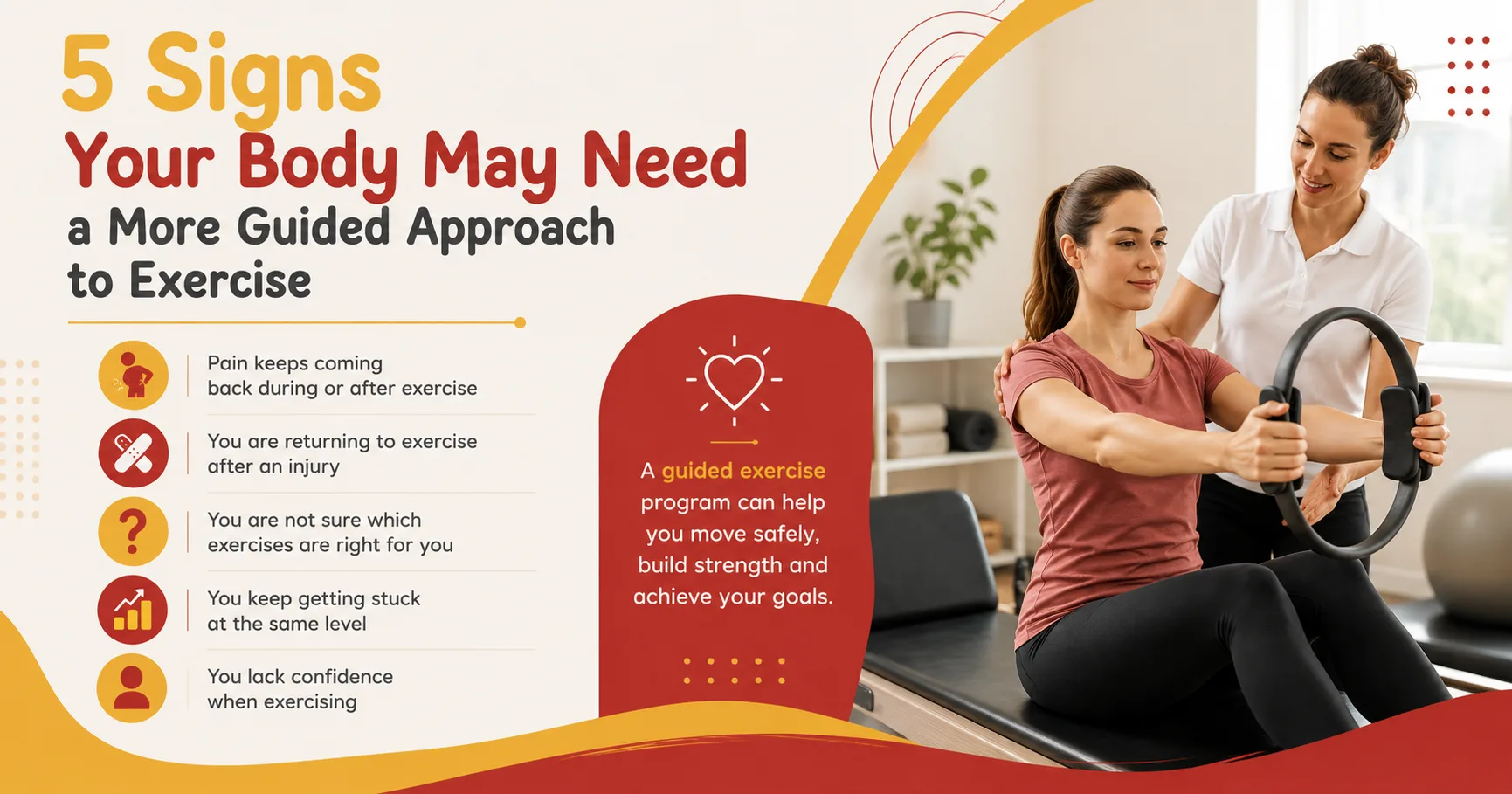
Here are five signs that it may be time to seek more individual guidance with your exercise.
1. Pain Keeps Coming Back During or After Exercise
Some muscle soreness after exercise is normal, particularly when you try a new activity. Persistent or recurring pain is different.
If your back, neck, shoulder, knee or hip regularly becomes painful during or after exercise, it may be a sign that your current program needs a closer look.
For example, you may enjoy running but notice that your knee becomes sore every few sessions. You might continue reducing your running distance, but the same problem keeps returning. In this situation, simply doing less may not address why the discomfort keeps appearing.
A physiotherapist or exercise professional can assess how you move, look at your strength and consider your exercise history. From there, they can help select exercises and training loads that are more appropriate for you.
The goal is not always to stop exercising. Often, it is about finding a better way to exercise while working towards the activities you enjoy.
2. You Are Returning to Exercise After an Injury
Getting back into exercise after an injury can be confusing.
You may feel better, but that does not always mean your body is ready to return to exactly the same training routine you followed before the injury.
For instance, someone recovering from a knee injury may be able to walk comfortably but still lack the strength or control needed for squats, running or jumping. Someone recovering from a shoulder injury may have good everyday movement but struggle when lifting weights overhead.
A guided exercise program can provide a gradual path back to activity.
Your exercises can change as your strength, movement and confidence improve. Instead of guessing when to increase the load or difficulty, you have a clearer plan to follow.
This can be especially helpful when returning to sport, gym training, recreational activities or physically demanding work.
3. You Are Not Sure Which Exercises Are Right for You
There is no shortage of exercise advice online.
One video recommends squats. Another recommends Pilates. Someone else says you should focus on stretching, while another person says strength training is the answer.
The problem is that an exercise that works well for one person may not be the right choice for another.
Your age, injury history, strength, mobility, lifestyle and goals can all influence the type of exercise that suits you.
A guided approach starts with your individual situation rather than simply handing you a standard workout.
For example, if your goal is to improve your lower-body strength but you have limited ankle mobility, your exercise plan may need to account for that. If you have been experiencing back discomfort, the focus may initially be on movement control and strength before progressing to heavier exercises.
This individual approach can make exercise feel much less confusing.
4. You Keep Getting Stuck at the Same Level
Have you been doing the same exercises for months without feeling like you are getting stronger or moving better?
This can happen when your program is no longer challenging enough, or when the exercises do not match your current goals.
Progress does not always mean lifting heavier weights. It may involve improving movement quality, increasing repetitions, changing resistance, developing balance or introducing more demanding exercises.
A good exercise program should change as you change.
Consider someone who begins with basic Clinical Pilates exercises after an injury. At first, the focus may be on control, mobility and foundational strength. Once these areas improve, their program may move towards resistance training, more complex movements and activities that relate directly to their goals.
This progression can help bridge the gap between rehabilitation and normal fitness training.
5. You Lack Confidence When Exercising
Sometimes the biggest barrier is not physical. It is confidence.
If you have experienced pain or injury, it is understandable to become cautious about certain movements. You may avoid lifting weights because you are worried about hurting your back, or stop doing certain exercises because your knee does not feel reliable.
That fear can make it difficult to know what you should and should not do.
Working with a qualified health professional can give you a clearer understanding of your current abilities. You can learn which movements are appropriate, how to perform them correctly and when it may be suitable to progress.
Over time, this can help you feel more comfortable using your body again.
What Does a Guided Exercise Program Look Like?
A guided exercise program should be based on more than your fitness level.
A qualified physiotherapist, exercise physiologist or osteopath may consider your health history, current symptoms, movement, strength, lifestyle and personal goals.
For someone with persistent lower back pain, for example, the program may include a combination of mobility work, core exercises, strength training and gradual exposure to movements that were previously uncomfortable.
For another person, the focus could be recovering from surgery, improving balance or returning to a favourite sport.
This is why personalised exercise can be useful. Your program is built around where you are now and where you want to go.
Clinical Pilates Can Be Part of a Guided Approach
Clinical Pilates is one option for people who want more individual support with exercise.
Unlike a standard group fitness class, Clinical Pilates is commonly based around an assessment and a program suited to the person's needs. Exercises can be adjusted based on pain, movement, strength and progress.
At MD Health, Clinical Exercise and Pilates programs are delivered by qualified health professionals, including physiotherapists, accredited exercise physiologists and osteopaths. Programs begin with a Full Body Assessment, which helps the clinician understand the person's movement, concerns and goals.
Clinical Pilates does not have to be the final destination either. For some people, it can form part of a wider exercise program that later includes traditional strength and conditioning.
The right approach depends on the person, their starting point and what they want to achieve.
How to Know When You Need More Guidance
You do not need to have a major injury before asking for help.
A guided approach may be useful if:
- Exercise regularly causes the same pain.
- You are returning to training after an injury or surgery.
- You are unsure which exercises are suitable for you.
- Your progress has stopped.
- You lack confidence with certain movements.
- You want to return to a particular sport or activity.
- You have a long-term condition that affects exercise.
- You want a program based around your individual goals.
Getting professional advice can also help you avoid spending months trying different exercises without knowing whether they are suitable for your situation.
Exercise Should Help You Do More of What You Enjoy
The purpose of exercise is not simply to complete a workout.
For many people, the real goal is being able to walk without discomfort, pick up their children, play sport, return to the gym, travel comfortably, enjoy a hobby or simply feel stronger in everyday life.
If your current exercise routine is not helping you move towards those goals, it may be time to look at your approach.
A more guided exercise program can give you the support, education and structure needed to work with your body rather than constantly feeling like you are guessing.
Whether that involves Clinical Pilates, strength training, physiotherapy-led exercise or a combination of approaches, the right program should reflect your needs and your goals.
Conclusion
Exercise does not have to be complicated, but it should make sense for your body.
Recurring pain, an old injury, stalled progress, uncertainty or a lack of confidence can all be signs that a generic workout may not be enough for you right now.
With guidance from a qualified health professional, you can gain a clearer understanding of how to exercise safely and how to gradually work towards the activities that matter to you.
If you are unsure where to begin, a professional assessment can be a useful first step. It can help identify where you are now and what type of exercise may be appropriate for your next stage.
Frequently Asked Questions
1. Who can benefit from a guided exercise program?
People managing pain, recovering from injury, returning to sport or feeling unsure about exercise may benefit from individual guidance. It can also help people who have stopped making progress with their current routine.
2. Is Clinical Pilates suitable for beginners?
Yes. Clinical Pilates can be adapted to different fitness levels and physical abilities. Exercises can be adjusted based on your movement, strength, symptoms and goals.
3. Should I stop exercising if I experience pain?
Not necessarily. The right response depends on the type, severity and cause of the pain. If pain keeps returning or affects your ability to exercise, speaking with a qualified health professional is a sensible step.
4. Can guided exercise help after an injury?
It can form an important part of returning to normal activity after an injury. A professional can help you progress exercises based on your current strength, movement and recovery stage.
5. How is guided exercise different from a regular gym program?
A regular gym program may follow general fitness principles, while guided exercise is based more closely on your individual needs, movement, health history and goals. Exercises and training levels can then be adjusted as you progress.