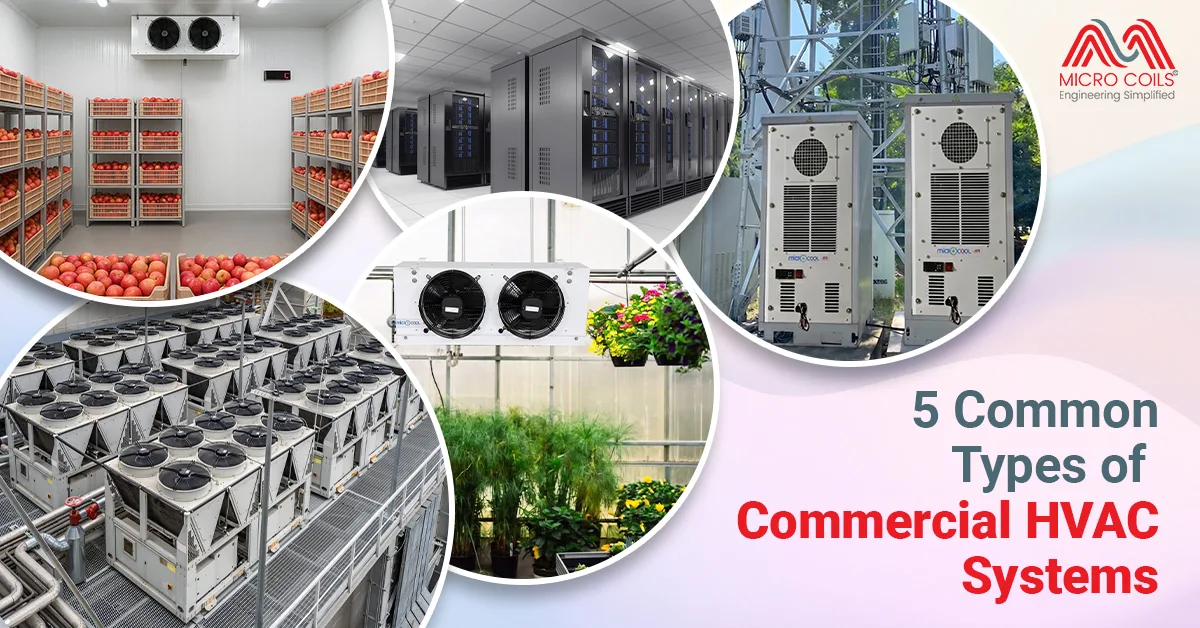
A commercial building has very different climate control needs compared to a home. The spaces are larger, the occupancy is higher, and the demand on the system runs for far longer hours every single day. Getting the right HVAC system in place is not just a matter of comfort. It directly affects energy costs, air quality, and how smoothly a business operates. Understanding the main types of commercial HVAC systems helps building owners and facility managers make decisions they will not regret later.
Why Commercial HVAC Needs Are Different?
Commercial HVAC systems handle far greater loads than residential units. A large office building, a shopping mall, or a hospital needs a system that can maintain consistent temperature and air quality across multiple zones simultaneously. HVAC systems account for a large portion of a building's energy consumption, and choosing the right system can reduce utility bills by 20 to 40 percent compared to inefficient setups.
The size of the space plays a major role in which system makes sense. For commercial buildings, a general rule of thumb is 25 to 30 BTUs per square foot for cooling and 30 to 60 BTUs per square foot for heating. A system that is too small will run constantly and still fail to maintain a comfortable temperature, while an oversized one wastes energy and drives up costs unnecessarily. Getting the load calculation right from the start saves a significant amount of trouble down the line.
1. Single-Split Systems
Single-split systems are the most basic commercial HVAC setup available and are widely used in smaller commercial spaces. They consist of one outdoor unit containing the compressor and AC condenser coil, and one indoor unit with the evaporator coil and blower fan, with refrigerant circulating between the two to enable heat exchange and temperature control. The simplicity of this design makes it easy to install, maintain, and repair when something goes wrong.
Single-split systems are often the most budget-friendly option for small commercial spaces. They work well for individual rooms or small office suites where each unit operates independently. The drawback is that each indoor space needs its own outdoor unit, which means multiple units are required for larger buildings with many separate zones. Single-split systems are effective air conditioning solutions for smaller commercial buildings and server rooms, but are not designed for larger buildings with multiple rooms.
2. Multi-Split Systems
Multi-split systems take the concept of a single-split setup and scale it up for more complex commercial spaces. They connect multiple indoor units to a single outdoor unit, and are suitable for medium-sized commercial buildings, effectively cooling or heating spaces of around 5,000 square feet. This configuration reduces the number of outdoor units needed, which saves space on the building exterior and simplifies the overall installation.
Multi-split systems work well for multi-tenant buildings, hotels, schools, and small office complexes. Each indoor unit can be controlled separately, which gives occupants in different areas some level of individual control over their comfort. The trade-off is a higher upfront cost compared to single-split systems, and they are not the right fit for very large buildings with heavy cooling demands spread across many floors.
3. Variable Refrigerant Flow (VRF) Systems
VRF systems represent a significant step up in both sophistication and efficiency. They have a single outdoor unit connected to multiple indoor units, and the key difference lies in their ability to vary the flow of refrigerant to each indoor unit based on real-time demand. This precise control means the system delivers exactly what each zone needs rather than running at full capacity across the entire building at all times.
VRF systems are a newer HVAC technology that can provide heating and cooling to a building using a refrigerant, and are a great solution for industrial and commercial buildings, as well as educational and hospital campuses and dense urban settings. They reduce energy consumption through higher energy utilization and are especially useful in buildings where different zones have very different heating and cooling needs at the same time. The AC coil price for VRF systems tends to be higher than standard split systems, but the long-term energy savings frequently justify that investment over several years of operation.
4. Variable Air Volume (VAV) Systems
VAV systems approach climate control differently from refrigerant-based systems. Rather than changing refrigerant flow, they adjust the volume of conditioned air delivered to each zone depending on what that space requires. VAV systems supply air at a variable temperature and airflow rate, can meet the varying heating and cooling needs of different commercial building zones, and are designed for large commercial buildings.
The most common types of VAV systems include the single duct terminal VAV box, which can be cooling only or with reheating, the fan-powered terminal VAV box, which has a fan to pull warmer air into the zone, the dual-ducted terminal VAV box using one hot and one cold duct, and the induction terminal VAV box. These systems are typically found in large office towers, universities, and government buildings where precise zone-by-zone control over a wide area is essential. They require a more complex installation but deliver strong performance and efficiency for large-scale applications.
5. Packaged Rooftop Units (RTUs)
Packaged rooftop units are one of the most commonly seen HVAC solutions in commercial settings, and for good reason. Packaged HVAC systems combine all essential components including the compressor, condenser, evaporator, and air handler into a single, self-contained unit, eliminating the need for separate indoor and outdoor equipment. Placing everything in one enclosure makes installation straightforward and keeps maintenance access simple.
RTUs are commonly used in low-rise commercial buildings like office towers, retail stores, and warehouses, and with proper maintenance they have a typical lifespan of 15 to 20 years. They connect to the interior of the building through ductwork to distribute conditioned air evenly across the space. With efficiency ratings commonly between SEER 13 and 18, packaged units deliver adequate efficiency suited to most commercial needs. The main limitation is exposure to outdoor weather conditions, which can affect component lifespan if the unit is not well maintained.
Choosing the Right System for Your Building
No single system works best for every commercial property. The decision comes down to the size of the space, the budget available, the local climate, and how the building is used day to day. If you plan to occupy the building for several years, investing in an energy-efficient system often pays off even if the upfront cost is higher.
Routine maintenance matters just as much as the initial choice. Common problems with commercial HVAC systems include short cycling, refrigerant leaks, clogged air filters, and dirty condenser coils, and addressing these issues promptly can enhance system efficiency and longevity. Keeping coils clean, filters fresh, and refrigerant levels correct are the basics that keep any commercial system running the way it should. Working with a qualified HVAC technician to assess your building before installation ensures the system you choose is genuinely matched to your needs rather than just the most popular option on the market.
Conclusion
Commercial HVAC systems range from simple single-split setups suited to small offices all the way to sophisticated VRF and VAV systems designed for large multi-zone buildings. Each type has clear strengths, and each comes with trade-offs around cost, complexity, and maintenance requirements. Taking the time to understand these differences before committing to a system is time well spent. The right choice creates a comfortable, energy-efficient environment for years. The wrong one becomes a recurring operational headache that costs far more to fix than it would have to get right from the start.