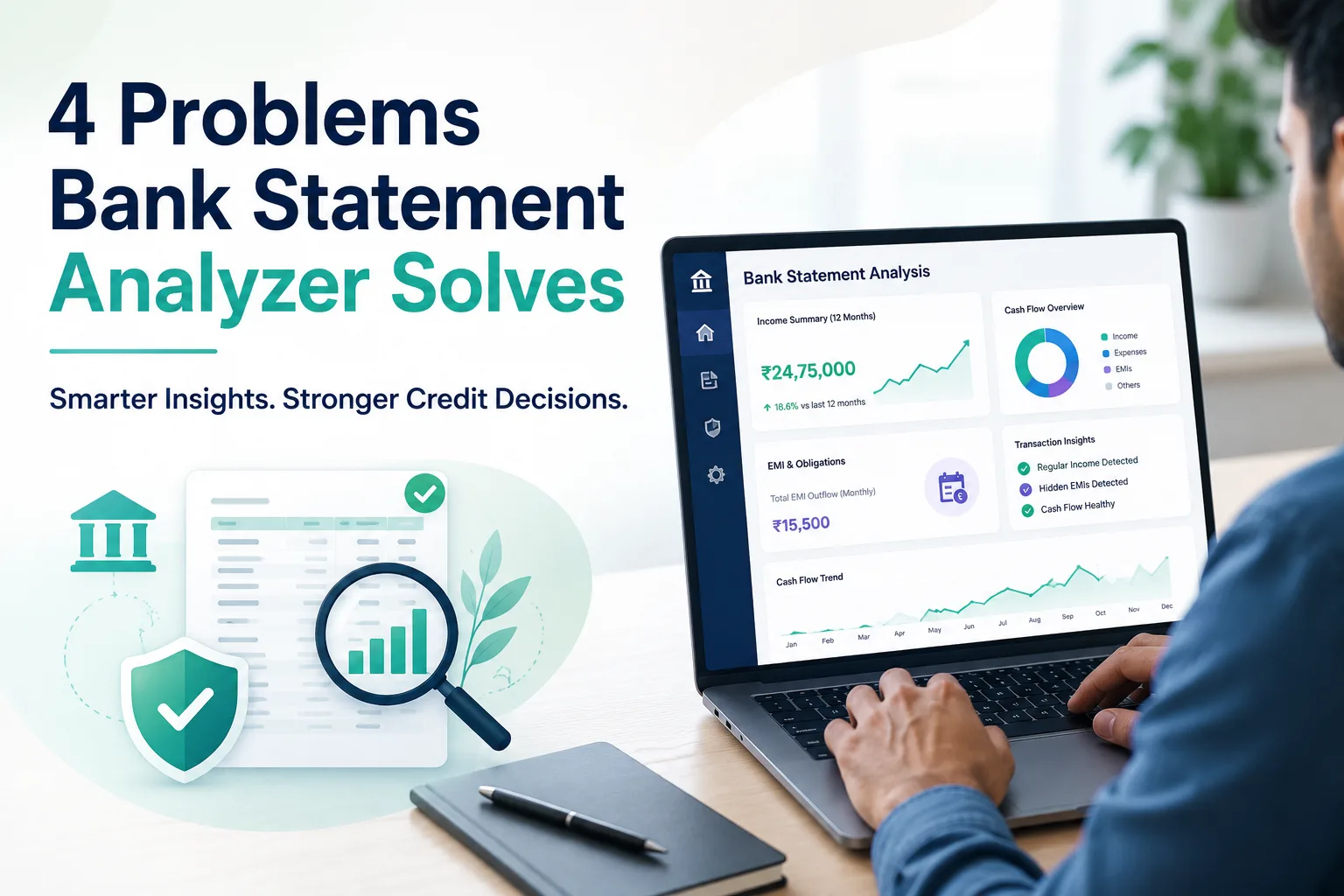
Digital lenders in India process thousands of loan applications every month. A bank statement analyzer takes the manual grunt work out of that process and replaces guesswork with actual data. If your team is still reviewing PDFs by hand, this is for you.
The pressure is real. NBFCs and digital lending platforms across India are competing on turnaround time, and a 3-day credit decision no longer cuts it when the borrower down the street is getting approved in hours. Speed without accuracy is its own risk though. That is exactly where a bank statement analyzer earns its place in the process.
Why Manual Statement Review No Longer Works
Loan volumes are rising fast across India's fintech sector. The old way of reviewing statements, which means a credit analyst opening each file, scanning transactions row by row, and filling out a spreadsheet, does not scale. It also introduces errors that cost money.
Most lenders already know this. These are the four problems that show up repeatedly once volume picks up.
Problem 1: Fraud Detection Happens Too Late
Tampered bank statements are more common than most lenders want to admit. PDFs can be edited with basic software, and a human reviewer does not always catch it, especially under volume pressure.
A Bank Statement Analyzer flags fraud at the intake stage by checking for:
- Font inconsistencies and formatting anomalies in the PDF
- Metadata mismatches between file properties and document content
- Unusual round-number deposits made just before the application date
- Income figures that do not align with declared salary or business turnover
Catching this before the file reaches underwriting stops bad loans before they start.
Problem 2: Cash Flow Assessment Takes Too Long
Manually reading 12 months of bank statements to understand a borrower's real income pattern can take 30 to 45 minutes per file. For a team processing 200 applications a day, that is not sustainable.
Bank statement analysis software reads the same 12 months in seconds. Transaction inflows get sorted by type — salary credits, business receipts, transfers — and anything that looks off, like income gaps or a sudden cash spike, gets flagged automatically. Your credit team gets a clean summary instead of a raw PDF dump.
This matters a lot for small business lending. MSME borrowers often have irregular but healthy cash flows that look messy on paper. Automated bank statement analysis reads the actual pattern rather than surface-level noise.
Problem 3: EMI Obligation Mapping Is Incomplete
Most applicants have existing EMIs that do not always show up on a CIBIL report. Loan repayments made to NBFCs or smaller digital lenders sometimes have a reporting lag. If your underwriting only checks bureau data, you are working with an incomplete picture.
A Bank Statement Analyzer identifies hidden EMI obligations by scanning for:
- Recurring fixed debits that match standard EMI amounts
- Monthly outflows to known lending institutions not on the bureau report
- Loan repayment patterns across 6 to 12 months of transaction history
- Debt-to-income ratios calculated from actual cash flow, not declared figures
That one fix alone can meaningfully reduce your default rate.
Problem 4: Inconsistent Underwriting Decisions
When five different credit analysts review the same file, they can come to five different conclusions. That inconsistency is a risk. It creates compliance exposure and makes it hard to build predictive models on top of your decision data.
Automated bank statement analysis standardises the inputs. Every application goes through the same logic, the same category mapping, and the same scoring framework. Your decisions become reproducible, which matters when regulators ask questions and when you are trying to improve your credit model over time.
What Good Bank Statement Analysis Looks Like in Practice
A well-built Bank Statement Analyzer does not just extract numbers. It understands context. It knows that a dip in inflows during October and November for a retail business in India might be seasonal, not a red flag. A salaried employee and a freelancer have completely different income shapes — good software accounts for that difference without your team having to manually flag it.
What your credit team actually needs is output they can act on immediately. Sorted, labelled, ready for a decision. Not another file that needs three more hours of interpretation before anyone can approve or reject.
India's lending market spans gig workers, kirana owners, small manufacturers, and salaried professionals. A system that treats all of them through the same rigid lens will get it wrong constantly. Context-aware bank statement analysis is what fixes that.
Conclusion
A Bank Statement Analyzer gives your credit team sharper inputs, not a replacement for their judgment. Fraud surfaces at intake. Cash flow reads accurately. Hidden EMIs come up before disbursal. Decisions stop varying from analyst to analyst.
Fintech lenders in India who are growing fast without these checks tend to find out the hard way later. Getting this right early is not a technical upgrade — it is a credit risk decision.
FAQ’s
What is a Bank Statement Analyzer?
Bank Statement Analyzer reads and processes bank transaction data automatically. Lenders use it to assess a borrower's actual income, monthly obligations, and spending behaviour without manual review.
How does a Bank Statement Analyzer detect fraud?
Bank Statement Analyzer looks for signs of PDF tampering, checks whether metadata matches the document content, and flags transaction patterns that look staged — like large deposits appearing a few days before the loan application.
Can a Bank Statement Analyzer work for MSME borrowers?
Bank Statement Analyzer works well for MSMEs precisely because their income does not follow a salary pattern. The software reads cash flow as it actually is across months, rather than expecting a fixed monthly credit.
How is bank statement analysis different from a credit bureau check?
A bureau report tells you how someone repaid debt in the past. Bank statement analysis tells you what their finances look like right now — actual inflows, current EMI outflows, real spending habits.
Is automated bank statement analysis compliant with RBI guidelines?
Enterprise-grade solutions are generally built to align with RBI's digital lending and data localisation requirements. That said, always check the vendor's compliance documentation before you sign anything.