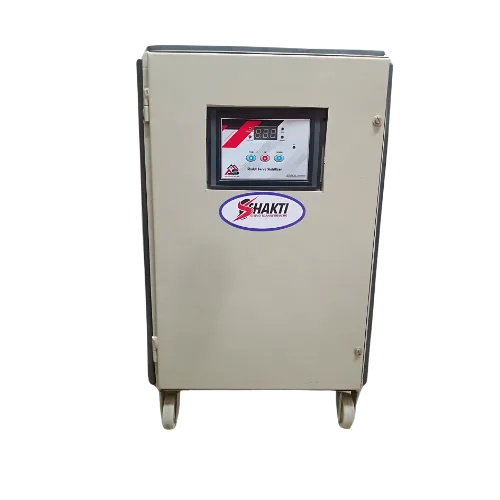
Anyone looking at a high-capacity stabilizer ends up asking the same questions. What can it run? Does it need three-phase supply? How is kVA different from kW? Here are straight answers about the 20 Kva Servo Stabilizer, so you can decide with confidence.
1. What does a 20 kVA servo stabilizer do?
It takes an unstable single-phase supply and delivers a steady output. A control card monitors the voltage, and a servo motor moves a carbon brush along a transformer winding to correct it in small steps. Your equipment then runs on stable power even when the grid swings.
2. What kind of load suits this capacity?
It suits very heavy single-phase loads: large homes and villas with many air conditioners, showrooms, hotels, hospitals, commercial kitchens and workshops with several machines. A 20 Kva Single Phase Stabilizer is the right choice when your combined load is too high for a 10 or 15 kVA unit to carry comfortably.
3. Do I need three-phase supply?
No. A 20 Kva Servo Stabilizer Single Phase works on a single-phase connection, so you do not need to rewire a building for three phase. This keeps installation simpler and cheaper.
4. What does “air cooled” mean?
It means the unit sheds heat through air circulation instead of oil. The 20kVA Single Phase Air Cooled Servo Stabilizer needs no oil checks or refills, so it is cleaner and easier to service. It does need open space around it and clean vents.
5. Is 20 kVA the same as 20 kW?
No, and this causes a lot of confusion. kVA is apparent power, and kW is real power. The two are linked by the power factor. At a typical power factor of 0.8, a 20 kVA unit supports about 16 kW of real load. Buyers who search for a Servo Stabilizer 20 Kilowatt should check whether their load is really 20 kW. If it is close to that figure, size up instead of running at the limit.
6. Can one stabilizer protect my whole building?
Yes, if the combined running load and start-up surges stay inside its rating. Fitting one unit at the main panel is often tidier and more economical than putting a small stabilizer on every appliance. Buildings with widely separated distribution boards may do better with two units. Some users also add a small UPS for computers and servers that must not shut down during power cuts, since a stabilizer does not store energy.
7. Is servo technology better than relay or static?
For heavy and sensitive loads, usually yes. Servo correction is smooth and continuous, which is gentler on compressors, motors and electronic boards. Relay and static types correct in coarser steps and suit light, non-critical loads.
8. What protection features should it have?
- Overload and short-circuit protection
- High and low voltage cut-off
- A delay timer to protect compressors after power returns
- A bypass switch for servicing
- Digital display of input and output voltage
9. How much maintenance does it need?
Very little, but not none. Keep the vents clean, check terminals for tightness and listen for changes in servo motor sound. Have a technician inspect the carbon brush, winding track and control card from time to time. Avoid running the unit at its maximum rating all day, because headroom extends its life.
10. How do I choose a good one?
Compare the input voltage range, output accuracy, build quality, protection features and warranty. Check after-sales support too, since service availability matters over the life of the unit. Price should be one factor among several, not the only one.
Final Thoughts
A well-chosen 20 kVA servo stabilizer quietly protects expensive equipment from the slow damage of unstable voltage. Size it from your real load, confirm your supply type, choose servo technology and plan for good ventilation, and it will keep your building running on steady power for years.