Let me ask you this honestly – when was the last time you went by a trade fair exhibit and actually stopped?
Not ’cause somebody waved you in. Not because the pen on the table was free. But the stand itself made you think 'I gotta see what this is.
That moment. That pause. It’s what your show stand design needs to generate in today's time. And the brands who do this properly aren’t just receiving increased foot traffic. “They are closing more business, creating better brand recall and walking away from shows with leads that actually convert.”
I have worked in this profession long enough to know that exhibition stand design has never moved at this speed. The struggle for visitor attention on the show floor has never been fiercer, and CEIR reports that 78% of trade show exhibitors expect to raise their spend on stand design in 2026 for one simple reason.
Whether you’re gearing up for GITEX, The Big 5, Intersec or any big trade fair in Dubai, the UK or Europe, here are the 12 exhibition stand design trends you really can’t afford to miss right now.
1. Immersive Experiences Are Now the Standard — Not the Luxury
A few years back immersive booths were a hot topic. “If your stand isn’t providing some kind of experience today you’re already behind.
Immersive experiences are no longer the preserve of big corporations or marquee events – they are now a mainstream. Research has shown that over half of audiences that want to have immersive experiences in their free time are of working age, therefore those same expectations are being taken into work situations.
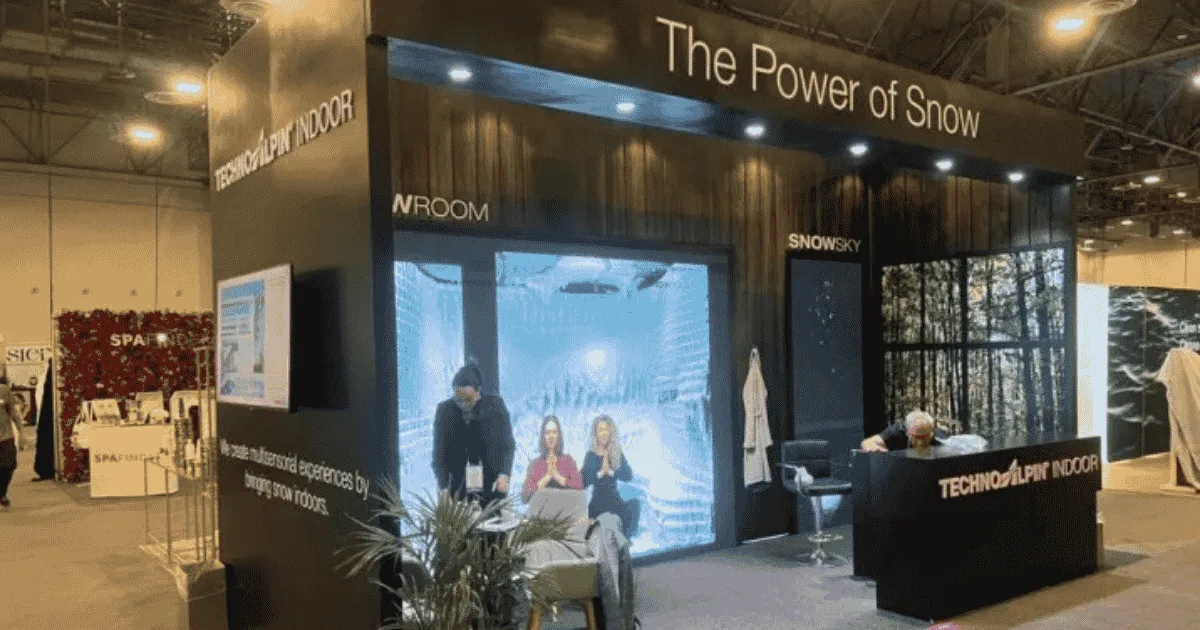
Think multi-sensory spaces where sight, sound, scent and even touch combine to tell your brand’s narrative. The visitor should not just see your product but they should experience using it.
What does this imply for you: Instead of a flat display, work with your exhibition stand contractor to create zones within your booth. Every zone should have a specific function - awareness, demonstration, conversation, conversion.
2. Eco-Friendly Exhibition Stand Design to be Mandatory
Here’s something a lot of exhibitors don’t understand until it’s too late – sustainability at trade exhibitions has moved from nice-to-have to regulatory obligation at many big locations.
IFEMA Madrid has promised to using 100% recyclable or reusable stand materials by 2027, while Messe Frankfurt has made trash reporting mandatory for all exhibitors from January 2026.
But beyond regulation, your audience really cares. Not only is your stand design being judged on aesthetics, but also on its environmental footprint, as 68% of European exhibitors are now being challenged by their own procurement or ESG departments with official sustainability targets.
Using eco-friendly booth materials – recycled aluminium frames, fabric graphics instead of hard panels, bamboo and reused wood – is now the sensible choice, both ethically and commercially.
What this means to you: Don’t wait until the end of the design process to discuss sustainable material possibilities. Ask your exhibition stand builder about these options from day one.
3. Modular Exhibition Stands — The Smartest Investment
If you’re exhibiting at more than one event a year (and most serious brands are) then a modular exhibition stand is one of the smartest financial decisions you can make.
Modular booth designs allow businesses to utilize the same structure for numerous events, and to customize the arrangement for different areas – so you’re not starting from scratch every time, and you’re not sending a whole stand to landfill after a three-day exhibition.
The beauty of a good modular design is that it does not look modular. If done right, it looks totally bespoke. The adaptability is behind the scenes, the impact is front and centre.
What this means for you: If you brief an exhibition stand designer, ask them to explain how the same modular system can be adapted for a 20sqm shell scheme at a local expo and a 100sqm custom build at an international show.
4. AR and VR Are Transforming Product Demonstrations
In trade fair booths, augmented reality and virtual reality finally crossed over from “gimmick” to “genuine business tool.”
Fabrics used in the booth are being infused with technologies like as AR, VR and AI to create customized, unforgettable experiences that engage visitors and extend brand reach well beyond the event floor.
In areas like construction, real estate, manufacturing, and technology, where the actual product might be hard to deliver to a show floor, AR and VR enable visitors to experience it nevertheless. "Seeing it, putting on a headset and walking through a building that hasn't been created yet. That’s quite good.
What this means for you: You don’t need to have a big expenditure to include AR in. One interactive AR station in a well-designed booth can become the most photographed and talked about aspect at your show.
5. Biophilic Design — Bringing Nature Into the Exhibition Hall
If you walk into a trade show after 3 hours on the floor, you’ll realize quickly why this trend is exploding. The noise, the throng, the fake lights, it’s tiresome. Brands who are creating a peaceful natural oasis amidst that bustle are rewarded with longer visitor dwell durations and better conversations.
Biophilic design incorporates natural elements like wood, live plants, organic textures and softer, more natural lighting. These characteristics assist create welcoming surroundings, inviting guests to feel calm, comfortable and open to conversation.
It works across practically every industry, from wellness to food, tech to banking. It indicates confidence, it signals sustainability and it signals that your business cares about the person being in front of you.
What this means for you: Just the addition of planters, wooden surfaces, and warm lighting to an otherwise modern stand can totally change the energy in your space.
6. Open Floor Plans and Inviting Layouts
The days of locking visitors in behind counters and closed walls are gone. Modern trade fair booths are leaving closed walls and limiting layouts in the dust. Open designs invite guests to come in and browse without reservation.
An open plan concept exudes confidence: your brand has nothing to hide and everything to exhibit. It lowers the psychic barrier between a passing visitor and a possible conversation.
What does this mean for you? Resist the desire to cover every square metre with products or furnishings. Negative space is not empty space. It’s breathing area that genuinely invites people in.
7. Dynamic LED Walls and Motion Graphics
Let's be honest — a printed backdrop in 2026 is already starting to feel dated. LED walls do what printed graphics simply can't: the content updates between shows, between sessions, even between hours. Product demo in the morning, live social feed in the afternoon, all from the same screen without touching the physical stand.
And here's what really matters on a busy show floor — movement catches eyes. When everything around you is still, a stand with motion becomes a magnet. Visitors don't consciously decide to look. They just do.
Over three years and multiple shows, an LED wall also costs far less than reprinting and shipping large-format graphics every single time.
What this means for you: When briefing your exhibition stand contractor, make at least one LED feature wall part of the plan. It's one of the highest-return decisions you can make in stand design.
8. Dedicated Lounge and Hospitality Zones
Trade exhibitions are tiring for the participants. Exhibitors are establishing lounge-like spaces in their displays and encouraging visitors to linger longer. And the longer you remain, the deeper the talk.
A strategically positioned seating area, coffee station or charging point converts your stand from a display area into a destination. People will come to you because your booth is a place to rest — and while they’re resting, your crew is talking to them.
What this implies for you: If you can afford it, devote at least 15–20% of your floor space to hospitality. It pays back in the quality of the relationship.
9. Data-Driven Booth Design
This one needs further discussion and it should be. Data analytics are becoming increasingly important in decisions about exhibition design. Heat mapping shows where visitors spend the most time and eye-tracking evaluates which graphics capture the most attention.
Brands that have been watching this data for even one or two shows are now constructing their next stand completely differently — relocating product displays, rearranging workers, adjusting the flow of foot traffic — all on the basis of what the numbers actually indicated.
What this implies for you: Ask your stand contractor whether they can assist with simple visitor tracking tools at your next show. Simple footfall counters can even provide you with insights which can totally modify your future stand design.
10. Hybrid Exhibition Stands — Connecting On-Site and Online Audiences Simultaneously
Your trade show presence is no longer confined to the edge of your booth. Hybrid designs allow marketers to reach on-site and online audiences simultaneously. These hybrid features increase your trade fair visibility and provide you with measurable information about how engaged visitors are.
Live-streamed product releases, real-time social media walls, virtual booth tours – all these take your exhibition ROI well beyond the event itself, to audiences who couldn’t be there in person, but are still prospective consumers for the exhibition.
What does this mean for you? Make sure your exhibit has at least one “camera friendly” moment – a section, product display or demo space that is expressly designed for streaming and content creation.
11. Bold Minimalism – Less Mess, More Impact
There is a counter-intuitive reality about exhibition stand design. The busier your display looks the less attention it will garner. The businesses that will lead the show floors in 2026 are doing it with restraint.
Minimalist aesthetics, paired with strong branding, are on the rise. It’s all about clean lines, open layouts, and giving your brand message room to breathe. A daring graph. One headline. Clear. One product, perfectly lighted, perfectly placed is the one. That stand gets broken off. That stand is remembered.
What this implies for you: Edit mercilessly. Visitors will not read any of your ten items if you try to say ten things at once. Select your one most crucial statement, then construct the stand on it.
12. AI-Powered Personalisation at the Booth
The next frontier in trade show booth design is artificial intelligence – not as a gimmick, but as a tool that actually improves visitor experience and lead quality.
Visitors to the show floor are getting big traction from interactive AI-enabled live demos and voice interfaces. AI may help qualify visitors, provide product information based on their preferences, and collect lead data in a conversational, not transactional fashion.
What this means for you: A simple AI-powered kiosk that asks visitors three qualifying questions and then sends them to the right product demo can substantially improve the quality of discussions your sales staff is having on the floor.
So, Which of These Trends Should You Actually Prioritise?
The honest answer is it depends on your budget, your sector and the exhibition you are exhibiting in.
Visitors spend an average of just 8.3 minutes at each stand they choose to visit. The issue is getting the entry in the first place.
That means your stand design - the structure, the images, the energy it exudes from 30 metres away - is doing the sale before your team has even opened their lips. It’s worth to get it correctly.
Exhibit Elevate is a company that designs and builds custom and modular exhibition stands for shows in Dubai, UK, Europe and USA. Whether you’re prepping for a huge international event or a regional expo, we can help you determine which of these trends truly makes sense for your company – and create something that garners that pause.
Ready to start preparing your next booth? Get in touch with our team and let’s speak about what’s possible.